
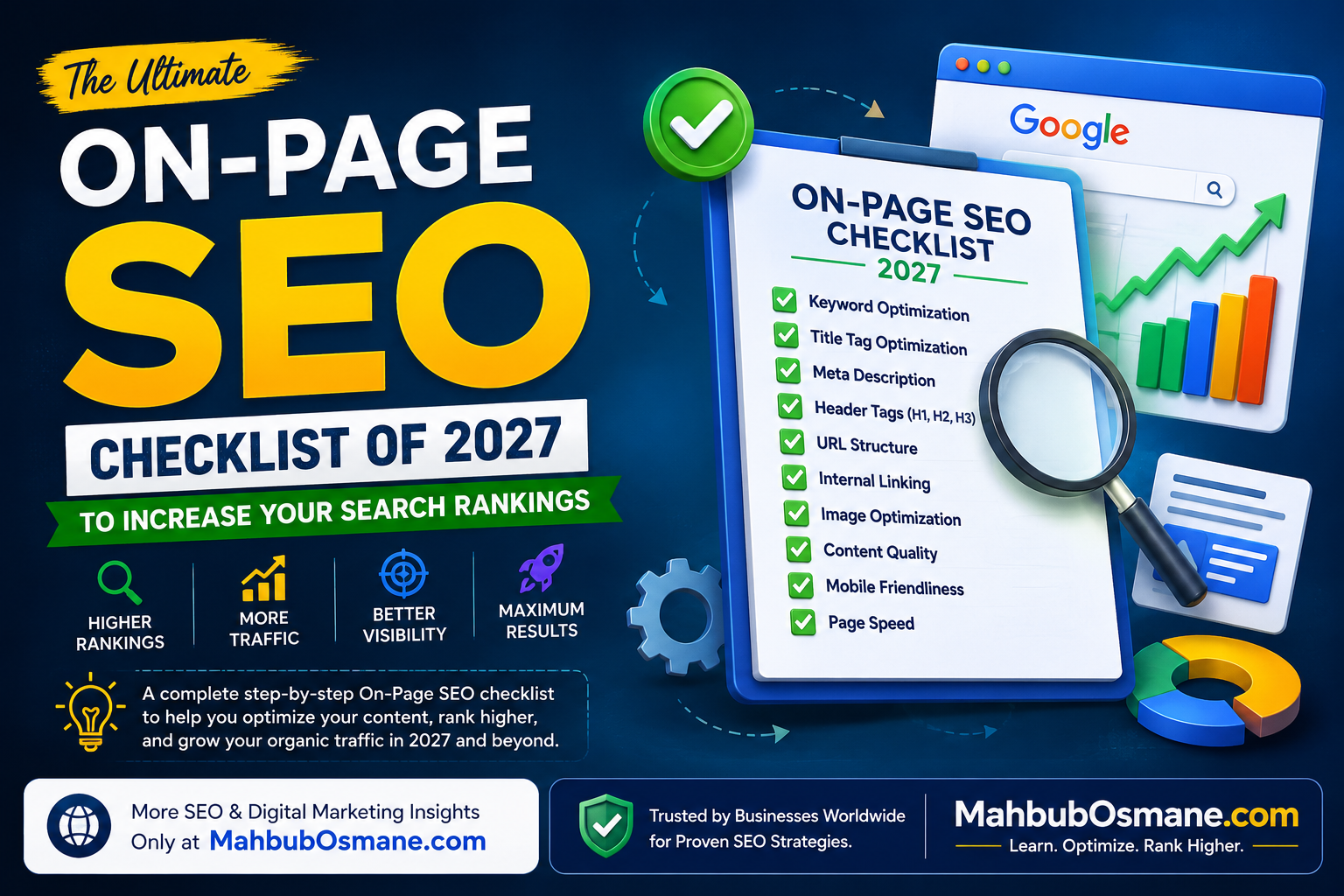
The Ultimate On-Page SEO Checklist For 2027
The SEO landscape hasn’t just evolved over the last few years—it has fundamentally shifted. If you are still optimizing content using the playbook from 2020, or even 2024, your search rankings are likely feeling the pinch.
By 2027, search engines have largely transcended basic keyword matching. We are living in an era dominated by Agentic AI Search, multi-modal user journeys (where text, voice, video, and images fuse seamlessly), and highly sophisticated intent-engine algorithms. Today, search engines don’t just index your words; they evaluate your brand’s real-world authority, the technical integrity of your user experience, and how effectively your content satisfies complex, multi-layered human queries.
On-page SEO in 2027 is the art and science of making your web pages perfectly legible, highly authoritative, and undeniably valuable to both advanced AI crawlers and human readers.
This comprehensive, step-by-step guide is your blueprint for dominating the search engine results pages (SERPs). Whether you are refreshing an established site or launching a brand-new content hub, this ultimate checklist will ensure your pages are optimized for maximum visibility and conversion.
Architecture, Core Crawlability, and AI Readability
Before an AI engine can rank your content or summarize it for a user, it must be able to parse your page cleanly. Technical structural health forms the bedrock of modern on-page SEO. If your code is bloated or your structure is confusing, your visibility drops to zero.
Zero-Bloat HTML Dom & Semantic Layouts
Search engine bots handle millions of pages per second. To save computational resources (render budget), they prefer lean, perfectly organized HTML structures.
-
Use Strict Semantic HTML: Ensure your page relies cleanly on layout tags:
<header>,<nav>,<main>,<article>,<section>,<aside>, and<footer>. Avoid excessive, nested<div>wrappers that create “DOM jungle” bloat. -
The Single H1 Rule: Every page must have exactly one
<h1>tag that defines the primary topic. -
Logical Heading Hierarchy: Organize secondary sections strictly with
<h2>through<h6>tags. Never skip levels (e.g., jumping from an<h2>directly to an<h4>) just for visual styling. Use CSS for styling, and keep HTML for structure. -
Clean Up Code Bloat: Strip out unused CSS, inline styles, and redundant JavaScript frameworks. A lighter document object model (DOM) translates directly to faster AI parsing.
Next-Gen Schema Markup (JSON-LD)
Structured data is no longer an optional enhancement; it is the primary language search engines use to construct knowledge graphs. In 2027, you must speak this language fluently.
-
Deploy Comprehensive Entity Schema: Go beyond basic
ArticleorProductschemas. Utilize specialized schemas likeTechArticle,FAQPage,HowTo,ProfilePage(crucial for showing author identity), andOrganization. -
Explicit Connective Attributes: Use attributes like
sameAs,knowsAbout, andauthorto explicitly link your content to recognized entities across the web (such as Wikipedia pages, official social profiles, or institutional databases). -
Validate Frequently: Use Schema.org’s Validator and Google’s Rich Results Test regularly to ensure there are no parsing syntax errors or missing required fields.
Intent-Driven URL Architecture
URLs should serve as a clear text-based map of your site’s hierarchy for both humans and bots.
-
Keep it Short and Descriptive: Aim for 3 to 5 words maximum. Drop unnecessary conjunctions, prepositions, and dynamic numbers (e.g., use
/on-page-seo-checklist/instead of/blog/p=49292/the-best-on-page-seo-checklist-for-beginners-in-2027/). -
Incorporate the Primary Target Keyword: Place your core keyword naturally within the URL slug.
-
Maintain Flat Hierarchies Where Possible: Limit subfolders unless they are vital for organizing large-scale e-commerce setups or extensive multi-category content hubs.
Advanced Content Optimization for the AI Era
Creating high-ranking content requires passing a strict evaluation metric: satisfying Search Intent while proving deep E-E-A-T (Experience, Expertise, Authoritativeness, and Trustworthiness).
Intent Mapping & Semantic Clusters
Keywords are no longer isolated targets; they are entry points into broader concepts.
-
Analyze the Core Search Intent: Before writing a single word, analyze the current SERP for your target phrase. Is the intent informational (the user wants to learn), transactional (they want to buy), commercial (they are comparing options), or navigational (they are looking for a specific brand)? Match your format precisely to what the search engine already favors.
-
Map Primary, Secondary, and LSI Keywords: Identify your primary target keyword, but support it with structurally relevant secondary keywords and Latent Semantic Indexing (LSI) terms—words naturally expected to appear alongside your topic.
-
Build Complete Semantic Topical Authority: Instead of treating pages like isolated islands, group related content into cohesive clusters. Use internal links to tie individual supporting pieces back to a central, high-level pillar page.
Optimizing for AI Overviews & Answer Engines
AI-driven search features look for specific content structures when generating summaries for users.
-
The “TL;DR” Summary Block: Place a concise, 2 to 3 sentence direct summary or answer near the very top of your page. This makes it incredibly easy for an AI model to extract and quote your page as a source definition.
-
Use Explicit Formatting for Lists: When outlining steps, recipes, or items, use clean Markdown or HTML bulleted (
<ul>) and numbered (<ol>) lists. AI engines frequently scrape these direct structures into featured snippets. -
The Q&A Format: Phrase subheadings exactly as common user questions (e.g., “What is the difference between technical and on-page SEO?”) followed immediately by a direct, authoritative answer.
Embedding Proof of E-E-A-T
Search platforms ruthlessly filter out generic, low-effort content. You must actively prove your credibility.
-
Detailed Author Bylines: Every informational piece should clearly display the author’s name, credentials, and a link to a comprehensive author profile page outlining their real-world experience.
-
First-Hand Experience Evidence: Weave in original case studies, data points, unique screenshots, quotes from subject matter experts, and personal anecdotes. Use phrases like “In our testing…” or “Our team evaluated…” to demonstrate genuine, hands-on experience.
-
Regular Content Audits & Update Timestamps: Display the “Last Updated” date clearly at the top of the page. Ensure that when you update content, you are genuinely adding fresh value, correcting outdated data, and expanding on new developments.
The Core UX & Interaction Framework
User experience is a foundational pillar of SEO. If users bounce away frustrated because your site is slow, layout elements shift unpredictably, or navigation is confusing, your rankings will tank.
       USER VISITS PAGE
               │
               ▼
┌──────────────────────────────┐
│  Loading Speed & Stability   │ ◄── Core Web Vitals (LCP, INP, CLS)
└──────────────┬───────────────┘
               │ Pass
               ▼
┌──────────────────────────────┐
│  Mobile & Visual Layout      │ ◄── Responsive design, readable text
└──────────────┬───────────────┘
               │ Pass
               ▼
┌──────────────────────────────┐
│  Engagement & Navigation     │ ◄── Internal links, clear CTAs
└──────────────────────────────┘
Core Web Vitals Optimization
You must pass technical web health metrics with flying colors.
-
Largest Contentful Paint (LCP): Ensure the main content block of your page loads within 2.5 seconds of the initial page load. Optimize this by compressing heavy header media and leveraging efficient browser caching.
-
Interaction to Next Paint (INP): Keep your page highly responsive. When a user clicks a button, menu, or link, the interface should respond visually within 200 milliseconds or less. Keep JavaScript execution light to prevent browser freezing.
-
Cumulative Layout Shift (CLS): Maintain visual stability. Ensure images, banners, and embedded dynamic frames have explicit height and width attributes pre-allocated in the code so elements don’t shift around unexpectedly while the user is reading.
True Mobile-First Navigation
Because the vast majority of web traffic originates on mobile devices, your site’s mobile performance is your site’s baseline performance.
-
Perfect Responsive Viewports: Text must be completely readable without requiring users to zoom horizontally. Buttons and tap links must feature enough padding to prevent accidental fat-finger clicks.
-
Clean Up Sticky Element Overload: Avoid cluttering small screens with intrusive sticky headers, persistent footers, floating newsletter forms, and cookie banners all at once.
-
Streamlined Asset Delivery: Serve modern, ultra-light image formats (like WebP or AVIF) and utilize lazy loading so off-screen elements only load as the user scrolls down to them.
The Definitive Step-by-Step On-Page Checklist
Let’s dive into the tactical action items you need to apply to every page before publishing.
Meta Title & Description Optimization
Your meta tags are your primary billboard on the search results page. They control your organic Click-Through Rate (CTR).
-
Keep Titles Between 50–60 Characters: Ensure your title doesn’t get cut off in the SERPs. Place your primary target keyword closer to the front of the title tag.
-
Write Compelling Meta Descriptions (120–155 Characters): Craft a concise summary that clearly states the page’s value and includes a subtle call-to-action (CTA). Use secondary latent keywords naturally here.
-
Avoid All Keyword Stuffing: Write strictly for human curiosity and clarity. Titles like “SEO Checklist, Best SEO Checklist, SEO Checklist 2027” look spammy and actively hurt user trust.
Heading Optimization (H1, H2, H3)
-
Include the Core Keyword in the H1: Ensure your primary keyword or a close variation lives naturally inside your page’s H1 title.
-
Sprinkle Sub-Keywords into H2s and H3s: Use your secondary, long-tail, and conversational queries to structure your subheadings.
-
Keep Headings Concise and Engaging: Headings should double as scannable signposts for readers scanning your article for quick answers.
Advanced Image & Multi-Modal SEO
Search engines index images and videos with incredible depth. Neglecting asset optimization misses out on massive alternative traffic channels.
-
Write Descriptive, Contextual Alt Text: Do not write
alt="image1.jpg"or simply stuff keywords likealt="seo checklist optimization tools". Instead, write clear, descriptive alt text that explains the exact contents of the image for visually impaired users:alt="A comprehensive step-by-step flowchart mapping out an advanced on-page SEO checklist workflow." -
Implement Descriptive File Names: Rename files from generic system defaults (
IMG_4920.png) to explicit, hyphen-separated keyword descriptions (on-page-seo-flowchart.png) before uploading. -
Wrap Images with Structural Captions: Use captions or nearby paragraph text to add clear context to your imagery, explicitly explaining what the reader should look for in the graphic.
Strategic Internal and External Linking
Links are the neural pathways of the web; they distribute ranking authority (link equity) across your ecosystem.
-
Craft Descriptive Anchor Text: Never use generic phrases like “click here” or “read more”. Use descriptive, keyword-rich anchor text that clearly communicates what the destination page is about (e.g., “consult our comprehensive [technical SEO audit guide] to fix crawl errors”).
-
Link to High-Authority External Sources: Do not be afraid to link out to trusted, non-competitive external websites (like academic research papers, official documentation, or major industry studies). This builds structural trust by showing search engines you back up your claims with reliable data.
-
Fix Broken Links and Avoid Redirect Loops: Regularly run automated site crawls to identify and fix internal 404 errors or lengthy 301 redirect chains that drain crawl budgets.
Maximizing Conversion & Retention
Traffic is completely useless if visitors leave your site without taking action. True modern SEO aligns optimization efforts directly with clear business growth metrics.
High-Context CTAs (Calls-to-Action)
-
Contextual Relevance: Match your lead magnets or product pitches directly to the specific problem discussed in that exact section of the article.
-
Clear Visual Prominence: Use contrasting button styles, callout blocks, or clean banner layouts to ensure your CTAs stand out without disrupting the reader’s flow.
-
Minimize Interstitial Annoyance: Avoid disruptive full-screen welcome mats or pop-ups that block main content the second a user arrives. This triggers search engine penalties and drives users away.
Readability and Content Design
-
Keep Paragraphs Short and Snappy: Limit paragraphs to 2 to 3 sentences max. Large blocks of text look intimidating on mobile screens and cause users to bounce.
-
Vary Visual Text Formats: Keep the reader engaged by using bold callouts, clear bullet points, indented blockquotes for expert commentary, and neat summary tables.
-
Maintain Clean Contrast: Ensure a high contrast ratio between your typography and background colors to prevent eye strain and make reading completely effortless.
Summary Checklist Matrix
Use this quick summary table to systematically review your web pages before hitting publish.
| Optimization Area | Checklist Element | Target Metric / Standard |
| Code & Architecture | Semantic Layout | Strict HTML5 validation, no DOM jungle bloat |
| Code & Architecture | JSON-LD Schema | Comprehensive entity tagging via validated JSON-LD |
| Code & Architecture | URL Structure | Short, clear, hyphen-separated, 3–5 words max |
| Content Strategy | Search Intent Match | Format explicitly aligns with current live SERP intent |
| Content Strategy | AI Summary Block | 2–3 sentence direct answer snippet near the top of the page |
| Content Strategy | E-E-A-T Credibility | Verified author profile byline + unique first-hand data |
| User Experience | Largest Contentful Paint | Page main content renders in less than 2.5 seconds |
| User Experience | Interaction to Next Paint | Interactive UI latency lower than 200 milliseconds |
| User Experience | Layout Stability (CLS) | Score under 0.1 via pre-allocated image dimensions |
| Tag & Asset Polish | Title & Meta Tags | Title: 50–60 chars; Meta Description: 120–155 chars |
| Tag & Asset Polish | Image Alt Optimization | Contextual, accessibility-friendly descriptive alt text |
| Link Integrity | Interlinking Context | Descriptive, keyword-conscious anchor text (no “click here”) |
The Path Forward
Dominating search rankings requires a balanced, intentional approach. It means matching clean, accessible technical code structures with genuinely deep, experience-backed writing that prioritizes helping human readers find real answers.
By systematically applying this checklist to your existing content assets and future publishing workflows, you aren’t just adjusting to the latest algorithm updates—you are building a resilient, authoritative, and future-proof digital footprint built to rank for years to come. Take it step by step, audit your pages regularly, and focus on delivering undeniable value.
Ready to Dominate the 2027 Search Rankings? Partner with an Elite Digital Agency.
Implementing an advanced on-page SEO strategy requires technical precision, deep algorithmic understanding, and flawless execution. At MahbubOsmane.com, we translate complex search engineering into measurable business growth. Whether you are operating in the competitive hubs of the USA, UK, Canada, Germany, and Lithuania, scaling up in the UAE, Saudi Arabia, Qatar, and Kuwait, or dominating the market in Bangladesh, our team delivers enterprise-grade execution.
Why Leading Global Brands Trust Us:
-
Proven Elite Status: 700+ successfully completed jobs with flawless 5-star feedback on Upwork.
-
Vetted Transparency: Fully verified and active on Hubstaff Talent for seamless global collaboration.
-
End-to-End Capabilities: Beyond professional SEO, we offer integrated AdOps, High-Converting Content Writing, Scalable Website Development, Premium Graphic Design, and Advanced Video Editing.
Stop leaving your search rankings, traffic, and revenue to chance. Let our global team scale your digital footprint today.
Connect With Our Experts Instantly
Choose your preferred channel below to discuss your project requirements. WhatsApp is fully operational across all communication lines.
📞 Direct Phone & WhatsApp Support:
-
Saudi Arabia Office:
+966549485900or+966553227950 -
Bangladesh Office:
+8801716988953
✉️ Secure Email Consultations:
-
Primary:
hi@mahbubosmane.com -
Secondary:
mahbubosmane@gmail.com
🌐 Secure Digital Portal:
-
Official Website: www.MahbubOsmane.com
Frequently Asked Questions
What is the primary difference between on-page SEO and off-page SEO?
On-page SEO refers to optimizations you control directly on your website, such as updating code structures, writing deep content, and tuning internal links. Off-page SEO focuses on external ranking signals that occur away from your site, such as earning backlinks, building social proof, and growing brand mentions on third-party platforms.
Why is semantic HTML structure so critical for search rankings?
Semantic HTML tags like <main>, <article>, and <section> provide clear architectural context to search engine spiders. Instead of forcing an AI crawler to parse an unstructured mess of generic layout wrappers, semantic tags declare the exact layout hierarchy, saving computational resources and ensuring your primary text is indexed accurately.
How long should a meta title be to prevent it from getting cut off?
A meta title tag should ideally stay between 50 and 60 characters, or under 600 pixels in total width. Staying within this boundary ensures that your entire headline displays clearly on desktop and mobile search screens without being truncated with an ellipsis.
What makes a meta description highly effective for click-through rates?
An effective meta description should be between 120 and 155 characters, include your primary target keyword naturally, and clearly articulate the direct benefit a user receives by clicking. It functions as your organic search ad copy, so it must feature a compelling call to action.
Does having multiple H1 tags on a single page damage your rankings?
While modern search systems can parse multiple H1 tags, maintaining a single H1 per page remains a technical best practice. A single H1 clearly signals the absolute core theme of the page, preventing structural confusion for search algorithms trying to categorize your content entity.
How should image alt text be written for optimal visibility?
Image alt text should be written as a descriptive, literal explanation of the image content to assist visually impaired screen-readers, while naturally incorporating relevant keywords. Avoid spammy keyword stuffing or generic file names; prioritize clear, high-context descriptions.
What are the recommended performance targets for Core Web Vitals?
Your page should achieve a Largest Contentful Paint (LCP) under 2.5 seconds, an Interaction to Next Paint (INP) under 200 milliseconds, and a Cumulative Layout Shift (CLS) score of less than 0.1. Meeting these targets ensures a stable, highly responsive user experience.
What is Cumulative Layout Shift and how do you prevent it?
Cumulative Layout Shift measures the visual stability of a webpage during loading. It is typically caused when images, ads, or dynamic structural elements lack defined width and height attributes in the code, forcing text to jump around unexpectedly while a user is actively reading.
Why is optimizing for mobile considered the baseline for SEO?
Search platforms index websites using mobile-first protocols, meaning the mobile layout of your webpage serves as the primary version evaluated for rankings. If a page performs poorly, loads slowly, or exhibits broken navigation on a mobile device, its desktop rankings will decline as well.
What role does JSON-LD schema markup play in modern search indexing?
JSON-LD structured data translates your human-readable copy into explicit machine-readable entities. By embedding this standardized code, you help search engines map your content into global knowledge graphs, increasing your eligibility for rich snippets and conversational AI summaries.
How do you optimize a section of text to win an AI Overview snippet?
To be easily extracted by search engine answer engines, place a concise 2 to 3 sentence direct summary or definition immediately following a clear question-based subheading. Using well-formatted bullet points or numbered lists also makes data easier for AI engines to scrape.
What is the best strategy for crafting internal link anchor text?
Anchor text must be highly descriptive and explicitly signal what the destination page is about. Avoid generic variations like “click here” or “learn more.” Instead, use context-rich phrases that naturally blend into your sentences while utilizing secondary keywords.
Is linking out to external websites bad for your page authority?
No, linking out to authoritative, non-competitive external resources does not drain your ranking power. Instead, pointing to trusted research papers, official documentation, or verified data sources establishes your page as a helpful, thoroughly researched reference hub.
How short should a search-friendly URL slug be?
A clean URL slug should ideally be between 3 and 5 words, lowercase, and separated exclusively by hyphens. Remove unnecessary dynamic tracking variables, dates, numbers, and short filler words to keep the URL highly readable for both users and search crawlers.
What does E-E-A-T stand for, and why does it affect search rankings?
E-E-A-T stands for Experience, Expertise, Authoritativeness, and Trustworthiness. While not a direct algorithmic scoring metric, search engines utilize comprehensive evaluation systems to filter out low-effort content, favoring pages that showcase real-world experience and clear author credentials.
How frequently should old blog content be reviewed and updated?
High-value content assets should undergo a thorough review at least once a year. When updating, focus on refreshing outdated data, adding unique first-hand case studies, correcting broken links, and adjusting the structural layout to align with shifting user intent.
What is a semantic content cluster, and how does it build authority?
A semantic content cluster is a structural grouping strategy where a central, comprehensive pillar page links out to multiple, tightly focused sub-topic pages, which then link back to the pillar. This deeply interconnected web structure signals total topical expertise to search engines.
How do intrusive pop-ups and full-screen layout overlays affect SEO?
Intrusive interstitials that block the main content immediately upon a user’s arrival disrupt the browsing experience, leading to rapid bounce rates. Search platforms actively devalue pages that make content inaccessible, particularly on smaller mobile viewports.
Can adding professional video to a text page improve its organic performance?
Yes, embedding high-quality, relevant video content can significantly increase user engagement and average time-on-page metrics. Additionally, properly optimized video assets with appropriate schema markup allow your page to capture valuable real estate in dedicated video search vertical fields.
External Resource
- Deploy comprehensive entity schema to help search engines map your content natively. You can construct and review your structured data patterns directly using the structural templates available at Schema.org.
-
To ensure your code syntax contains no breaking formatting errors, validate your embedded code configurations using the official Google Rich Results Test.
-
When structuring your content to capture featured snippets and answer engine responses, it is vital to follow the core optimization guidelines outlined in the Google SEO Starter Guide.
-
Achieving structural visual stability requires fine-tuning your scripts and image assets. You can measure your field data scores and run real-time diagnostics via the PageSpeed Insights engine.
Internal Resources
- Building deep topical authority requires aligning your target phrases with real user requirements. If your website is currently dropping in organic traction or missing out on key keyword opportunities, consider launching a comprehensive campaign through our dedicated Professional SEO Services.
- Code cleanups, script deferrals, and database scaling form the foundation of premium site performance. If your current layout components are causing structural layout shifts, explore how our team builds high-speed platforms on our Website Development Services hub.
- Identifying hidden indexation drops, broken links, and structural flaws requires an objective technical diagnosis. Before updating your anchor tags, run a deep crawl check using our specialized SEO Audit Service.
- Maximizing your digital return on investment means treating organic traffic, paid media, and conversion funnels as a unified ecosystem. To scale your international conversions, leverage our complete Digital Marketing Service suite.
About the Author
Mahbub Osmane is a digital marketing expert who helps businesses build effective online strategies, including selecting and managing the right social media channels for growth. With hands-on experience across platforms and markets, Mahbub shares practical, actionable insights to help businesses connect with their audience and grow their brand presence.
Contact information Email: hi@mahbubosmane.com Website: https://mahbubosmane.com/ Mobile: +966 54 948 5900 (KSA) / +880 1716 988953 (BD) Address: 2282 7284 Al Malawi Southern 1, As Sulimaniyah Dist, Makkah 24236, Saudi Arabia