
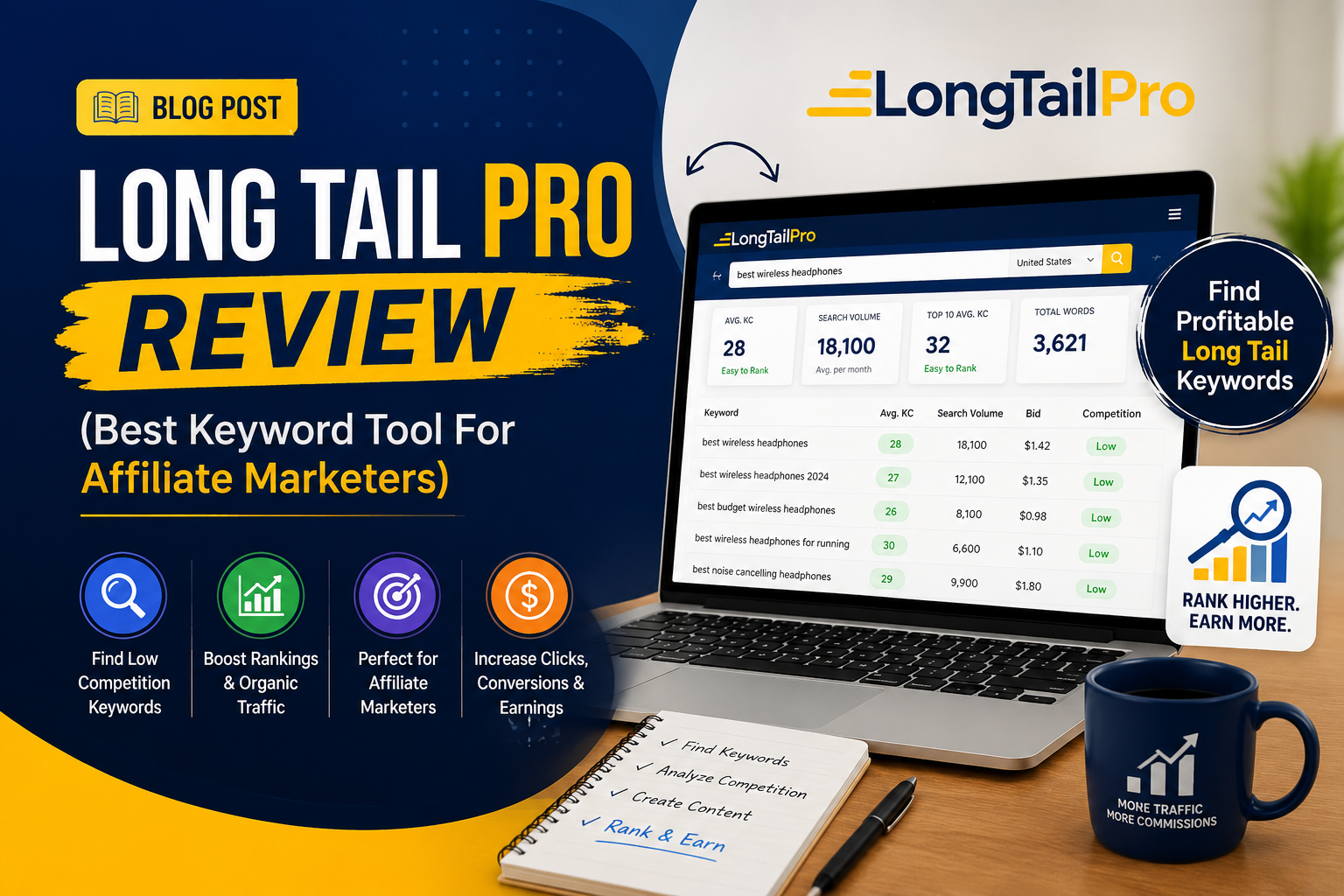
Long Tail Pro Review (Best Keyword Tool For Affiliate Marketers)
Finding the right keywords is often the single biggest hurdle for affiliate marketers. You can have a beautiful website, high-converting affiliate offers, and brilliant copy—but if you are targeting keywords that are either too competitive or completely devoid of traffic, your site will sit silently on page 5 of Google.
While massive, all-in-one SEO suites offer everything from backlink tracking to advanced enterprise features, their steep price points (often crossing over $130 per month) can easily drain a growing affiliate budget. This is where Long Tail Pro enters the frame.
Designed specifically for niche site builders, affiliate bloggers, and search engine optimization (SEO) practitioners who care about speed and precision, Long Tail Pro acts as a specialized laser cutter rather than a multi-tool. It filters through the noise to surface hyper-targeted phrase variations with lower organic competition.
In this deep-dive review, we are going to look behind the curtain of Long Tail Pro. We will break down its core capabilities, analyze how its metric data compares to industry heavyweights, and walk step-by-step through a practical workflow to find high-value, rankable affiliate keywords.
What is Long Tail Pro?
Long Tail Pro is a cloud-based keyword research application originally created in 2011 by veteran niche marketer Spencer Haws. Over the years, the software evolved from a desktop-based application into a fast, web-accessible platform tailored to help users identify long-tail keywords—phrases that typically contain three or more words, show clear buyer intent, and feature relatively low search competition.
Instead of trying to rank for a massive broad term like “running shoes,” Long Tail Pro helps you uncover hidden paths like “best trail running shoes for flat feet with wide toe box.” While the broad term is fiercely defended by multi-million dollar brands, the long-tail variation represents a clear, accessible pool of traffic from a user who is standing by with a credit card in hand.
The core engineering behind Long Tail Pro focuses on extracting suggestions at scale from Google’s keyword planner data, pairing those suggestions with custom domain and page metrics, and boiling the competitive landscape down into a single, straightforward score.
Core Features Breakdown
To understand whether Long Tail Pro deserves a place in your marketing workflow, let’s unpack the primary features that drive its dashboard.
The Keyword Suggestion Engine
The foundational tool within the platform allows you to enter up to 5 “seed keywords” simultaneously. From those entry points, the software will quickly generate up to 400 long-tail keyword suggestions in a single pass.
You can approach your research through three main methodologies within the interface:
-
Related Keywords: Generates traditional lateral phrase ideas based on search pattern clustering.
-
Competitor Analysis: Allows you to input a top-ranking competitor’s URL to reverse-engineer the specific terms that are driving their traffic.
-
Manual Keywords: If you already have a massive bulk list compiled from free scraping tools or search auto-suggest lists, you can paste them into Long Tail Pro to pull advanced performance data in bulk.
Keyword Competitiveness (KC) Score
The platform’s flagship feature is its Keyword Competitiveness (KC) Score. This proprietary metric uses a 0 to 100 scale to quantify how difficult it will be to rank a new content asset on the first page of Google for any given phrase.
The mathematical engine behind the KC score parses the top 10 results currently ranking on Google for that phrase, factoring in critical organic ranking variables:
-
Page Authority (PA) and Domain Authority (DA): Standard indicators of the site’s structural authority across the web.
-
Trust Flow and Citation Flow: Metrics that measure the trustworthiness and volume of the backlink profiles pointing to those specific pages.
-
Keyword Placement: Whether the target search query is physically included in the title tags, meta descriptions, and header tags of the competing pages.
The lower the KC number, the easier it is for a newer, less authoritative affiliate site to slide onto the first page of search results.
In-Depth SERP Analysis
Clicking on any individual keyword pulls open a comprehensive breakdown of the current Search Engine Results Page (SERP). Instead of just looking at abstract numbers, you get a clean view of the current top 10 competitors side-by-side.
This view outlines their site age, indexed URLs, backlink quantities, and internal link distributions. For an affiliate marketer, this allows you to spot structural weaknesses—such as an independent forum or an outdated blog ranking on page one—which signals a clear opening for a well-optimized, comprehensive product review.
Rank Tracker
Keyword research is only half the battle; tracking your progress is what keeps your strategy on course. Long Tail Pro includes a built-in Rank Tracker that monitors your site’s positioning for designated terms. It refreshes positions automatically and delivers weekly summary reports directly to your inbox, saving you the expense of a separate rank-tracking subscription.
Technical Site Audit & Backlink Analysis
Recent iterations of the software have expanded its footprint into comprehensive SEO management. The platform now features a Site Audit module that crawls your domain to flag technical issues affecting search visibility, such as broken links, slow-loading assets (Core Web Vitals issues), and missing metadata.
Additionally, the Backlink Analysis tool allows you to audit your own link profile or dissect where your competitors are securing their authority-building inbound links.
Side-by-Side Tool Comparison
To see how Long Tail Pro stacks up against alternative keyword research suites, let’s analyze their target use-cases, pricing structures, and metric indicators.
| Feature / Metric | Long Tail Pro | Semrush | KWFinder (Mangools) | LowFruits |
| Primary Focus | Rapid long-tail discovery & validation | Enterprise all-in-one marketing suite | User-friendly keyword analysis | Auto-suggest extraction & SERP weak spot identification |
| Difficulty Metric | KC Score (0–100) | KD % (0–100%) | KD Score (0–100) | Weak Spots indicator (Icons) |
| Starting Price | ~$37 / month | ~$139.95 / month | ~$29.90 / month (Annual) | Pay-as-you-go or ~$29 / month |
| Data Source Depth | Google Keyword Planner + Custom Metrics | Proprietary clickstream + Massive global databases | Scraped search patterns + Moz/Majestic API data | Google Autocomplete scraping |
| Best Suited For | Lean affiliate marketers & niche site builders | Agencies, e-commerce, & enterprise teams | SEO beginners & general bloggers | Affiliate marketers seeking zero-competition terms |
Step-by-Step Guide to Finding Profitable Affiliate Keywords
Finding the right terms requires a repeatable, structured process. Here is the operational blueprint for using Long Tail Pro to isolate low-competition, high-intent keywords that can drive actual revenue.
Decoding the KC Score: What the Numbers Actually Mean
One of the easiest ways to waste your keyword limits is misunderstanding the difficulty tiers within the dashboard. The metric scales translate to distinct organic realities:
- KC 0 to 25: Very Easy (The Green Zone)
These phrases are prime targets for brand-new affiliate websites. The top 10 results are often filled with unoptimized pages, old forum threads, or completely irrelevant topics. With a well-structured, comprehensive article, you can frequently climb to the first page without an extensive link-building campaign.
- KC 26 to 35: Mildly Competitive (The Yellow Zone)
Accessible for growing niche sites that have built a modest foundation of authority. To rank here, you will need clean on-page SEO, high-quality media assets, and potentially a handful of relevant internal or external backlinks.
- KC 36 to 50: Highly Competitive (The Orange Zone)
This space is typically occupied by well-established, mid-tier authority blogs and specialized media outlets. Entering this territory requires a structured content silo strategy (content clustering) and intentional outreach to earn high-quality external links.
- KC 51+: Extreme Competition (The Red Zone)
Dominated by massive enterprise brands, national news outlets, and legacy publications (think Forbes, Wirecutter, or TechRadar). Avoid targeting these terms unless your domain already commands massive authority and a dedicated technical SEO team.
The Pros and Cons of Long Tail Pro
No marketing tool is flawless. To maintain an objective view, let’s look closely at where Long Tail Pro excels and where it falls short.
The Advantages (Pros)
-
Exceptional Filter Speed: The ability to instantly set strict metric boundaries allows you to sort through thousands of terms and build an entire month’s content calendar in a single afternoon.
-
Intuitive Visual Design: The clean layout avoids the cluttered, data-heavy confusion that often paralyzes beginners when using larger enterprise tools.
-
Cost-Efficient Accessibility: Starting at less than a third of the cost of premium suites, it offers a sustainable entry point for boot-strapped affiliate marketers.
-
Accurate Intent Modification: The multi-seed entry function simplifies the process of finding highly specific “buyer intent” long-tail terms.
The Drawbacks (Cons)
-
Limited Complementary Databases: Its backlink index and technical crawling depths do not match the scale of infrastructure-heavy tools like Ahrefs or Semrush.
-
Dependency on Input Depth: If you input poor, overly generic seed keywords, the engine can return repetitive or low-value phrase variations.
-
Restricted Daily Limits on Entry Tiers: Lower-tier plans enforce strict daily limits on keyword generations, which might feel restrictive if you run multiple niche properties simultaneously.
The Strategic Power of Long-Tail Content Clustering
To maximize the return on your investment with Long Tail Pro, you shouldn’t just target isolated keywords. Instead, utilize your long-tail discoveries to build a content cluster.
For instance, if your core commercial article targets the phrase “best ergonomic office chairs for lower back pain” (a commercial long-tail term), use Long Tail Pro to locate five highly specific, informational phrases like:
-
How to adjust office chair for lumbar support
-
Are mesh chairs good for sciatica
-
Ergonomic chair vs knee stool comparison
By writing dedicated, short articles for each of those informational terms and linking them directly back to your primary commercial page, you show search engine crawlers that your site possesses comprehensive topical authority on the subject. This clustering strategy makes your primary affiliate pages significantly more resilient against algorithmic shifts.
Final Verdict: Is Long Tail Pro Worth It?
Ultimately, Long Tail Pro remains a highly effective, specialized asset for affiliate marketers who prioritize keyword discovery, niche validation, and clear competitive analysis.
If you are a solo content creator, a niche site builder, or a growing agency looking to unlock rankable keyword opportunities without paying for a massive enterprise marketing suite, this tool delivers exceptional value for its price point. It helps you avoid high-competition traps and guides your writing team toward predictable, compounding search traffic victories.
However, if your daily work requires deep, forensic backlink auditing, complex programmatic competitive site mapping, or massive enterprise multi-channel management, you may find the tool’s secondary features limiting, making an all-in-one suite like Semrush a more appropriate match despite the higher price tag.
For the pure affiliate marketer whose business thrives on finding overlooked organic traffic opportunities, Long Tail Pro provides a clear competitive edge. By keeping your workflow focused on long-tail precision over broad, competitive ambition, you put your site on the fastest track to sustainable organic revenue.
Ready to Dominate the Search Results? Let’s Build Your Digital Success Story.
Uncovering the right long-tail keywords is only the first step. To transform that high-intent traffic into compounding revenue, you need a cohesive digital ecosystem—from technically flawless websites to elite content execution and performance-driven ad operations.
Whether you are scaling a niche affiliate brand or expanding an established enterprise across Saudi Arabia, the UAE, Qatar, Kuwait, the USA, the UK, Canada, Germany, Lithuania, or Bangladesh, MahbubOsmane.com delivers the specialized execution your business demands.
Why Global Brands Partner With Us
We bring institutional-grade strategy backed by an elite, proven freelance track record:
-
Proven Elite Quality: Over 700+ successfully completed jobs with flawless 5-star feedback on Upwork.
-
Vetted Transparency: Proudly featured and actively available on Hubstaff Talent.
-
End-to-End Digital Capabilities:
-
Professional Search Engine Optimization (SEO) & Content Strategy
-
Advanced AdOps & Paid Traffic Management
-
Premium Content Writing & Creative Copywriting
-
High-Performance Website Development
-
Custom Graphic Design & Enterprise Video Editing
-
Let’s Connect Today
Skip the guesswork and start scaling with a team trusted by hundreds of businesses worldwide. Our global consultation lines are fully open, and WhatsApp is available across all numbers for immediate messaging or direct calling.
-
Saudi Arabia Office:
+966549485900or+966553227950 -
Bangladesh Office:
+8801716988953 -
Direct Corporate Email:
hi@mahbubosmane.comormahbubosmane@gmail.com -
Official Website: www.MahbubOsmane.com
Frequently Asked Questions (FAQ)
What exactly makes a keyword a “long-tail” keyword?
Long-tail keywords are highly specific search phrases that usually contain three or more words. Unlike broad seed terms (e.g., “coffee maker”), long-tail phrases (e.g., “best under-cabinet espresso machine for small kitchens”) have lower individual search volumes but carry incredibly clear buyer intent and substantially lower organic competition.
How does Long Tail Pro calculate its Keyword Competitiveness (KC) score?
The proprietary KC score (ranging from 0 to 100) analyzes the top 10 results currently ranking on Google for a given phrase. It evaluates critical on-page and off-page SEO data points from those pages, including Page Authority (PA), Domain Authority (DA), Trust Flow, Citation Flow, and whether the exact keyword appears in the title tags and headers.
What is a “good” KC score for a brand-new website?
If you are launching a new affiliate site with little to no domain authority, you should strictly target keywords with a KC score of 25 or below. These are classified as “Very Easy” or “Easy,” meaning you can often rank on the first page of Google through high-quality content matching the user intent, without needing a massive backlink portfolio.
Can I use Long Tail Pro to spy on my competitors?
Yes. The platform includes a Competitor Analysis module. Instead of inputting a seed keyword, you paste the URL of a competing affiliate blog or niche site. The tool reverse-engineers their site structure to extract the exact search terms currently driving their organic search engine traffic.
Where does Long Tail Pro pull its keyword volume and search data from?
Long Tail Pro primarily extracts its foundational data streams directly from Google’s Keyword Planner API. It then synthesizes that baseline data with advanced metric integrations from established SEO databases like Moz and Majestic to form its competitive analysis.
Is Long Tail Pro suitable for local SEO tracking, or is it just for affiliate sites?
While heavily favored by affiliate marketers, it works exceptionally well for local businesses. You can filter keyword generations by country, state, or specific city boundaries to uncover localized search patterns (e.g., “best digital marketing agency in Dhaka” or “top corporate SEO expert in Riyadh”).
Does the tool offer a built-in rank tracker?
Yes. Long Tail Pro includes an integrated Rank Tracker that continuously monitors your website’s positions for designated target phrases. It auto-refreshes your positions and sends concise weekly summary updates directly to your inbox so you don’t have to buy a separate tracking app.
How many seed keywords can I analyze at one time?
The platform allows you to enter up to 5 distinct seed keywords simultaneously in a single pass. The generation engine can then scale those variations to yield up to 400 highly targeted keyword variations in a matter of seconds.
What are commercial intent modifiers, and how do I filter for them?
Commercial intent modifiers are words that indicate a user is ready to make a purchase decision. Inside Long Tail Pro, you can use the advanced text filter to isolate these phrases by setting the tool to only display queries containing words like “best,” “review,” “vs,” “alternative,” “coupon,” or “under $X.”
Does Long Tail Pro offer technical site auditing tools?
Yes. Recent versions feature a comprehensive Site Audit module. This tool crawls your affiliate domain to find technical errors that hurt your search engine rankings, such as broken links (404 errors), missing meta descriptions, duplicate content, and slow-loading pages.
Can I try Long Tail Pro for free before committing to a monthly plan?
Long Tail Pro occasionally offers low-cost trial periods (such as a 7-day trial for $1 or $7) or standard money-back guarantees depending on their active promotions. It is best to check their official pricing page for the most current trial offers.
How does Long Tail Pro compare to high-end tools like Semrush or Ahrefs?
Semrush and Ahrefs are massive, all-in-one marketing suites built for large agencies and enterprise teams, which reflects in their high price points. Long Tail Pro is a specialized tool optimized specifically for quick, laser-targeted keyword research and niche verification at a fraction of the cost.
What is the difference between Page Authority (PA) and Domain Authority (DA) in the SERP view?
Domain Authority (DA) measures the overall ranking power and trust of the entire website (e.g., Amazon.com has a very high DA). Page Authority (PA) measures the specific strength of the exact individual page ranking for that keyword. If a site has a high DA but a very low PA for a specific article, it means their page is weak, creating an opening for you to beat them with better content.
What are “Content Clusters,” and how do I build them using this tool?
Content clustering is a strategy where you write a main pillar article (targeting a commercial keyword) and support it with multiple smaller articles (targeting informational keywords). You can use Long Tail Pro to find both types of terms, then link the informational articles back to your main affiliate page to build massive topical authority.
Are there limits on how many keywords I can search per day?
Yes. Depending on the tier you select (Starter, Pro, or Agency), Long Tail Pro enforces daily limits on keyword calculations and SERP lookups. The Starter plan is perfect for solo bloggers, while the Pro and Agency tiers are built for teams running multiple projects simultaneously.
Can I export my keyword data into excel or a CSV file?
Yes. Once you have filtered your list down to the perfect low-competition keywords, you can export the entire data table as a CSV or Excel spreadsheet with a single click. This is perfect for building content calendars or sending data to your writing team.
Is Long Tail Pro a cloud-based application or a desktop download?
Long Tail Pro is 100% cloud-based. While its earliest versions from years ago required desktop software installation, it now runs completely inside any standard web browser, ensuring fast performance on Windows, Mac, or mobile devices without consuming your computer’s RAM.
I found a keyword with a low KC score but 0 monthly searches. Should I write about it?
Sometimes yes. Google’s keyword data tools often underreport search volumes for brand-new, ultra-specific search queries. If a long-tail phrase shows clear buyer intent and zero competition, writing a quick article on it can net you early, highly targeted buyer traffic before your competitors notice it.
Can I outsource my SEO and keyword research execution?
Absolutely. If you want to skip the learning curve and have elite professionals handle your keyword mapping, technical SEO, content generation, and website buildouts, you can partner directly with verified global agencies like MahbubOsmane.com to scale your traffic seamlessly.
Internal Resources
-
Boost Your Affiliate Commissions: Check out our complete blueprint on How to Start a Profitable Affiliate Marketing Blog to see how to monetize your new long-tail search traffic.
-
Scale Your Content Production: Need high-quality content to target your new keywords? Explore our professional Content Writing and Copywriting Services to hire vetted, SEO-trained writers today.
- Maximize E-Commerce Conversions: Learn how to pair your keyword research with high-converting landing pages by visiting our dedicated Website Development and Design Solutions.
External Resources
- Understand Domain Metrics: Learn more about how metrics like Trust Flow and Citation Flow impact your Keyword Competitiveness by reading the documentation on the Majestic SEO Glossary.
-
Master Topical Authority: Dive deeper into organizing your newly discovered keyword variations into search-engine-resilient silos via the HubSpot Guide to Content Hubs and Clusters.
-
Baseline Traffic Data: Explore how the foundation of this platform’s metrics is compiled by checking out the Google Keyword Planner Utility.
About the Author
Mahbub Osmane is a digital marketing expert who helps businesses build effective online strategies, including selecting and managing the right social media channels for growth. With hands-on experience across platforms and markets, Mahbub shares practical, actionable insights to help businesses connect with their audience and grow their brand presence.
Contact information Email: hi@mahbubosmane.com Website: https://mahbubosmane.com/ Mobile: +966 54 948 5900 (KSA) / +880 1716 988953 (BD) Address: 2282 7284 Al Malawi Southern 1, As Sulimaniyah Dist, Makkah 24236, Saudi Arabia