
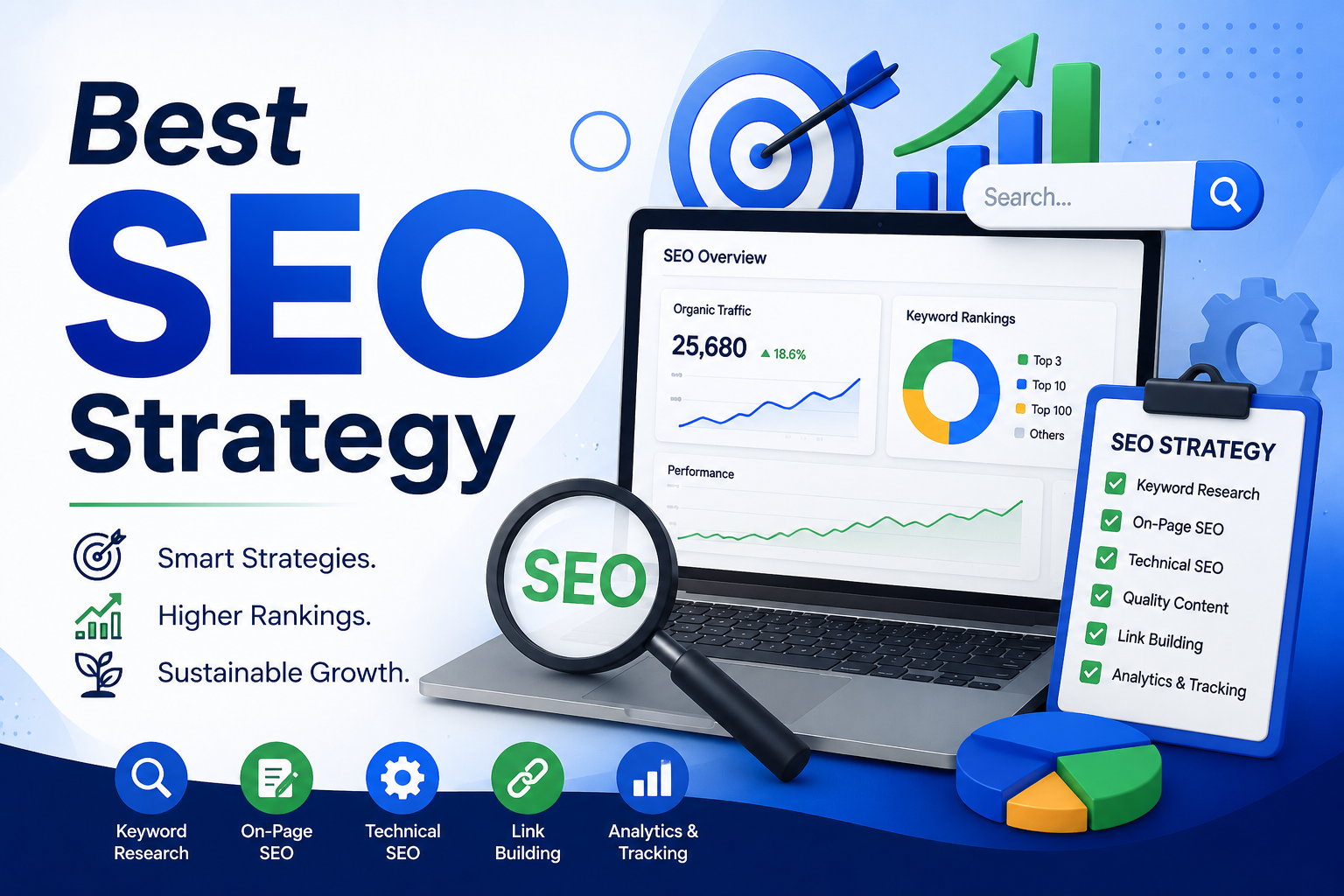
Best SEO Strategy: The Complete Guide to Dominating Search Rankings and AI Search
Search Engine Optimization (SEO) has changed more in the last two years than it did in the previous decade.
For years, ranking on Google was primarily about keywords, backlinks, and technical optimization. While those elements still matter, the rise of AI-powered search, AI Overviews, conversational search engines, and answer engines has transformed the way people discover information online.
Many marketers still ask:
- Do keywords still matter?
- Can AI-generated content rank?
- How do I get traffic from AI search?
The answer is simple:
SEO is not dead.
Old SEO is dead.
The websites that continue using outdated tactics such as keyword stuffing, mass-produced AI articles, and spammy backlink schemes are losing visibility. Meanwhile, websites focused on expertise, authority, trust, and user value are gaining more traffic than ever.
This guide explains the best SEO strategy and how businesses, bloggers, agencies, and website owners can stay ahead of competitors.
Understanding SEO
SEO is no longer just Search Engine Optimization.
It has evolved into:
- Search Engine Optimization (SEO)
- Answer Engine Optimization (AEO)
- Generative Engine Optimization (GEO)
- AI Visibility Optimization
Modern search engines don’t just rank pages.
They:
- Read content
- Understand entities
- Analyze expertise
- Generate summaries
- Provide direct answers
- Recommend trusted sources
Your goal is no longer simply ranking #1.
Your goal is becoming the most trusted source that AI systems and search engines choose to cite.
Why Traditional SEO Is No Longer Enough
In previous years, you could rank by:
- Targeting exact-match keywords
- Building backlinks aggressively
- Publishing large volumes of content
Today, those tactics alone are insufficient.
Search engines have become significantly better at understanding:
- Context
- Search intent
- Expertise
- User satisfaction
- Trustworthiness
- Real-world authority
A website with 50 genuinely helpful articles often outperforms another website with 500 low-quality AI-generated posts.
Quality now beats quantity.
The #1 SEO Strategy: Build Topical Authority
If there is one strategy that outperforms almost everything else in 2026, it is topical authority.
Topical authority means becoming the best source on a specific subject.
Instead of publishing random articles, create an interconnected content ecosystem.
For example, if your website is about SEO, cover:
Core Topics
- SEO basics
- Technical SEO
- Local SEO
- Ecommerce SEO
- Link building
- Content marketing
Advanced Topics
- AI SEO
- GEO
- AEO
- Entity SEO
- Semantic SEO
- Search intent optimization
Supporting Topics
- SEO tools
- Keyword research
- Search Console tutorials
- SEO case studies
When search engines see comprehensive coverage of a topic, they begin viewing your website as an authority.
Authority leads to rankings.
Rankings lead to traffic.
Traffic leads to revenue.
Create Content for Humans First
One of Google’s most consistent messages has been simple:
Create content for people, not search engines.
Many websites still produce content solely to rank.
That approach no longer works.
Instead, every piece of content should answer:
-
What problem does this solve?
- Why should someone trust this content?
- What unique value does this provide?
When creating content, focus on:
Original Insights
Share:
- Personal experiences
- Case studies
- Research
- Data
- Real examples
Actionable Advice
Readers should leave your article knowing exactly what to do next.
E-E-A-T Is More Important Than Ever
One of the biggest ranking concepts in 2026 is E-E-A-T.
It stands for:
- Experience
- Expertise
- Authoritativeness
- Trustworthiness
Google increasingly evaluates whether content comes from credible sources.
Experience
Show real-world experience.
Include:
- Screenshots
- Examples
- Personal testing
- Case studies
Expertise
Demonstrate knowledge.
Use:
- Research
- Detailed explanations
- Industry insights
Authoritativeness
Build recognition within your niche.
Authority grows through:
- Mentions
- Citations
- High-quality backlinks
- Brand reputation
Trustworthiness
Trust is the foundation.
Include:
- About pages
- Contact information
- Author profiles
- Transparent policies
Trustworthy websites consistently outperform anonymous content farms.
Optimize for AI Overviews
AI Overviews are changing search behavior dramatically.
Users increasingly receive answers before clicking a website.
This doesn’t mean traffic disappears.
It means your content must become the source AI systems trust.
How to Optimize for AI Overviews?
Answer Questions Clearly
Use concise answers near the beginning of sections.
Use Structured Headings
Good examples:
- What is SEO?
- Why is SEO important?
- How does SEO work?
Create Definition Sections
AI systems love extracting definitions.
Add Key Takeaways
Summaries increase citation opportunities.
Use Lists
AI systems frequently pull information from:
- Bullets
- Tables
- Step-by-step instructions
Keyword Research Has Evolved
Keywords still matter.
However, keyword obsession does not.
The focus has shifted toward:
Search Intent
Understand why someone searches.
Intent categories include:
Informational
Example:
“What is SEO?”
Navigational
Example:
“Google Search Console”
Commercial
Example:
“Best SEO tools”
Transactional
Example:
“Buy SEO services”
Your content must align perfectly with user intent.
Semantic SEO and Entity Optimization
Search engines now understand relationships between topics.
For example:
SEO is connected to:
- Google Search Console
- Backlinks
- Content Marketing
- Crawling
- Indexing
- Search Intent
Instead of repeating the same keyword endlessly, include related concepts naturally.
This creates semantic relevance.
Semantic relevance strengthens rankings.
Build Content Clusters
One of the strongest strategies in 2026 is the pillar-cluster model.
Pillar Page
Create a comprehensive guide.
Example:
“Ultimate Guide to SEO”
Cluster Content
Create supporting articles:
- Technical SEO Guide
- Link Building Guide
- Local SEO Guide
- AI SEO Guide
Link all cluster pages back to the pillar page.
This structure helps search engines understand topical authority.
Technical SEO Still Matters
Great content cannot perform if technical issues exist.
Important technical SEO areas include:
Site Speed
Fast websites rank better and convert better.
Improve:
- Image optimization
- Caching
- Code compression
Mobile Optimization
Most users browse on mobile devices.
Your website must be:
- Responsive
- Fast
- Easy to navigate
Crawlability
Search engines must access pages efficiently.
Maintain:
- XML sitemaps
- Clean architecture
- Internal linking
Core Web Vitals
Monitor:
- Loading speed
- Visual stability
- Responsiveness
Technical SEO creates the foundation for everything else.
Internal Linking Is a Hidden SEO Superpower
Many websites ignore internal links.
That’s a mistake.
Internal links:
- Distribute authority
- Improve crawling
- Increase page views
- Strengthen topical relevance
Every article should connect naturally with related content.
Think of your website as a web, not a collection of isolated pages.
Link Building
Backlinks remain important.
However, quality matters more than quantity.
Avoid:
- Link farms
- Spam directories
- Purchased links
Focus on:
Digital PR
Earn mentions through:
- Research
- Data studies
- Unique insights
Guest Posting
Contribute valuable content to authoritative websites.
Resource Link Building
Create resources people naturally reference.
Examples:
- Statistics pages
- Industry reports
- Free tools
The best links are earned, not manufactured.
Brand Building Is the New SEO
One of the biggest SEO shifts is the rise of brand authority.
Search engines increasingly trust recognizable brands.
Strong brands receive:
- More clicks
- More mentions
- More backlinks
- More citations
Invest in:
Social Media
Build audience trust.
Email Marketing
Own your audience.
Community Building
Create loyal followers.
Consistent Branding
Be memorable.
Brand signals often separate top-ranking sites from average ones.
Video SEO Is Essential
Video consumption continues growing.
Many users prefer watching rather than reading.
Create:
- Tutorials
- Product reviews
- Walkthroughs
- Educational content
Optimize:
- Titles
- Descriptions
- Chapters
- Thumbnails
Video content can rank in:
- YouTube
- AI-powered search results
Local SEO Strategy
For local businesses, local SEO remains crucial.
Optimize:
Google Business Profile
Keep information updated.
Reviews
Encourage genuine customer feedback.
Local Citations
Maintain consistency across directories.
Local Content
Create city-specific resources and pages.
Local trust signals heavily influence visibility.
Schema Markup and Structured Data
Structured data helps search engines understand content.
Useful schema types include:
- Article
- FAQ
- Organization
- Person
- Product
- Review
- Local Business
Schema improves eligibility for enhanced search appearances.
While not a direct ranking factor, it improves understanding and visibility.
User Experience Is an SEO Factor
Great user experience improves:
- Engagement
- Conversions
- Retention
Focus on:
Readability
Use:
- Short paragraphs
- Headings
- Bullet points
Navigation
Make content easy to find.
Design
A clean interface increases trust.
Users who enjoy your website send positive signals to search engines.
AI Content: Use It Wisely
AI is a powerful tool.
However, blindly publishing AI-generated content is risky.
Best practice:
Use AI For
- Research assistance
- Outlines
- Content ideation
- Draft creation
Add Human Expertise
Include:
- Experience
- Insights
- Opinions
- Case studies
Human-enhanced AI content consistently outperforms purely automated content.
Measure What Matters
SEO success requires measurement.
Track:
Organic Traffic
Monitor growth trends.
Rankings
Track important keywords.
Conversions
Traffic without conversions is meaningless.
Engagement Metrics
Measure:
- Time on page
- Bounce rate
- User interaction
Data-driven SEO wins long term.
The Future of SEO Beyond
The future belongs to websites that become trusted sources.
Search engines and AI systems increasingly reward:
- Expertise
- Authority
- Experience
- Trust
The websites that survive will be those that genuinely help users.
Future SEO trends include:
- AI-driven search
- Voice search
- Multimodal search
- Entity optimization
- Brand authority
- Answer engine visibility
Businesses that adapt early will dominate their markets.
Final Thoughts
The best SEO strategy is surprisingly simple:
Create the most useful content on your topic.
Then strengthen it with:
- Topical authority
- E-E-A-T
- Technical SEO
- Internal linking
- Quality backlinks
- Structured data
- Brand building
- AI search optimization
Forget shortcuts.
Forget SEO tricks.
Forget outdated ranking hacks.
The websites winning are those that prioritize users while making their content easy for search engines and AI systems to understand.
If you focus on becoming the most trusted source in your niche, rankings, traffic, leads, and revenue will follow.
SEO is no longer about gaming algorithms.
It’s about becoming the answer.
Ready to Future-Proof Your Rankings with a Winning SEO Strategy?
Search engine algorithms are evolving faster than ever. Implementing a standard SEO checklist is no longer enough to dominate the search engine results pages (SERPs). To stay ahead of the competition, maximize organic visibility, and drive sustainable growth, your brand needs an agile, data-driven strategy executed by proven experts.
At MahbubOsmane.com, we help businesses across Saudi Arabia, the UAE, Qatar, Kuwait, the USA, the UK, Canada, Germany, Lithuania, and Bangladesh build resilient digital ecosystems that turn search traffic into measurable revenue.
Why Global Brands Trust MahbubOsmane.com:
-
Elite Track Record: 700+ completed jobs with flawless 5-star feedback on Upwork.
-
Verified Professionalism: Available for secure, enterprise-grade collaboration on Hubstaff Talent.
-
Comprehensive Digital Solutions: A single, synchronized team handling all facets of your online growth.
Our Full-Suite Professional Services:
-
Professional SEO & Content Writing: Advanced optimization techniques built for the 2026 search landscape, paired with high-converting, authoritative content.
-
AdOps & Digital Marketing: High-ROI paid campaigns designed to maximize your ad spend across all major ad networks.
-
Website Development & Graphic Design: Ultra-fast, responsive, and visually stunning websites optimized for excellent user experience and high search visibility.
-
Professional Video Editing: Engaging corporate and promotional video production optimized for modern social media algorithms.
Don’t let your competitors capture your traffic in 2026. Partner with a globally recognized, top-rated digital agency to scale your business today.
Get Your Free Strategy Consultation!
Connect with our global team via phone, WhatsApp, or email to discuss your digital transformation.
-
Saudi Arabia (Call / WhatsApp): +966 54 948 5900 / +966 55 322 7950
-
Bangladesh (Call / WhatsApp): +880 1716-988953
-
Email Us Directly: hi@mahbubosmane.com / mahbubosmane@gmail.com
-
Explore Our Work: www.MahbubOsmane.com
🟢 Connect Instantly via WhatsApp
Frequently Asked Questions
What’s the biggest shift in SEO strategy ?
The biggest shift is the move toward AI-driven and generative search experiences. Instead of optimizing purely for ranking in a list of ten blue links, sites now need content structured to be cited or summarized directly by AI search features.
Do I still need to do keyword research?
Yes, but the approach has evolved from targeting exact-match keywords to covering topics comprehensively. Search engines now prioritize semantic relevance and user intent over precise keyword density.
What is E-E-A-T and why does it matter more now?
E-E-A-T stands for Experience, Expertise, Authoritativeness, and Trustworthiness. It matters more because AI-generated answers pull heavily from sources that demonstrate real-world credibility, so thin or anonymous content struggles to rank or get cited.
How important are Core Web Vitals?
Page experience signals remain a meaningful ranking factor, especially for mobile users. Sites with slow load times or unstable layouts continue to see reduced visibility regardless of content quality.
Is voice search optimization still relevant?
Yes, voice search continues to grow, particularly for local and conversational queries. Optimizing for natural-language questions and concise, direct answers helps content perform well in voice results.
What role does AI-generated content play in SEO strategy now?
AI-generated content can be a useful tool for drafting and research, but search engines reward content that’s edited, fact-checked, and enhanced with genuine expertise. Publishing unedited AI output at scale carries real risk of quality penalties.
How should I adapt to zero-click searches?
Since many queries are now answered directly on the search results page, the strategy shifts toward building brand visibility and capturing clicks through unique data, tools, or content that can’t be fully summarized elsewhere.
Are backlinks still a major ranking factor?
Backlinks remain important, but quality and relevance matter far more than volume. A handful of links from authoritative, topically relevant sites outweighs dozens of low-quality links.
How has local SEO changed?
Local SEO now leans heavily on structured data, accurate business listings, and review signals, since AI-powered local search results often pull directly from this information to answer “near me” style queries.
What is structured data (schema markup) and do I need it?
Structured data is code that helps search engines understand the context of your content, such as product details, reviews, or FAQs. It’s increasingly important in 2026 because it improves your chances of being featured in rich results and AI summaries.
Should I prioritize video content in my SEO strategy?
Video continues to gain visibility in search results, particularly short-form video. Optimizing video titles, transcripts, and descriptions helps both traditional search engines and video-specific platforms surface your content.
How often do I need to update existing content?
Regularly auditing and refreshing older content remains a strong practice, since search engines favor pages that reflect current information, especially for topics where facts or best practices change over time.
What’s the best way to prepare for algorithm updates?
Focusing on genuinely useful, well-researched content rather than chasing specific ranking tactics is the most reliable way to stay resilient through algorithm changes.
How does mobile-first indexing affect my site?
Mobile-first indexing means search engines primarily evaluate the mobile version of your site, so a clunky or incomplete mobile experience can hold back your entire site’s performance.
What metrics should I track to measure SEO success?
Beyond rankings, it’s useful to track organic traffic, click-through rate, conversion rate, and visibility in AI-generated answers or featured snippets, since these better reflect real-world impact.
How important is internal linking for SEO?
Internal linking remains valuable for helping search engines understand site structure and for distributing authority across related pages, which supports both crawlability and user navigation.
Do long-tail keywords still matter?
Long-tail keywords are arguably more valuable now, since they align closely with the specific, conversational queries people use in AI-assisted and voice search.
How does user experience (UX) tie into SEO strategy?
Search engines increasingly use engagement signals, such as time on page and bounce rate, as indirect indicators of content quality, so a clean, intuitive UX supports SEO performance.
What’s the role of social proof and reviews in SEO?
Reviews and social proof contribute to trust signals that both users and search algorithms weigh, particularly for local businesses and e-commerce sites competing in crowded markets.
External resources
- To stay current on official algorithm changes, Google’s Search Central Blog is the most reliable source for confirmed updates and guidance.
- For a deeper understanding of E-E-A-T and how it’s evaluated, Google’s own Search Quality Rater Guidelines outlines exactly what reviewers look for.
- If you want to benchmark your site’s loading speed and Core Web Vitals, PageSpeed Insights provides a free, detailed performance report.
- To research how AI-driven search features are reshaping click-through behavior, industry studies from Search Engine Land regularly publish data-backed analysis.
Internal resources
- Before diving into strategy, it helps to have the technical basics covered; see our guide on How to Select a Domain Name & Hosting for Your Website to make sure your foundation is solid.
- Since page speed plays into both SEO and user experience, check out our post on How to Improve Website Loading Speed for practical fixes.
- If you’re new to keyword research, our breakdown in Keyword Research Basics for Beginners walks through finding the right terms for your niche.
- For sites targeting local customers, our guide on Local SEO Checklist covers listings, reviews, and map rankings.
About the Author
Mahbub Osmane is a digital marketing expert who helps businesses build effective online strategies, including selecting and managing the right social media channels for growth. With hands-on experience across platforms and markets, Mahbub shares practical, actionable insights to help businesses connect with their audience and grow their brand presence.
Contact information Email: hi@mahbubosmane.com Website: https://mahbubosmane.com/ Mobile: +966 54 948 5900 (KSA) / +880 1716 988953 (BD) Address: 2282 7284 Al Malawi Southern 1, As Sulimaniyah Dist, Makkah 24236, Saudi Arabia