
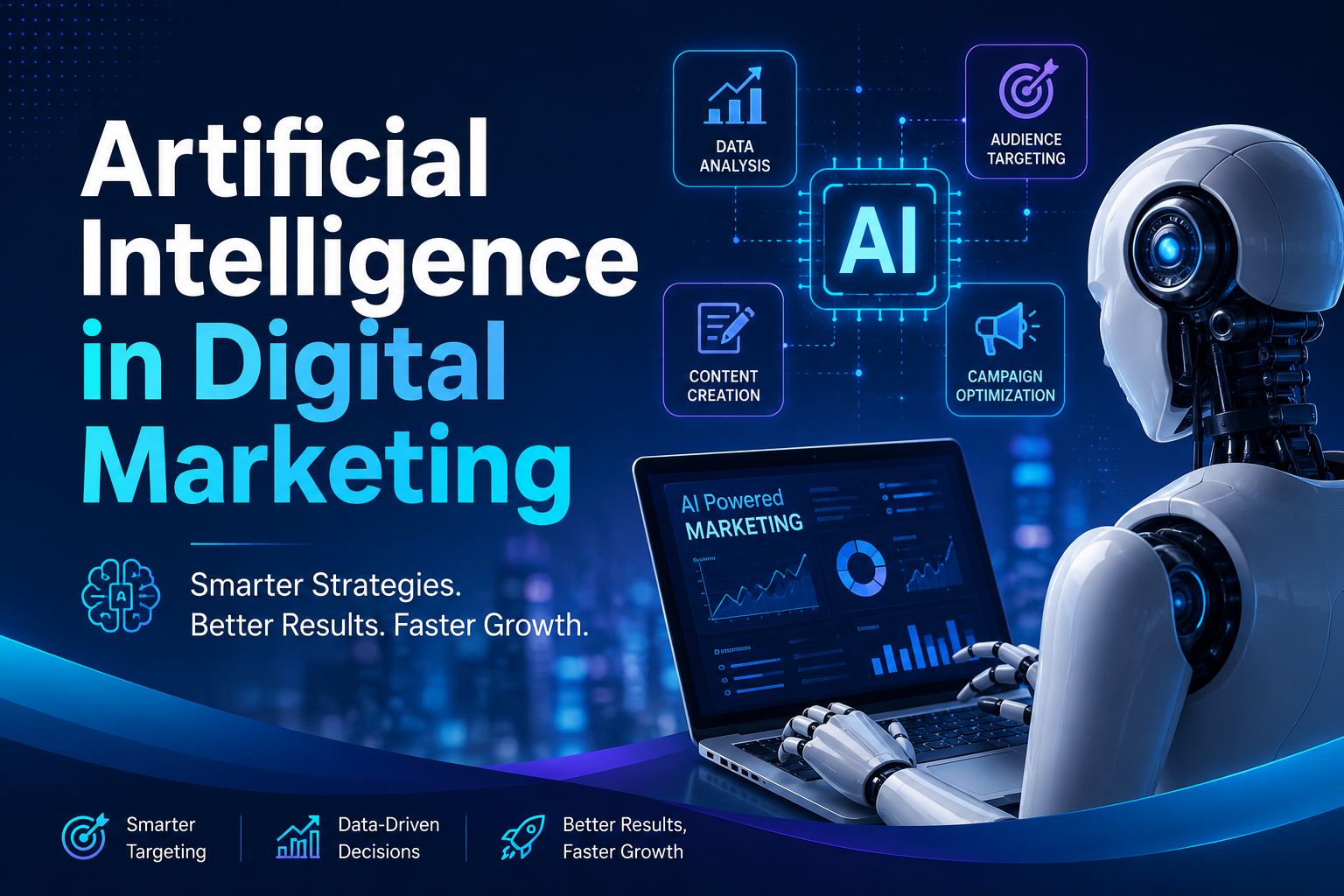
The Definitive Guide to Artificial Intelligence in Digital Marketing: Strategies, Tools, and the Future of Growth
The digital marketing landscape isn’t just changing; it is being fundamentally re-engineered. A few years ago, Artificial Intelligence (AI) in marketing was largely a buzzword confined to enterprise predictive analytics or basic automated email flows. Today, it is the underlying infrastructure of the entire digital ecosystem.
From the algorithms deciding what you see on your social media feeds to the generative tools writing copy and the hyper-personalized predictive engines shaping consumer behavior, AI has evolved from an optional competitive advantage into an absolute prerequisite for growth.
For modern marketers, businesses, and content creators, understanding AI is no longer about predicting the future—it’s about surviving and thriving in the present. This comprehensive guide breaks down exactly how AI is transforming digital marketing, how you can leverage it today, and what steps you must take to stay ahead.
The Paradigm Shift: Why AI Changes Everything
Traditional digital marketing has always been a game of guessing, testing, and scaling. Marketers looked at historical data, formed a hypothesis, ran an A/B test, analyzed the results, and optimized manually.
While effective, this process possesses two massive bottlenecks: human speed and data volume. Humans can only process so many data points at once, and we can only build so many variations of a campaign before hitting a wall of resource exhaustion.
AI removes these boundaries by shifting digital marketing from a reactive model to a predictive, real-time model.
Data Processing at Scale
Modern consumers leave behind massive, fragmented digital footprints across social media, search engines, websites, and mobile apps. AI algorithms can ingest terabytes of this unstructured data instantly, identifying subtle patterns, preferences, and anomalies that a human analyst would never notice.
Hyper-Personalization
In the past, segmentation meant breaking an audience down into broad demographics (e.g., “Females aged 25–34 interested in fitness”). AI enables one-to-one personalization. It treats every single customer as an independent segment, serving unique content, product recommendations, and messaging based on their precise real-time behavior.
Continuous Automation
Unlike human-driven campaigns that require manual intervention to shift budgets or adjust targeting, machine learning models continuously optimize themselves. They learn from every click, conversion, and skip, adapting your marketing infrastructure 24/7.
Core Pillars of AI in Digital Marketing
To effectively integrate AI into your marketing strategy, it helps to look at it through the lens of functional pillars. AI fundamentally upgrades four core areas of marketing execution: Content Creation, Search Engine Optimization (SEO), Paid Advertising, and Customer Experience.
Pillar 1: Content Creation & Generative AI
Generative AI has democratized content creation, shifting the primary bottleneck from production execution to strategic curation. Tools built on Large Language Models (LLMs) allow teams to scale their creative output exponentially.
-
Copywriting & Ideation: AI excels at generating headlines, social media copy, ad variations, and email subject lines. By feeding a model specific audience brand personas and guidelines, it can generate dozens of distinct copy variations tailored to different psychological triggers in seconds.
-
Long-Form Content Production: While human editorial oversight remains non-negotiable for quality and factual accuracy, AI acts as a powerful research and drafting assistant. It can build comprehensive content outlines, draft initial sections, summarize long source documents, and repurpose a single blog post into newsletter snippets, LinkedIn updates, and video scripts.
-
Visual & Audio Generation: Beyond text, generative AI models create high-quality images, generate custom background tracks, and even produce realistic voiceovers for video content. This drastically lowers the barrier to entry for multi-media marketing campaigns.
Pillar 2: The Evolution of Search (SEO & SGE)
Search engines were among the earliest adopters of machine learning (such as Google’s RankBrain and BERT). However, the rise of Search Generative Experiences (SGE) and conversational answer engines means SEO strategies must undergo a radical evolution.
-
From Keywords to Search Intent: Search algorithms no longer just match strings of keywords; they understand the semantic intent and contextual meaning behind a user’s query. AI tools help marketers map out comprehensive topical authority hubs rather than just writing articles optimized around a single keyword phrase.
-
AI-Powered Optimization: SEO tools leverage AI to analyze top-ranking competitors instantly. They identify gaps in content length, subtopics covered, readability levels, and internal linking structures, providing a data-backed blueprint for what content needs to be created to rank.
-
Optimizing for Conversational AI: As users increasingly turn to AI assistants to find answers directly, optimization is shifting toward being cited as a trusted source within AI knowledge graphs. This requires a focus on structured data, deep primary data research, schema markup, and clear, authoritative answering formats.
Pillar 3: Predictive Paid Advertising & Media Buying
The days of manual bid adjustments and tedious micro-targeting in ad networks are largely over. Major advertising platforms like Google Ads and Meta Ads have completely wrapped their media buying engines in AI.
-
Automated Budget Allocation: Modern programmatic ad platforms use machine learning to predict which users, placements, and times of day are most likely to yield a conversion. Systems like Google’s Performance Max automatically move budget across Search, YouTube, Display, and Discover in real-time based on performance.
-
Lookalike & Predictive Targeting: Instead of guessing interests, you can feed AI engines your first-party customer data. The AI analyzes thousands of implicit variables to find “lookalike” audiences who behave exactly like your highest-value customers, maximizing return on ad spend (ROAS).
-
Dynamic Creative Optimization (DCO): Marketers upload a matrix of different images, videos, headlines, and descriptions. The ad network’s AI dynamically pieces them together in real-time, displaying the exact combination it predicts will convert a specific user based on their individual history.
Pillar 4: Advanced Customer Experience (CX) & Conversational Commerce
Getting a user to your website is only half the battle. AI ensures that once they arrive, their experience is frictionless, relevant, and engaging.
-
Intelligent Conversational Agents: Traditional chatbots followed rigid, frustrating “if/then” decision trees. Modern AI-driven virtual assistants understand natural language, interpret context, access inventory systems, and handle complex customer inquiries, troubleshooting, or product discovery seamlessly.
-
Behavioral Predictive Recommendations: E-commerce giants have set the standard for product recommendations. AI tracks a user’s mouse movements, dwell time, purchase history, and cart additions to dynamically alter the website layout and recommend cross-sells or upsells with surgical precision.
-
Churn Prediction: By analyzing customer interaction metrics (support ticket frequency, login drops, billing changes), predictive models can flag customers who are at a high risk of canceling a subscription or switching brands, triggering automated retention campaigns before the user departs.
Step-by-Step Framework for Implementing AI
Deploying AI within your marketing infrastructure shouldn’t be a chaotic scramble to adopt every shiny new tool. It requires a structured, deliberate approach to protect your brand, budget, and data integrity.
[Define Objectives] ➔ [Audit Data Infrastructure] ➔ [Select the Right Stack] ➔ [Human-in-the-Loop]
Step 1: Define Specific Objectives
Never adopt an AI tool simply because it is trending. Start with a distinct marketing friction point or operational bottleneck. Ask yourself:
-
Are we spending too much time drafting baseline social media copy?
-
Is our ad spend failing to target the right audience segments?
-
Do we have low engagement on our website’s product recommendations?
Isolate one or two clear KPIs (e.g., reduce content production time by 30%, increase email click-through rate by 15%) before introducing a tool.
Step 2: Audit and Clean Your Data Infrastructure
AI models are entirely dependent on data quality. If you feed an AI algorithm incomplete, siloed, or dirty customer data, it will yield inaccurate insights—a concept known as “garbage in, garbage out.”
-
Consolidate your data streams into a centralized system, such as a Customer Data Platform (CDP) or an organized CRM.
-
Ensure accurate tracking tags are set up properly across your website and conversion funnels.
-
Audit your historical data to remove duplicates and fix broken formatting.
Step 3: Select Your Tools Wisely
Build an integrated stack where tools communicate smoothly with one another. Avoid tool bloat by leaning into the native AI capabilities built into platforms you already use (e.g., HubSpot’s AI assistants, Shopify’s native product recommendations) before buying standalone niche software.
When evaluating standalone AI software, prioritize tools that offer clear data privacy compliance and robust API integration options.
Step 4: Establish a “Human-in-the-Loop” Workflow
AI should be treated as an incredibly fast, infinitely scalable intern—not an autonomous executive. Every piece of content, automated sequence, or predictive model requires human oversight. Create strict editorial and operational guardrails to review AI outputs for tone, brand consistency, factual correctness, and compliance before anything goes live.
Essential AI Marketing Tool Categories
The market is saturated with tools, but they generally map back to distinct use cases. Here is an overview of the structural landscape of tools driving digital marketing today:
| Category | Primary Functions | Popular Industry Examples |
| Generative Text & Strategy | Copywriting, content outlines, scripting, brainstorming, repurposing content. | OpenAI ChatGPT, Claude (Anthropic), Jasper AI |
| SEO & Market Intelligence | Content gap analysis, keyword intent clustering, automated site audits, SERP analysis. | SurferSEO, Semrush (Scribe/Copilot), MarketMuse |
| Visual Creative & Design | Ad creative generation, image editing, scaling assets, brand design variations. | Midjourney, Canva Magic Studio, Adobe Firefly |
| Marketing Automation & CRM | Predictive lead scoring, automated email send-time optimization, dynamic segmentation. | HubSpot AI, Salesforce Einstein, Klaviyo |
Ethical Considerations, Challenges, and Risks
While the benefits of AI are undeniable, rushing blindly into automation carries serious operational, legal, and brand risks that marketers must actively manage.
The Risk of Content Homogenization
Because generative AI models train on existing web data, they naturally trend toward the statistical average. If every brand in an industry uses the exact same prompts to write their articles and social posts, all market content begins to sound identical.
Brands risk losing their unique perspective, tone of voice, and creative edge. AI should provide the foundational framework, but the unique insights, real-world stories, and distinct personality must come from human creators.
Intellectual Property and Copyright Uncertainty
The legal landscape surrounding generative AI models is still evolving globally. Questions regarding who owns the copyright to AI-generated output, and whether training models on copyrighted web data constitutes fair use, remain subject to active litigation. Marketers must exercise caution, particularly when producing large-scale creative work or commercial assets entirely via generative prompts.
Data Privacy and Consumer Trust
AI relies heavily on gathering user data to personalize experiences. With data privacy regulations globally becoming increasingly strict (such as GDPR, CCPA, and the phase-out of third-party cookies), brands must be exceptionally transparent about how they collect, store, and utilize consumer information.
If users feel an AI tracking system is overly intrusive or handling their personal information securely without clear consent, it can destroy brand trust instantly.
Algorithmic Bias
Machine learning models reflect the biases present in the data used to train them. In ad targeting or automated recruitment/lead qualification, biased algorithms can inadvertently exclude specific demographics, resulting in unfair distribution or wasted ad spend. Regular audits of campaign performance demographics are essential to catch and correct these skewing effects.
Preparing for the Future: Skills Marketers Need
AI is not going to replace marketers. However, marketers who use AI will replace marketers who do not. To remain indispensable, digital marketing professionals must shift away from rote execution tasks and develop highly strategic, technical skill sets.
Prompt Engineering & Context Architecture
Knowing how to speak to AI models is a core operational skill. Marketers must master how to write precise prompts that include role definitions, target audience parameters, stylistic constraints, structural frameworks, and contextual background to extract elite outputs from generative models.
Data Literacy and Analytics Interpretation
As AI handles data collection and pattern identification, the marketer’s job becomes interpreting why those patterns matter and how to translate them into broader business initiatives. You need to understand data schemas, attribution models, and how to spot systemic errors in machine learning outputs.
Strategic Brand Positioning and Storytelling
AI cannot experience emotion, build genuine human relationships, or draw from authentic personal experiences. The future of marketing relies heavily on creative direction, community building, experiential marketing, and raw human storytelling—elements that cannot be emulated by a machine learning model.
AI Tool Stack Orchestration
The modern marketing director must act as a systems architect. The skill lies in selecting disparate AI platforms, integrating them cleanly into existing workflows, ensuring data compliance, and training team members to utilize them uniformly across the organization.
Conclusion: Embracing the Agile Marketing Era
Artificial Intelligence represents the most disruptive change to digital marketing since the creation of the internet itself. It has rewritten the rules of how brands connect with consumers, scale creative ideas, and optimize capital efficiency across advertising networks.
The barrier to entry has never been lower, but the cost of waiting has never been higher. By implementing a thoughtful, ethical, and human-guided AI strategy, you can eliminate mundane administrative bottlenecks, unlock deep consumer insights, and scale your growth to heights that were impossible just a few short years ago.
The future belongs to the agile marketer who views AI not as a threat, but as the ultimate cognitive amplifier. Start small, test rigorously, maintain rigorous human oversight, and begin integrating intelligent automation into your digital marketing workflow today.
Transform Your Digital Growth with an Elite Global Marketing Partner
The future of digital marketing is fast, data-driven, and powered by Artificial Intelligence. To stay ahead of the competition in today’s hyper-connected economy, your business needs more than just baseline execution—you need an elite team capable of engineering scalable growth.
At MahbubOsmane.com, we bridge the gap between cutting-edge technology and human creative excellence. Whether you are expanding your footprint in the GCC, scaling an enterprise in North America and Europe, or dominating local markets, we deliver high-performance digital solutions tailored to your bottom line.
Our Core Specialized Expertise:
-
Professional SEO & Content Writing: Build topical authority and rank at the top of both traditional search engines and modern AI Search Generative Experiences (SGE).
-
Precision AdOps (Paid Media): High-ROI campaign architecture across Google Ads, Meta, and programmatic networks.
-
Web Development & Graphic Design: High-converting, lightning-fast websites coupled with striking, premium brand visuals.
-
Corporate Video Editing: Compelling visual storytelling optimized for maximum engagement across LinkedIn, YouTube, and social ecosystems.
Built on Global Elite Trust
We don’t just promise results—our track record speaks for itself. As an elite agency presence on the world’s top freelance platforms, we have successfully delivered 700+ completed jobs with flawless 5-star feedback on Upwork. Our verified availability on Hubstaff Talent further reflects our commitment to absolute transparency, real-time tracking, and uncompromised project delivery.
We proudly accelerate business growth for ambitious brands across Saudi Arabia, UAE, Qatar, Kuwait, USA, UK, Canada, Germany, Lithuania, and Bangladesh.
Ready to Scale Your Digital Performance?
Let’s design a digital marketing strategy that drives measurable revenue for your enterprise. Reach out to our consulting team today via email, web, or direct messaging.
-
Website: www.MahbubOsmane.com
-
Corporate Email: hi@mahbubosmane.com | mahbubosmane@gmail.com
-
Saudi Arabia Office: +966549485900 or +966553227950 (WhatsApp Available)
-
Bangladesh Office: +8801716988953 (WhatsApp Available)
Frequently Asked Questions (FAQ)
What is the role of Artificial Intelligence (AI) in digital marketing?
AI in digital marketing refers to the use of machine learning, natural language processing (NLP), and advanced data analytics to automate marketing tasks, predict customer behavior, and deliver hyper-personalized experiences. Instead of relying solely on manual A/B testing and broad demographic segmentation, AI allows brands to analyze vast amounts of data in real-time to optimize campaigns instantly.
How can AI improve my business’s Search Engine Optimization (SEO)?
AI-driven SEO shifts the focus from simple keyword stuffing to semantic search intent and topical authority. Tools like SurferSEO or Semrush analyze search engine results pages (SERPs) instantly, identifying content gaps, recommended word counts, and required subtopics. AI also helps optimize your site architecture, predict trending search queries, and structure content to rank in modern conversational search tools.
What is Google’s Search Generative Experience (SGE), and how do I optimize for it?
Google SGE utilizes generative AI to provide direct, synthesized answers right at the top of search results, often bypassing traditional links. To optimize for SGE, your brand must focus on producing deep, original primary data, clear schema markup, and authoritative structured data. Your site needs to be cited as a trusted source within AI knowledge graphs by providing direct, unambiguous answers to complex user questions.
Can generative AI completely replace human content writers?
No. While tools like ChatGPT and Claude are exceptional for scaling content production, brainstorming, and structuring outlines, they lack human empathy, real-world experience, and deep emotional storytelling. Purely AI-generated text often trends toward structural averages, resulting in brand homogenization. A “human-in-the-loop” workflow—where human editors fact-check, refine brand voice, and infuse personal insights—is vital to maintaining quality and avoiding search engine penalties.
How does AI optimize paid advertising and media buying?
Modern ad ecosystems (like Meta Ads and Google’s Performance Max) use predictive machine learning models to handle audience targeting and bidding. Instead of manual adjustment, AI algorithms calculate conversion probabilities based on implicit user behavior data, automatically shifting ad spend in real-time to the platforms, placements, and times of day that yield the highest Return on Ad Spend (ROAS).
What is Dynamic Creative Optimization (DCO) in paid ads?
Dynamic Creative Optimization is an AI process where a marketer uploads an assortment of headlines, descriptions, images, and video assets into an ad platform. The AI then dynamically pairs these assets together in real-time, matching specific combinations to the precise psychological triggers and past browsing behaviors of an individual user.
What is the difference between legacy chatbots and modern AI conversational agents?
Legacy chatbots followed rigid, frustrating “if/then” decision trees; if a user deviated from the script, the bot failed. Modern AI conversational agents use Natural Language Processing (NLP) to understand context, intent, and colloquial phrasing. They can access external CRM or inventory data to answer complex product discovery queries, troubleshoot issues, and close sales autonomously.
How does AI enable hyper-personalization in e-commerce?
AI tracks immediate user behaviors—such as mouse hover patterns, scroll depth, item comparison duration, and cart history. It uses this real-time behavioral data to dynamically restructure website layouts, customize email marketing send times, and display highly accurate predictive product recommendations tailored exclusively to that specific customer.
What is predictive analytics, and how does it predict customer churn?
Predictive analytics processes historical consumer data to identify subtle behavioral flags that precede an action. For customer churn, the AI monitors drops in login frequency, increases in support tickets, or changes in feature usage. When a customer matches a historical “churn pattern,” the system flags them automatically, triggering targeted retention emails or promotional offers to keep them engaged.
Does Google penalize websites that use AI-generated content?
Google’s official guidelines state that they reward high-quality content, regardless of how it is produced. They penalize content designed primarily to manipulate search rankings (spam). If your AI content is deeply researched, helpful, accurate, and fulfills user intent (following Google’s E-E-A-T framework: Experience, Expertise, Authoritativeness, Trustworthiness), it can rank exceptionally well.
Is customer data safe when integrated into marketing AI platforms?
Data privacy is one of the most critical challenges of the AI era. When deploying AI tool stacks, enterprises must ensure compliance with international data protocols like GDPR and CCPA. It is vital to use enterprise-grade AI software that protects data privacy, anonymizes consumer touchpoints, and does not use proprietary customer data to train open-source public models.
What risks should my business avoid when adopting AI marketing tools?
The primary risks include content homogenization (sounding identical to your competitors), algorithmic bias (wasting ad budgets due to skewed data segments), intellectual property gray areas, and “garbage in, garbage out” results stemming from disorganized or dirty CRM databases. Strict human oversight is the ultimate safeguard against these risks.
What new skills do modern digital marketers need to survive the AI transition?
Marketers must pivot away from rote operational execution and master prompt engineering, data literacy, tool stack integration, and high-level strategic positioning. The future belongs to creative directors and systems architects who can direct AI workflows rather than manually building every asset themselves.
What are the best AI tools currently available for digital marketing?
The market features several specialized categories:
-
Generative Copywriting: ChatGPT, Claude, and Jasper AI.
-
SEO Optimization: SurferSEO, Semrush, and MarketMuse.
-
Visual Assets: Midjourney, Canva Magic Studio, and Adobe Firefly.
-
Automation/CRM: HubSpot AI, Salesforce Einstein, and Klaviyo.
How can small or medium businesses compete with big enterprises using marketing AI?
AI actually levels the playing field. Historically, only massive enterprises could afford large data analysis or creative design teams. Today, mid-market businesses can use accessible, cost-effective AI platforms to instantly generate insights, automate customer service, and scale high-performing ad campaigns with minimal overhead.
How does AI help in video editing and production for social media?
AI simplifies video marketing by automating transcription, generating intelligent captions, removing background noise, and auto-framing wide-angle clips into vertical formats for TikTok or YouTube Shorts. It can also analyze performance metrics across social feeds to advise video editors on what hooks or pacing structures retain viewer attention longest.
How should a company begin integrating AI into its existing marketing workflows?
Do not try to automate everything at once. Identify a single operational bottleneck—such as spending too many hours drafting baseline ad copy variants or missing website conversion opportunities. Audit your target customer data streams, select a specific tool, establish strict human review guidelines, measure the results against your baseline KPIs, and scale from there.
Internal Resources
-
For cutting-edge strategies on organic growth: Explore our comprehensive guide on Professional SEO Services to learn how to outrank your competitors in search engine results.
-
To supercharge your brand’s conversion rates: Read our expert analysis on how modern Digital Marketing Services can transform your casual website traffic into high-value paying customers.
- To build a robust, lightning-fast foundation for your business online: Browse our dedicated resources on high-performance Website Development optimized for both desktop and mobile users.
-
For high-impact, persuasive content that converts readers: Head over to our Content Writing Services and discover how we blend data-driven research with flawless copy.
External Resources
-
To understand official guidelines on automated content: Review Google’s official documentation regarding Google Search’s guidance about AI-generated content to ensure your strategy remains completely compliant.
-
For a deeper dive into modern search algorithm mechanics: Check out the latest technical analysis on Google’s Search Generative Experience (SGE) directly via the Google Keyword Blog.
-
To explore advanced machine learning capabilities in paid ads: Read Meta’s comprehensive blueprint on Advantage+ Shopping Campaigns and Automated Ads to optimize your social media advertising budgets.
-
For verified metrics on international digital marketing adoption data: Study the comprehensive HubSpot State of Marketing Report to track how global enterprises are deploying AI software.
About the Author
Mahbub Osmane is a digital marketing expert who helps businesses build effective online strategies, including selecting and managing the right social media channels for growth. With hands-on experience across platforms and markets, Mahbub shares practical, actionable insights to help businesses connect with their audience and grow their brand presence.
Contact information Email: hi@mahbubosmane.com Website: https://mahbubosmane.com/ Mobile: +966 54 948 5900 (KSA) / +880 1716 988953 (BD) Address: 2282 7284 Al Malawi Southern 1, As Sulimaniyah Dist, Makkah 24236, Saudi Arabia