
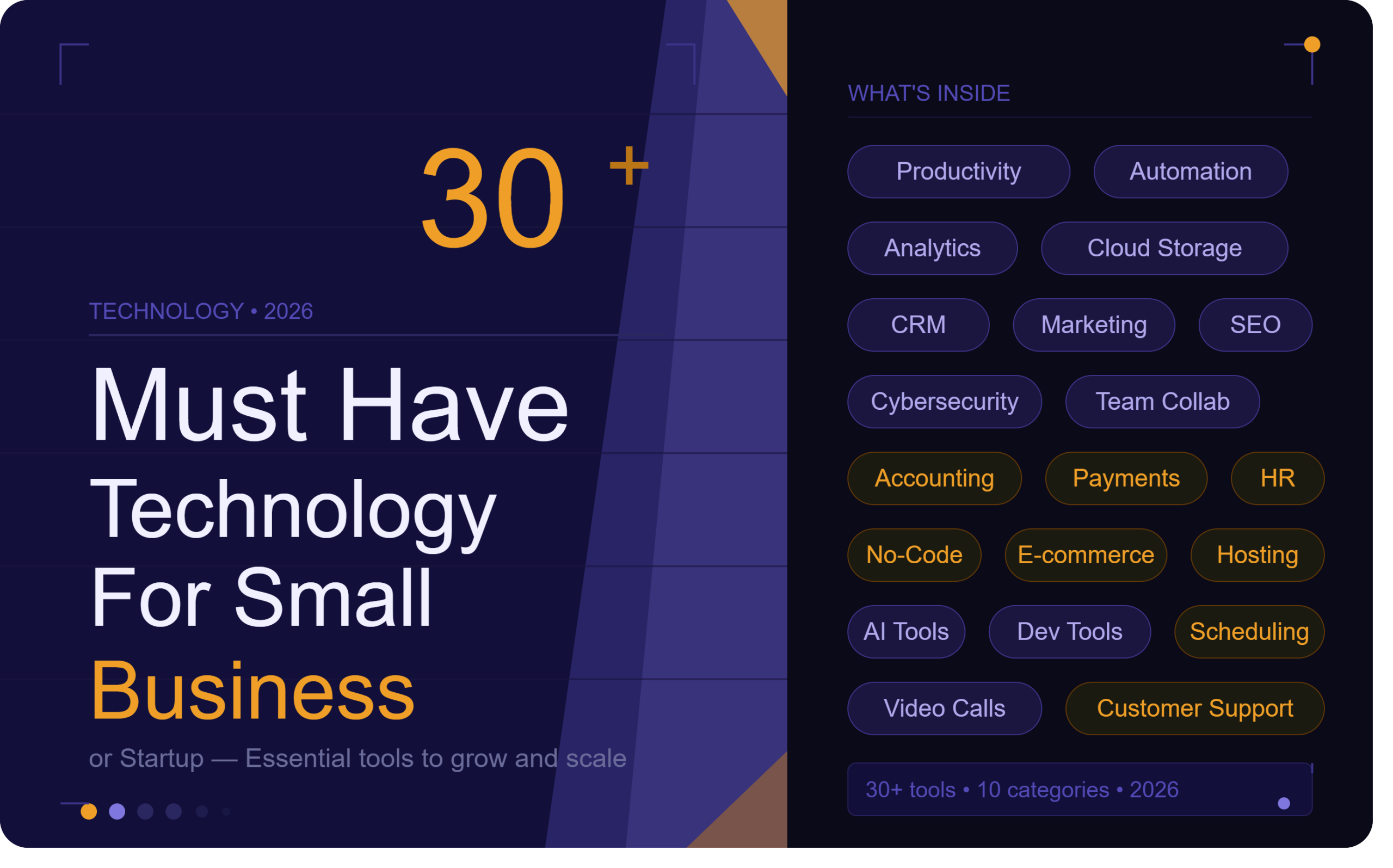
30+ Must-Have Technology For Small Businesses or Tech Startup in 2027
In the rapidly evolving landscape of modern commerce, technology has ceased to be a mere luxury reserved for enterprise-level conglomerates. Today, it stands as the foundational bedrock upon which successful startups and small businesses are built. Operating a lean organization without an optimized digital infrastructure is akin to entering a Formula 1 race on a bicycle. The right technological ecosystem acts as a force multiplier—it levels the playing field, automates mundane operational burdens, expands marketing reach, secures digital assets, and transforms raw data into actionable strategic insights.
Building this architecture can feel overwhelming. With thousands of Software-as-a-Service platforms claiming to be the silver bullet for operational excellence, founders and managers often fall into the trap of subscription fatigue, paying for overlapping or underutilized tools. The goal is not to adopt technology for the sake of novelty, but to build a cohesive, integrated stack where every platform communicates seamlessly, driving maximum efficiency and ROI. This comprehensive guide outlines the indispensable technologies across every major pillar of business operations, providing a strategic roadmap to supercharge your venture.
The Digital Foundation and Operations
Every business requires a digital headquarters—a core infrastructure that establishes its brand identity, hosts its online presence, and manages daily administrative communications. Without a robust foundation, all other software additions will sit on shaky ground.
Cloud Productivity and Collaboration Suites
The centralized nervous system of any modern business is its cloud-enabled productivity suite. These ecosystems combine corporate email hosting, document creation, spreadsheets, presentation builders, and cloud storage into a unified platform. Choosing a comprehensive workspace eliminates communication silos and ensures that team members can collaborate on documents in real-time from anywhere in the world. They provide granular administrative controls, enterprise-grade security, and native integration with hundreds of external business applications, forming the baseline operational environment for your team.
Reliable Domain Registration and Scalable Cloud Hosting
Your web address and the servers that host your digital properties constitute your virtual storefront. Investing in a reliable domain registrar that offers privacy protection, robust DNS management, and two-factor authentication safeguards your brand’s digital identity. Complementing this is your cloud hosting provider. Startups require hosting infrastructure that balances speed, uptime, and scalability. Managed cloud hosting environments ensure that whether your site receives ten visitors or ten thousand simultaneous spikes from a successful marketing campaign, your platform remains online, fast, and fully secure without requiring a dedicated internal IT engineering team.
Intelligent Content Management Systems
A corporate website is no longer a static digital brochure; it is a dynamic marketing asset, a lead generation engine, and often the primary point of transactional interaction. Deploying a flexible content management system allows non-technical team members to publish content, update product information, and design landing pages without writing code. The ideal content management architecture offers an extensive ecosystem of plugins, themes, and integrations, allowing your website to evolve in tandem with your business goals.
Virtual Private Networks and Distributed Network Security
With the rise of remote work and decentralized teams, securing the connection between your workforce and your internal business data is paramount. Virtual Private Network technologies create encrypted data tunnels, preventing malicious actors from intercepting proprietary corporate information when employees connect via public Wi-Fi or unsecured home networks. Implementing cloud-managed network security tools ensures that your intellectual property remains safe, regardless of where your distributed team chooses to log in.
Customer Relationship and Growth Architecture
Customers are the lifeblood of any business venture. Managing how you attract, engage, retain, and understand them requires specialized systems designed to capture intent and streamline the buyer’s journey.
Customer Relationship Management Platforms
At the center of your growth engine sits the Customer Relationship Management platform. This technology tracks every interaction a prospect or customer has with your brand—from their initial website visit and download behavior to sales calls, email exchanges, and purchase histories. A well-configured platform breaks down walls between your sales, marketing, and customer success teams, providing a single source of truth that allows for personalized customer experiences, accurate revenue forecasting, and data-driven sales pipelines.
Inbound and Automated Marketing Suites
Reaching audiences at scale requires intelligent automation. Advanced marketing automation suites enable small teams to design complex, behavioral-triggered email campaigns, nurture leads through the sales funnel, score prospects based on engagement levels, and orchestrate omnichannel campaigns. By automating repetitive messaging sequences, your marketing department can maintain a highly personalized touch with thousands of prospects simultaneously, freeing up creative energy for strategic asset development.
Enterprise Social Media Management Systems
Maintaining an active, responsive presence across multiple social networks is a logistical challenge for small teams. Social media management platforms aggregate your social profiles into a single dashboard, enabling centralized content scheduling, visual asset planning, and unified inbox management. Furthermore, these platforms provide deep listening capabilities and analytics, monitoring brand mentions across the web and providing insights into audience sentiment and engagement trends.
Conversion Optimization and Website Analytics
To optimize your marketing spend, you must understand what happens after a user clicks on your ads or lands on your website. Web analytics and conversion rate optimization tools track user behavior, traffic sources, bounce rates, and conversion paths. Utilizing heatmapping and session recording technologies allows you to visually witness how users interact with your digital interfaces, revealing friction points in your checkout or lead capture forms and enabling rapid, iterative user experience improvements.
Search Engine Optimization Toolkits
Organic search remains one of the most cost-effective and sustainable customer acquisition channels. Search engine optimization platforms provide critical intelligence regarding keyword search volumes, competitive analysis, backlink tracking, and technical site audits. Armed with this data, startups can craft content strategies targeted directly at the solutions their prospective clients are actively searching for, outmaneuvering larger competitors on major search engine result pages.
Communication and Team Synergy
As organizations scale, communication overhead threatens to stifle productivity. Transitioning away from fragmented internal emails toward streamlined, contextual communication systems keeps teams aligned and agile.
Centralized Team Communication Platforms
Real-time messaging applications designed for business create organized digital workspaces broken down by departments, specific projects, or casual topics. These platforms reduce internal email clutter by facilitating instant messaging, file sharing, and lightweight huddles. By centralizing conversations and making them searchable, new team members can get up to speed rapidly on historical project contexts without needing tedious informational handovers.
High-Definition Video Conferencing and Virtual Meeting Spaces
In a globalized economy, face-to-face connection remains vital for relationship building, whether dealing with remote employees, vendor partners, or prospective clients. Dedicated video conferencing technologies offer high-definition video, crystal-clear audio, screen-sharing capabilities, and automated transcription features. These tools turn remote meetings into collaborative workspaces, complete with interactive whiteboards and recorded archives for compliance and training.
Unified Cloud Telephony and VoIP Systems
While digital text and video dominate, a professional corporate telephone presence remains necessary for building trust and handling direct customer inquiries. Voice over Internet Protocol systems replace traditional hardware phone systems with flexible, cloud-based software. These solutions provide businesses with local or toll-free numbers, interactive voice response routing menus, call forwarding to mobile devices, and automated voicemail-to-email transcriptions, allowing your team to run a professional call center from their laptops.
Project Execution and Task Management
An idea is only as good as its execution. Transforming high-level company goals into daily tasks requires frameworks that visualize workflows, assign accountability, and track project velocities.
Visual Project Management Platforms
Whether your company uses Agile sprints, Scrum methodologies, or classic Kanban boards, visual project management software is non-negotiable. These platforms allow managers to break down complex initiatives into discrete tasks, assign owners, set strict deadlines, attach files, and track progress transparently. This visibility eliminates ambiguity regarding project ownership and status updates, keeping remote and hybrid teams synchronized.
Digital Knowledge Bases and Internal Wikis
As your startup grows, institutional knowledge risks becoming siloed within the minds of early employees. Internal wiki and documentation platforms serve as the centralized brain of your organization. Here, teams document standard operating procedures, training manuals, company policies, and technical code repositories. A searchable, well-maintained knowledge base accelerates employee onboarding and ensures operational consistency across all departments.
Financial Control and Transaction Processing
Maintaining a clear view of cash flow, runway, and financial compliance is critical for startup survival. Modern financial technologies automate bookkeeping and secure payment processing, keeping your books audit-ready.
Automated Cloud Accounting Software
Manual bookkeeping on traditional spreadsheets is error-prone and inefficient. Cloud accounting systems link directly to your business bank accounts and credit cards, automatically importing transactions, categorizing expenses, and reconciling balances using intelligent algorithms. These platforms generate instant financial statements—including profit and loss reports, balance sheets, and cash flow projections—giving founders real-time visibility into the financial health of their venture.
Modern Payment Gateways and Merchant Services
To generate revenue, you must make it frictionless for customers to pay you. Integration with advanced payment gateways allows your business to accept credit cards, debit cards, mobile wallets, and localized alternative payment methods securely over the internet. The right payment infrastructure handles compliance, fraud detection, international currency conversions, and recurring subscription billing logic, transferring funds directly into your merchant accounts efficiently.
Automated Invoicing and Billing Software
For service-based startups or business-to-business enterprises, managing client invoices can become an administrative bottleneck. Automated billing platforms allow you to generate professional, branded invoices, schedule recurring payments for long-term retainers, and configure automated payment reminders for overdue accounts. This ensures steady cash flow inflows while preserving positive client relationships through courteous, system-generated notifications.
Expense Management and Corporate Card Systems
Tracking employee spending, travel expenses, and SaaS subscriptions can quickly descend into a nightmare of lost paper receipts. Modern corporate card and expense management platforms allow administrators to issue virtual or physical cards to employees with pre-approved spend limits tied to specific vendor categories. Employees simply snap a photo of their receipts via a mobile application, and the system automatically matches the receipt to the transaction and syncs it with your central accounting software.
Automated Payroll and HR Compliance Systems
Compensating your team accurately and navigating the complex maze of employment taxes, health benefits, and local labor regulations is a massive administrative burden. Modern payroll platforms automate payroll processing, calculate tax withholdings, file payroll taxes with government entities, and facilitate direct deposits for both W2 employees and independent international contractors. Many of these solutions also include self-service onboarding portals where new hires can upload tax documentation and sign employment agreements securely.
Customer Support and Retention Ecosystems
Acquiring a customer is expensive; retaining them is where profitability happens. Providing world-class support requires software that organizes user issues and delivers fast, contextual resolutions.
Omnichannel Helpdesk and Ticketing Systems
When customers experience technical glitches or billing questions, they reach out via email, web forms, live chat, or social media. Helpdesk software consolidates these fragmented incoming queries into a single, unified ticketing stream. Support agents can prioritize, assign, tag, and collaborate on tickets, ensuring no customer inquiry falls through the cracks. These systems track key performance metrics like first-response times and customer satisfaction scores to help maintain high service standards.
Live Chat Platforms and Conversational AI
Modern consumers demand instantaneous answers. Integrating live chat widgets directly onto your website or web application enables real-time engagement during crucial decision-making moments. Furthermore, layering conversational AI chatbots onto these widgets allows your business to offer 24/7 basic support. These bots handle routine questions regarding shipping, pricing, or simple troubleshooting, escalating complex issues to human agents only when necessary.
Customer Feedback and Survey Mechanisms
Continuous improvement requires listening to your user base. Dedicated customer feedback platforms enable startups to design and deploy targeted Net Promoter Score surveys, customer effort score evaluations, and post-interaction questionnaires. Analyzing this feedback highlights systemic friction points in your product or service delivery, giving your product and success teams the precise information needed to reduce churn and increase customer lifetime value.
Data Management, Business Intelligence, and Cybersecurity
Data is the new oil, but unorganized data is nothing more than digital sludge. Startups must implement systems that aggregate, visualize, and protect their data pipelines.
Cloud Storage and Unified Asset Management
As your business creates promotional videos, sales decks, contracts, and software code, managing these assets becomes vital. Centralized cloud storage repositories offer secure, structured environments where files can be organized, shared via secure links, and accessed across devices. Granular permission controls ensure that sensitive internal files are only accessible to authorized personnel, preventing accidental data leaks.
Business Intelligence and Data Visualization Dashboards
Modern businesses generate data across dozens of different applications—from CRM software to web analytics and accounting platforms. Business intelligence tools ingest these disparate data streams, blending them into centralized, visual dashboards. These real-time dashboards display your key performance indicators, enabling leadership teams to make data-backed strategic decisions quickly rather than relying on gut feelings or delayed end-of-month reports.
Robust Password Management and Identity Access Control
The human element remains the weakest link in corporate cybersecurity. Relying on weak, recycled passwords across multiple business platforms invites catastrophic security breaches. Corporate password management systems force the generation of highly complex, unique passwords for every application, safely encrypting them within a secure vault. Administrators can securely share application access with employees without ever revealing the actual plaintext passwords, revoking access instantly when an employee departs the company.
Endpoint Security and Next-Generation Antivirus
Every laptop, smartphone, and tablet connected to your company’s network represents a potential gateway for malware, ransomware, and phishing attacks. Deploying endpoint security and device management software across all corporate-owned and employee-owned work devices ensures continuous monitoring for suspicious activity. These systems isolate infected devices from the network, wipe lost devices remotely, and push mandatory security updates automatically, protecting the business perimeter.
automated Digital Signature and Contract Management
Chasing clients for physical signatures on contracts, non-disclosure agreements, and statements of work delays business velocity. Digital signature technologies allow parties to sign legally binding documents electronically on any device within seconds. These platforms maintain immutable cryptographic audit trails, proving document validity and ensuring compliance while accelerating the speed of sales cycles and vendor agreements.
Niche-Specific Infrastructure
While the aforementioned technologies form the core of almost any operational structure, businesses in physical product delivery or services require specialized technological engines to manage their specific operations.
E-Commerce Platforms and Digital Storefronts
For startups selling physical or digital goods directly to consumers, an enterprise-grade e-commerce engine is mandatory. These specialized platforms manage your product catalogs, handle complex cart checkout logistics, compute real-time shipping costs, manage inventory levels, and process payments securely. The leading platforms offer extensive app ecosystems that allow startups to scale functionality as their order volumes increase.
Inventory, Logistics, and Supply Chain Management Systems
If your startup handles physical inventory, keeping manual logs will quickly lead to stockouts or costly overstock situations. Supply chain and inventory management software tracks stock levels in real-time across multiple warehouses or retail locations. These systems predict reorder points based on historical sales velocities, generate purchase orders automatically, and track incoming shipments from suppliers, ensuring your working capital is tied up efficiently.
Customer Appointment Scheduling Engines
For consulting firms, agencies, medical practices, or service providers, the back-and-forth email dance to schedule a meeting is a waste of productive time. Appointment scheduling engines link directly to your team’s calendars, showing real-time availability to prospective clients. Clients simply choose a convenient time slot, and the system automatically creates the calendar invite, provisions a video conference link, and sends SMS or email reminders to minimize no-shows.
Designing and Integrating Your Technology Stack
Acquiring these technologies is merely the first step; the true competitive advantage occurs when these platforms are woven together into an automated ecosystem. An optimal stack focuses heavily on integration, ease of use, and scalability.
When evaluating any software platform, check its native integration library. For instance, you want your CRM to pass data seamlessly to your marketing automation tools, and your e-commerce gateway to automatically push sales data directly to your cloud accounting system. When native integrations do not exist, use code-free automation platforms and API connectors. These middleware technologies act as digital translators, allowing you to build customized automation rules—such as automatically saving email attachments to specific cloud storage folders or alerting your team’s communication channel whenever a high-value lead fills out a form on your website.
Adopting technology should be an iterative process guided by your current bottlenecks. Start with the absolute core: a cloud productivity suite, a reliable website setup, and a basic CRM or project management tool. As your team expands and workflows complicate, layer on marketing automation, advanced cybersecurity, and business intelligence dashboards. By systematically deploying this robust technological framework, your startup or small business constructs an agile, resilient, and highly scalable operation designed to outcompete and thrive in the modern market landscape.
Future-Proof Your Business with Professional Digital Marketing Solutions
Having the right technology stack is only the beginning. To truly grow your small business or startup, you need a powerful online presence, strategic marketing, and a brand that stands out in today’s competitive digital landscape.
At MahbubOsmane.com, we help businesses across Saudi Arabia, UAE, Qatar, Kuwait, USA, UK, Canada, Germany, Lithuania, and Bangladesh accelerate growth with premium digital solutions tailored to their goals.
Our Professional Services
- ✅ Search Engine Optimization (SEO)
- ✅ Google Ads & AdOps Management
- ✅ High-Converting Content Writing
- ✅ Business Website Design & Development
- ✅ Professional Graphic Design
- ✅ Video Editing & Motion Graphics
- ✅ Complete Digital Marketing Solutions
Why Businesses Choose MahbubOsmane.com
✔ 700+ successfully completed projects on Upwork
✔ Consistent 5-Star client feedback
✔ Available on Hubstaff Talent
✔ Proven experience serving startups, SMEs, and established businesses worldwide
Whether you’re launching a new startup or scaling an established business, our team delivers measurable results through data-driven marketing strategies and high-quality creative services.
Contact Us Today
Saudi Arabia (Call / WhatsApp)
+966 54 948 5900
+966 55 322 7950
Bangladesh (Call / WhatsApp)
+880 1716 988953
Email: hi@mahbubosmane.com
Alternative Email: mahbubosmane@gmail.com
Website: www.MahbubOsmane.com
Frequently Asked Questions
What are the absolute must-have technologies for a new startup in 2026? The core stack includes reliable cloud storage (Google Workspace or Microsoft 365), a website/e-commerce platform (WordPress or Shopify), accounting software (QuickBooks or Xero), project management tools (ClickUp or Asana), communication tools (Slack + Zoom), and basic cybersecurity (password manager + antivirus/endpoint protection). These cover operations, visibility, finances, and security from day one.
How much should a small business budget for technology tools in the first year? Most bootstrapped startups spend $2,000–$8,000 annually on essential tools. Focus on freemium or low-cost plans first ($0–$50/month per tool). Prioritize ROI: tools that save time or generate revenue (e.g., CRM or email marketing) justify higher spend earlier.
Should I use all-in-one platforms or best-of-breed tools? It depends on team size. Solopreneurs and small teams benefit from all-in-one solutions like Google Workspace, Microsoft 365, or ClickUp to reduce integration headaches. Growing teams often switch to specialized best-of-breed tools (e.g., HubSpot CRM + dedicated accounting) for deeper functionality.
Which free tools are actually powerful enough for serious business use? Excellent free tiers exist for Canva (design), Google Workspace (productivity), Trello or Notion (project management), Mailchimp (up to 500 contacts), Stripe (payments), and Bitwarden (passwords). Many startups run profitably for 6–12 months using only free plans.
What technology should every small business have for cybersecurity? At minimum: a password manager (Bitwarden or 1Password), two-factor authentication everywhere, endpoint protection (Microsoft Defender or CrowdStrike), regular backups (cloud + local), and employee security awareness training. Consider a VPN for remote teams.
Is AI technology necessary for small businesses right now? Not mandatory, but highly recommended. Tools like ChatGPT, Claude, or Grok for content and idea generation, Gemini or Copilot for productivity, and AI-powered features in Canva, Notion, and email tools deliver massive time savings. Start with free versions and scale up.
How do I choose the right CRM for my small business? Evaluate based on your sales cycle and team size. HubSpot is excellent for inbound and free growth. Salesforce is powerful but complex. For simplicity, try Pipedrive or Freshsales. Look for easy integration with your email and accounting tools.
What’s the best way to manage finances as a startup? Use dedicated accounting software (Xero or QuickBooks Online) instead of spreadsheets. Integrate with your bank account and payment processors. Add expense tracking (Expensify or ReceiptBank) and regular financial reviews. Hire a part-time bookkeeper or fractional CFO as you grow.
Do I need a separate project management tool if I use Google Workspace? Google Workspace covers basic needs, but dedicated tools like ClickUp, Asana, or Monday.com offer better task tracking, timelines, automation, and team visibility. Most teams outgrow shared Google Docs/Sheets within a few months.
How important is having a professional website for a startup? Extremely important. A modern, mobile-friendly website (built with Framer, Webflow, or WordPress + Elementor) acts as your 24/7 salesperson, builds credibility, and supports SEO. Even a simple one-page site is better than none.
What communication tools are essential for remote or hybrid teams? Slack or Microsoft Teams for async chat, Zoom or Google Meet for video calls, and Loom for quick video updates. Combine with a shared calendar and status tools to reduce meeting fatigue.
Should I invest in marketing automation early? Yes, once you have consistent leads. Start with email marketing (Mailchimp or ConvertKit) and social scheduling (Buffer or Hootsuite). As you scale, move to HubSpot or ActiveCampaign for full automation (nurturing sequences, lead scoring, etc.).
How do I ensure my tech stack scales with my business? Choose tools with strong integration ecosystems (Zapier/Make), usage-based or tiered pricing, and good customer support. Regularly audit your stack every 6 months and migrate before you outgrow limitations.
What are common mistakes startups make with technology choices? Over-complicating the stack too early, ignoring data security, choosing tools based on hype instead of needs, failing to train the team, and not tracking ROI. Another big mistake is using too many disconnected tools that create data silos.
Are there must-have tools specifically for e-commerce businesses? Yes: Shopify or WooCommerce (storefront), Klaviyo (email/SMS marketing), Gorgias or Zendesk (customer support), Google Analytics 4 + Shopify analytics, and inventory/shipping tools (ShipStation or Easyship). Don’t forget fraud prevention and abandoned cart recovery.
How can small businesses use data analytics without a big team? Start simple with Google Analytics 4 for website traffic, built-in dashboards in your CRM and accounting software, and tools like Google Looker Studio for custom reports. AI-powered tools (e.g., in HubSpot or Polymer) make insights accessible without data science skills.
What document management and collaboration tools are recommended? Notion or Coda for all-in-one workspace, Google Workspace or Microsoft 365 for core documents, and DocuSign or HelloSign for e-signatures. These replace scattered folders and email attachments effectively.
How do I handle payments and invoicing efficiently? Use Stripe or PayPal for online payments, combined with QuickBooks or Xero for invoicing and accounting. For service businesses, tools like Harvest, Freshbooks, or HoneyBook combine time tracking, invoicing, and client management.
Is it worth paying for premium versions of tools? Yes, when limitations of free plans impact productivity or revenue (e.g., removing branding, adding automation, or increasing storage/users). Calculate the time saved versus cost—many tools pay for themselves quickly.
How often should I review and update my technology stack? Conduct a full tech stack audit every 6 months. Review usage, costs, team feedback, and new features. Stay informed via newsletters (Product Hunt, SaaS directories) and community groups, but avoid “shiny object syndrome.”
External Resources
-
For Cloud Productivity and Collaboration Suites:
To choose the right operating infrastructure for your distributed staff, compare the enterprise-tier features and security protocols across Google Workspace alongside the alternative productivity systems hosted natively on Microsoft 365.
-
For Strategic Customer Relationship Management Platforms:
To build structured, predictive revenue funnels that track leads smoothly across marketing touchpoints, deploy industry-validated architectures like HubSpot CRM or the deeply customizable options available on Salesforce.
-
For Cloud Storage and Corporate Asset Security:
Safeguard your historical corporate documentation, media files, and codebases by utilizing cloud storage frameworks built directly into enterprise systems such as Dropbox Business.
-
For Robust Password Management and Identity Controls:
Protect sensitive operational logins and maintain strict identity access management over external software apps by deploying corporate tools like 1Password.
Internal Resources
-
For Implementation, Technical Setup, and Strategy Optimization:
Building a high-impact digital presence requires continuous tactical oversight. If your growing company wants to successfully configure, automate, and scale these modern systems, collaborate with the expert development and marketing teams at MahbubOsmane.com Web Services.
-
For Scaling Customer Acquisition Channels through Search Engine Optimization:
Deploying an advanced marketing stack requires high-visibility growth pipelines to capture web traffic. To maximize your search ranking velocity and organically dominate target keywords, explore tailored, high-impact strategies via MahbubOsmane.com SEO Services.
About the Author
Mahbub Osmane is a Digital Marketing Expert dedicated to empowering startups with the right technological tools. Based between Saudi Arabia and Bangladesh, he helps entrepreneurs navigate the complex digital landscape. For consulting inquiries, reach out via mobile at +966549485900 (KSA) or +8801716988953 (BD), or email hi@mahbubosmane.com. Learn more at https://mahbubosmane.com/.