
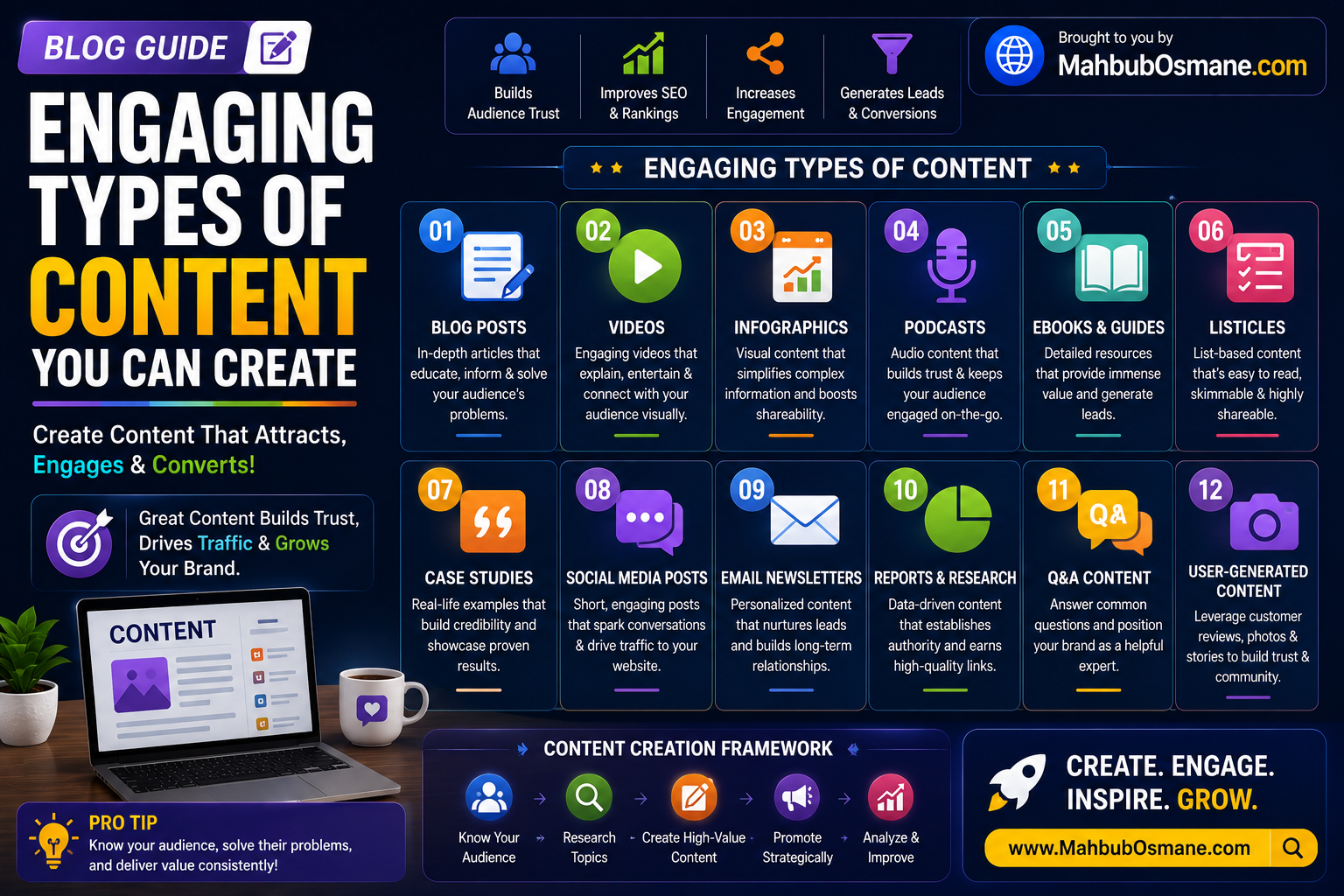
Engaging Types of Content You Can Create
In the early days of digital marketing, “content” was synonymous with blog posts. If you could write a semi-coherent 800-word article with a handful of keywords scattered throughout, you were doing great.
But the digital landscape has shifted dramatically.
Today, audiences are bombarded with a constant stream of information. Attention spans are shorter, and users are highly selective about where they spend their cognitive energy. If you rely solely on standard text posts, you are leaving a massive amount of traffic, engagement, and conversions on the table.
To stand out, you need to diversify. You must create multidimensional, highly engaging content that appeals to different learning styles, satisfies varying user intents, and stands out on crowded social feeds.
This comprehensive guide breaks down the most engaging types of content you can create, why they work, and exactly how to implement them to grow your audience and brand.
The Core Content Matrix: What Drives True Engagement?
Before diving into the specific formats, let’s establish what makes content “engaging.” Engagement isn’t just a vanity metric like pageviews; it’s defined by actions—comments, shares, saves, sign-ups, and time spent on a page.
According to data from the Content Marketing Institute, diversified content portfolios perform significantly better than single-format strategies:
| Content Type | Primary Human Needs Met | Average Engagement Lift | Best Channels |
| Visual / Infographics | Quick comprehension, ease of sharing | High shareability (up to 3x more shares on social) | Pinterest, LinkedIn, Blog Posts |
| Interactive Content | Curiosity, personalization, self-discovery | Up to 2x more conversions than static content | Websites, Landing Pages |
| Video Formats | Emotional connection, entertainment | High dwell time (80% increase in time on site) | YouTube, TikTok, Reels, Blogs |
| Audio (Podcasts) | Multi-tasking, deep-dive learning | High brand loyalty and finish rates | Spotify, Apple Podcasts, Web Players |
| Written (Deep-Dive) | Authority, educational value, search intent | High organic search traffic and backlink potential | Niche Blogs, Medium, Google |
Visual & Graphic-Heavy Content: Visualizing Complex Data
We are visual creatures. The human brain processes visual information significantly faster than plain text. If you can take a complex concept and turn it into an intuitive visual layout, you instantly win your reader’s attention.
Infographics
An infographic is a visual representation of information, data, or knowledge. It combines minimalist text, charts, and illustrations to give an easy-to-understand overview of a topic.
-
Why it works: It simplifies the complex. Instead of forcing a reader to digest 2,000 words of statistical data, a well-designed infographic tells the story in thirty seconds.
-
How to create them: You don’t need to hire an expensive graphic designer. Tools like Canva, Venngage, and Piktochart offer thousands of pre-built templates. Focus on keeping your color palette clean (no more than 3-4 colors) and your text highly concise.
“Instructographics” and Step-by-Step Diagrams
Unlike a standard infographic that focuses heavily on data points, an instructographic walks the user through a physical or digital process. It’s a visual how-to guide.
-
Why it works: It is highly actionable. Users save and pin these images for future reference, making them goldmines for organic traffic on platforms like Pinterest.
-
Best Use Cases: Recipes, quick tech setups, design rules, or workout routines.
Interactive Content: Turning Passive Scrollers into Active Participants
Static content asks your audience to read, watch, or listen. Interactive content asks your audience to participate. By shifting the user from a passive observer to an active participant, you dramatically increase their investment in your brand.
Quizzes and Assessments
From playful “Which Star Wars Character Are You?” tests to serious B2B readiness assessments, quizzes are incredibly addictive.
-
Why they work: They leverage the psychological principle of self-discovery. People love to learn about themselves and share those results with their peers.
-
How to monetize/leverage: Use the results page of your quiz as a segmented lead generation gate. For instance, if a user takes a “What’s Your Digital Marketing Score?” quiz and scores low on SEO, you can instantly redirect them to your agency’s SEO audit services.
Interactive Calculators
If your business involves numbers, budgeting, ROI, or estimates, you should build an interactive calculator.
-
Why they work: They provide immediate, highly personalized utility. A prospective homebuyer will spend minutes playing with a mortgage calculator, adjusting rates and down payments, whereas they might skim past a written article explaining mortgage math.
-
Examples to create:
-
ROI Calculators: “See how much time you save using our software.”
-
Fitness Calculators: Calorie or macronutrient calculators based on body weight and goals.
-
Budgeting Tools: Custom financial planners for specific life events.
-
Video Content: Building Immediate Trust and Connection
If a picture is worth a thousand words, a video is worth a million. Video allows your audience to see your face, hear your voice, and read your body language, accelerating the trust-building process faster than any other medium.
Short-Form Vertical Video (Reels, TikToks, YouTube Shorts)
These bite-sized, portrait-mode videos have completely changed how social media platforms distribute organic reach.
-
Why it works: The algorithms favor them heavily. Because they are short (usually 15 to 60 seconds), the barrier to consumption is incredibly low.
-
The Golden Rule: You must hook the viewer within the first 3 seconds. Use on-screen text, dynamic motion, or a compelling opening question to stop the thumb from scrolling.
Long-Form Educational Videos & Tutorials
For platforms like YouTube or self-hosted video libraries, long-form content is still king for building authority.
-
Why it works: Users head to long-form video with high intent. They want to learn how to fix a leaky sink, how to code a Python script, or how to master Facebook Ads.
-
Pro-Tip: Always pair your long-form videos with structured blog posts. You can embed the video at the top of the post, which keeps users on your webpage longer—sending positive signals to search engine algorithms.
Written Content: The Undisputed King of SEO and Authority
While flashier media formats command massive attention, written content remains the foundational backbone of the internet. If you want sustainable, free search engine traffic that keeps delivering leads years after you press publish, you must master these written formats.
Complete, Definitive Guides
A definitive guide is designed to be the absolute last resource a user needs to read on a specific topic. Instead of scratching the surface of five different sub-topics, a definitive guide dives deep into every single corner.
-
Why it works: Search engines love comprehensive resources. When a search engine sees a 3,000+ word post that thoroughly answers a user’s search query, it ranks it higher. It also acts as a natural magnet for natural backlinks from other websites.
-
How to write them: Break the post down into logical, chronological chapters. Use plenty of subheadings, bullet points, and call-out boxes so the text remains easy to scan.
Case Studies and Real-World Examples
A case study is a deep dive into a real-world project, experiment, or client success story. It takes the form of: Problem -> Solution -> Results.
-
Why it works: It provides proof. Anyone can write a theoretical “how-to” post, but showing the step-by-step actions you took to take a client from $0 to $10,000 in monthly revenue builds unmatched credibility.
-
The structure to use:
-
The Challenge: Outline the initial roadblock.
-
The Strategy: Detail the exact roadmap, tools, and steps used to address the challenge.
-
The Results: Showcase hard numbers, graphs, and screenshots proving the success.
-
Step-by-Step: How to Plan Your Content Calendar
Diversifying your content can feel overwhelming if you try to do everything at once. To prevent burnout, you need a systematic approach to planning, production, and scheduling. Follow this chronological workflow to build your roadmap:
The Art of Repurposing: Work Smarter, Not Harder
One of the biggest mistakes content creators make is treating every piece of content as a one-time event. They spend ten hours writing a brilliant blog post, share it once on social media, and then move on to the next piece.
This is a fast track to burnout.
Instead, adopt a “Create Once, Distribute Everywhere” framework. A single cornerstone piece of content can be sliced and diced into dozens of smaller, platform-specific assets.
                  [1 Core Deep-Dive Blog Post]
                               │
       ┌───────────────────────┼───────────────────────┐
       ▼                       ▼                       ▼
[1 Podcast Episode]    [3 Short-Form Videos]   [1 Detailed Infographic]
       │                       │                       │
       ▼                       ▼                       ▼
  Audio Clips            TikToks, Reels          Pinterest Pins,
 for Social Media        & YouTube Shorts        LinkedIn Slide Decks
The Repurposing Workflow in Action
Let’s trace how this works in practice. Suppose you write a comprehensive guide titled “10 Ways to Scale Your E-commerce Store in 2026.”
-
The Original Asset: A 3,000-word blog post rich with data and case studies.
-
Asset 2 (Video): You record yourself walking through the top three points from the blog post. This becomes a 10-minute YouTube video.
-
Asset 3 (Short-Form Video): You take the best 45-second tip from that video, add captions, and upload it as a Reel/Short/TikTok.
-
Asset 4 (Infographic): You turn the “10-step checklist” from the blog into a visual flowchart graphic using a Canva template.
-
Asset 5 (Email Newsletter): You draft a quick personal email sharing a story about point #4, linking back to the full blog post for the rest.
By using this ecosystem model, you maximize the mileage of every single idea you generate.
The Golden Rule of Engagement: Content that attempts to speak to everyone ends up connecting with no one. Before choosing your format, make sure you intimately understand the digital habits of your specific target audience.
Ready to Transform Your Content Into a Revenue Engine?
Creating engaging content is only half the battle—distributing it, optimizing it for search engines, and converting that traffic into paying customers requires an elite digital strategy. Whether you are aiming to dominate search rankings, scale your ad revenue, or establish a flawless digital presence, you don’t have to do it alone.
At MahbubOsmane.com, we help ambitious businesses across Saudi Arabia, the UAE, Qatar, Kuwait, the USA, the UK, Canada, Germany, Lithuania, and Bangladesh build digital systems that scale.
Why Global Brands Trust Us:
-
Elite Freelance Track Record: Over 700+ successfully completed jobs with flawless 5-star feedback on Upwork.
-
Verified Authority: Proudly featured and available for hire on Hubstaff Talent.
-
End-to-End Digital Solutions: We are your dedicated growth partners for:
-
Professional SEO & Content Writing
-
Advanced AdOps & Programmatic Setup
-
Custom Website Development & Maintenance
-
High-Converting Graphic Design & Video Editing
-
Let’s stop leaving traffic and revenue on the table. Partner with a proven team that delivers tangible ROI.
Get in Touch with Us Today:
-
📧 Email: hi@mahbubosmane.com / mahbubosmane@gmail.com
-
🌐 Web: www.MahbubOsmane.com
-
🇸🇦 Saudi Arabia Office: +966549485900 / +966553227950 (WhatsApp Available)
-
🇧🇩 Bangladesh Office: +8801716988953 (WhatsApp Available)
FAQ
What are the most engaging types of content I can create for my business?
The most engaging content types include interactive content (like quizzes and calculators), high-quality video (both short-form reels and long-form tutorials), visual data (infographics and diagrams), and deep-dive written content (comprehensive guides and data-backed case studies). The best approach is a mix that aligns with your specific audience’s preferences.
Why is content diversification important for digital marketing?
Audiences consume information differently based on their preferences, habits, and time constraints. By diversifying your content, you expand your reach across multiple channels, improve website dwell time, appeal to different learning styles, and maximize your organic visibility on search engines and social platforms.
How often should a small business publish new content?
Consistency always outperforms sheer volume. For a lean team or solo business owner, starting with one comprehensive blog post and two to three pieces of short-form content per week is highly sustainable. It is better to publish high-quality content predictably than to burn out by posting low-value updates daily.
What makes interactive content convert better than static content?
Interactive content requires active participation from the user, which triggers curiosity and a sense of personalization. Because users must input their own information to receive a tailored result—such as a calculation or quiz score—they become more invested in the outcome, leading to higher conversion rates.
Do I need professional design skills to create high-performing infographics?
Not anymore. Modern cloud-based graphic tools like Canva, Venngage, and Visme provide professional, pre-designed templates tailored for data visualization. Focus on keeping your layout clean, minimizing text blocks, and sticking to a consistent corporate color palette.
What is the ideal length for a long-form blog post to rank well on search engines?
While there is no rigid rule, studies consistently show that in-depth articles ranging between 1,500 and 3,000 words tend to perform best for organic search. Length should always be driven by depth and value—ensure every paragraph directly addresses the search intent of the reader.
How do short-form vertical videos fit into a B2B marketing strategy?
Short-form vertical videos (like LinkedIn videos, YouTube Shorts, and Reels) are excellent for high-level brand awareness, sharing quick industry insights, debunking myths, or giving behind-the-scenes glimpses of your agency operations. They serve as a powerful top-of-funnel tool to drive traffic to your longer assets.
What is the difference between an infographic and an instructographic?
An infographic focuses primarily on visualizing data, statistics, and conceptual trends. An instructographic is a visual step-by-step tutorial designed to walk a user through a physical, technical, or creative process, making it highly actionable and save-worthy.
How can an interactive calculator help generate high-quality B2B leads?
Calculators provide immediate, practical utility by solving a specific problem for a prospective client, such as calculating potential ROI, ad spend distributions, or project estimates. By placing the final calculation behind a quick email gate, you secure highly qualified leads who are actively evaluating business solutions.
What is content repurposing and why should I use it?
Content repurposing is the process of taking one core piece of content (like a comprehensive guide) and breaking it down into multiple smaller assets (such as social media graphics, video scripts, email newsletters, and slide decks). It maximizes your output value while minimizing production time and creative burnout.
How do I choose the best content formats for my specific industry?
Analyze where your ideal clients spend most of their professional time and how they consume information. B2B audiences generally respond well to case studies, white papers, LinkedIn slide decks, and calculators. B2C audiences often lean toward engaging vertical videos, interactive quizzes, and high-impact imagery.
Why are case studies considered highly effective for conversion?
Case studies shift your marketing from theoretical promises to factual proof. By mapping out a real-world project using a clear framework—detailing the initial challenge, the strategic execution, and the final data-backed results—you build immediate trust with prospects facing identical issues.
How can I prevent content creation burnout while managing a business?
The most efficient method is batch production. Instead of trying to create content every day, dedicate one specific block of time to brainstorm and write your core assets, and another separate day to record videos or design layouts. Coupling this approach with a clear content calendar keeps your pipeline predictable.
What is the best way to write a definitive guide that stands out from competitors?
To build a truly definitive guide, look at the top-ranking results for your target topic and identify what they are missing. Add unique value by including proprietary data, real-world screenshots, expert quotes, custom graphics, and actionable templates that readers cannot find anywhere else.
How can video content help lower friction in the sales pipeline?
Video humanizes your digital presence by showcasing your team’s real voices, faces, and personalities. When prospects watch educational tutorials or video case studies, they build an emotional connection with your brand before ever speaking to a sales representative, effectively shortening the sales cycle.
Should I focus more on creating new content or promoting existing assets?
A good rule of thumb is the 80/20 rule: spend 20% of your resources creating high-value content, and dedicate the remaining 80% to distributing, promoting, and repurposing it across various platforms to ensure it reaches the widest possible audience.
What metrics should I track to know if my content strategy is succeeding?
Instead of focusing solely on vanity metrics like impressions, closely track actionable indicators of deep engagement. Look at organic traffic growth, average dwell time on your pages, bounce rates, social shares, comment depth, and conversion rates on your primary calls to action.
How does professional content writing impact overall website SEO performance?
Professional content writing ensures your pages are built structurally for search algorithms and logically for human readers. It integrates proper keyword mapping, semantic phrasing, clean header tags, and internal link structures that help search engines crawl your site and index you higher for commercial keywords.
Internal Resources
-
Deepen Your Knowledge on Search Strategy: For a complete breakdown of infrastructure modifications and content targeting rules that engines favor, explore our detailed resource: What is SEO? The Ultimate Guide to Search Engine Optimization.
-
Execute a Clean Optimization Strategy: When you are ready to implement systemic keyword mappings and technical safety standards on your site, discover how our targeted White Hat SEO Service delivers transparent organic growth.
-
Scale Your Brand Messaging Infrastructure: If you want to train your internal team or master the foundations of semantic keyword formatting and user alignment, read our breakdown on the Content Writing Course to Unlock Your Writing Potential.
External Resources
-
Review Global B2B and B2C ROI Benchmarks: To see the exact breakdowns of how modern marketing investments are moving toward interactive tools, social commerce channels, and short-form video ecosystems, check out the authoritative HubSpot Blog: The Top Marketing Channels of 2026.
-
Track Global Content Operations Trends: For insights on building integrated multi-platform governance strategies and designing frameworks that capture audience attention spans, reference the data published by the Content Marketing Institute.
-
Analyze Core Visual Engagement Data: To look closer at industry metrics detailing how visual charts, templates, and high-impact layout designs lift traffic metrics by the numbers, review the statistical study on Digitaloft: 50 Content Marketing Statistics You Need to Know.
About the Author
Mahbub Osmane is a digital marketing expert who helps businesses build effective online strategies, including selecting and managing the right social media channels for growth. With hands-on experience across platforms and markets, Mahbub shares practical, actionable insights to help businesses connect with their audience and grow their brand presence.
Contact information Email: hi@mahbubosmane.com Website: https://mahbubosmane.com/ Mobile: +966 54 948 5900 (KSA) / +880 1716 988953 (BD) Address: 2282 7284 Al Malawi Southern 1, As Sulimaniyah Dist, Makkah 24236, Saudi Arabia