
How to Make a Career Plan: A Complete Step-by-Step Guide to Building a Successful Career
Choosing a career is one of the most important decisions you will make in your life. However, choosing a profession is only the beginning. To build a successful and satisfying career, you need a clear direction, realistic goals, useful skills, continuous learning, and a plan for turning your goals into action.
Many people spend years working without knowing where they want their career to go. They may change jobs frequently, follow trends without understanding whether those careers suit them, or pursue qualifications that do not contribute meaningfully to their long-term goals.
A career plan can help prevent these problems.
A good career plan gives you a roadmap for where you want to go professionally and what you need to do to get there. It does not mean that you must follow one fixed path for the rest of your life. Careers change, industries evolve, personal circumstances change, and new opportunities appear. Therefore, an effective career plan should be specific enough to provide direction while remaining flexible enough to adapt.
Career planning generally involves understanding yourself, exploring career options, setting goals, identifying skill gaps, gaining relevant experience, building professional relationships, and regularly reviewing your progress. Career exploration resources such as CareerOneStop also emphasize assessing interests, skills, work values, and career information before choosing a direction.
This guide explains how to make a career plan from the beginning and how to turn that plan into practical action.
What Is a Career Plan?
A career plan is a structured roadmap that outlines your professional goals and the steps you intend to take to achieve them.
It can include:
- Your career interests
- Your strengths and weaknesses
- Your preferred industries
- Your target job roles
- Your education requirements
- Your professional skills
- Your certifications
- Your work experience goals
- Your income objectives
- Your networking strategy
- Your short-term goals
- Your long-term goals
- Your professional development activities
- Your backup career options
For example, someone interested in digital marketing might create a career plan that begins with learning SEO, content marketing, analytics, and paid advertising. They might then build practical projects, obtain an entry-level position, specialize in SEO, develop leadership skills, become an SEO manager, and eventually establish their own agency.
The exact path will vary from person to person.
The important thing is to create a direction based on your interests, abilities, values, opportunities, and goals.
Why Is Career Planning Important?
Without a plan, it is easy to become reactive.
You may accept whichever job becomes available, study whatever your friends are studying, or change careers because someone told you a particular industry is profitable.
A career plan helps you make decisions intentionally.
Career planning gives you direction
When you know what you are working toward, it becomes easier to decide which opportunities are worth pursuing.
For example, if your long-term goal is to become a software engineer, you can evaluate courses, internships, projects, certifications, and job opportunities based on whether they move you closer to that goal.
It helps you identify skill gaps
Your desired career may require skills you do not currently possess.
Career research can help you compare your current abilities with the skills employers commonly expect.
This allows you to identify exactly what you need to learn instead of studying randomly.
It improves decision-making
Career planning provides a framework for evaluating job offers, education programs, career changes, and professional opportunities.
Instead of asking only, “Does this opportunity pay well?” you can ask:
- Does it support my long-term goals?
- Will I learn valuable skills?
- Does it provide relevant experience?
- Will it improve my professional network?
- Does the work environment suit me?
- Is there room for advancement?
It increases motivation
Large career goals can seem overwhelming.
Breaking them into smaller milestones makes them more manageable.
Instead of saying, “I want to become a successful marketing professional,” you can establish smaller goals such as:
- Complete a marketing course.
- Learn keyword research.
- Build three sample projects.
- Improve communication skills.
- Create a professional portfolio.
- Apply for relevant jobs.
- Gain one year of practical experience.
- Specialize in a specific area.
Small achievements gradually build toward larger goals.
Start With Self-Assessment
The first step in creating a career plan is understanding yourself.
A career should not be selected solely because it is popular or pays well. Your interests, strengths, values, personality, preferred working environment, and lifestyle goals should also influence your decision.
Career exploration tools commonly encourage people to examine interests, skills, and work values when identifying potential career directions.
Identify your interests
Ask yourself:
- What subjects do I enjoy learning about?
- What activities do I naturally enjoy?
- What problems do I enjoy solving?
- What topics can I discuss for hours?
- What type of work makes me curious?
- What activities make me lose track of time?
Your interests can provide clues about suitable career areas.
For example:
Someone who enjoys writing may explore content writing, journalism, copywriting, technical writing, communications, or marketing.
Someone who enjoys analyzing information may explore data analysis, finance, research, business intelligence, or technology.
Someone who enjoys helping people may consider education, consulting, customer success, human resources, healthcare, social services, or training.
Interest does not guarantee career success, but it can help identify areas worth exploring.
Identify your strengths
Make a list of things you are good at.
Your strengths might include:
- Communication
- Writing
- Leadership
- Mathematics
- Problem-solving
- Research
- Sales
- Organization
- Creativity
- Technology
- Public speaking
- Relationship building
- Strategic thinking
- Project management
- Analytical thinking
Do not focus only on academic abilities.
Your personal and workplace skills can be equally important.
Identify your weaknesses
A career plan should be honest.
Ask yourself:
- Which skills do I lack?
- What tasks do I struggle with?
- What feedback have I received from teachers, managers, clients, or colleagues?
- Which professional skills do I need to improve?
- What habits are limiting my progress?
Weaknesses are not permanent.
The purpose of identifying them is to create an improvement plan.
Identify your work values
Your career should fit your priorities.
Some people value high income. Others prioritize flexibility, stability, creativity, independence, social impact, leadership, learning opportunities, or work-life balance.
Ask yourself:
- Do I prefer stability or variety?
- Do I want to work independently or in a team?
- Do I prefer remote work, office work, or hybrid work?
- How important is income to me?
- How important is flexibility?
- Do I want leadership responsibility?
- Do I want a predictable schedule?
- Do I want to work for a large organization or a small company?
- Do I want to build my own business?
Understanding these values can help you avoid choosing a career that looks attractive but does not fit your lifestyle.
Determine What Kind of Career You Want
Once you understand yourself better, start exploring possible career directions.
Do not immediately choose one job title.
Instead, create a broader list.
For example, someone interested in technology might consider:
- Software development
- Cybersecurity
- Data analysis
- Cloud computing
- Artificial intelligence
- UX design
- Product management
- IT support
- Technical consulting
Then research each option.
Career research should include information such as typical responsibilities, required education, skills, experience, certifications, salary information, employment trends, and related occupations. CareerOneStop’s occupation profiles, for example, provide information across these areas for hundreds of occupations.
Research the Job Market
Do not build your career plan based only on assumptions.
Research the market.
Look at current job advertisements and examine what employers are requesting.
Pay attention to:
- Common job titles
- Required qualifications
- Preferred qualifications
- Technical skills
- Soft skills
- Experience requirements
- Certifications
- Salary ranges
- Industry sectors
- Geographic demand
- Remote opportunities
- Career progression
Job advertisements can provide valuable information about the skills employers actually want.
For example, if you want to become a digital marketing specialist and repeatedly see employers requesting SEO, Google Analytics, content strategy, paid advertising, reporting, and communication skills, those areas should become part of your development plan.
Choose a Primary Career Direction
After researching different possibilities, narrow your options.
You do not necessarily need to identify one perfect career immediately.
Instead, choose:
- A primary career direction
- One or two alternative directions
- A short-term target
- A long-term target
For example:
Primary direction: Digital marketing
Specialization: SEO
Short-term goal: Obtain an SEO executive position
Medium-term goal: Become an SEO specialist or strategist
Long-term goal: Become an SEO manager, consultant, or agency owner
This creates direction without forcing you to predict your entire life.
Set Career Goals
One of the most important parts of career planning is goal setting.
A goal should describe a specific result you want to achieve.
Instead of saying:
“I want to improve my career.”
Say:
“I want to become a digital marketing specialist within the next three years by developing SEO, content marketing, analytics, and paid advertising skills and gaining practical experience.”
A useful goal should be:
- Specific
- Measurable
- Achievable
- Relevant
- Time-bound
These principles are commonly known as SMART goals.
Short-term career goals
Short-term goals usually cover the next few months to approximately one or two years.
Examples include:
- Complete a professional course.
- Learn a new software platform.
- Improve communication skills.
- Create a professional portfolio.
- Update your resume.
- Apply for relevant jobs.
- Obtain an internship.
- Earn a certification.
- Attend industry events.
- Build professional connections.
Medium-term career goals
Medium-term goals may cover approximately two to five years.
Examples include:
- Become a senior employee.
- Move into a specialist role.
- Take responsibility for projects.
- Increase your income.
- Develop management skills.
- Build a strong professional reputation.
- Move into a higher-level organization.
- Transition into a new specialization.
Long-term career goals
Long-term goals may cover five, ten, or more years.
Examples include:
- Become a department manager.
- Become an executive.
- Become an industry specialist.
- Start a business.
- Become an independent consultant.
- Build a professional brand.
- Reach a specific income level.
- Lead a large team.
- Become an expert in a specialized field.
Long-term goals do not need to be perfectly predictable.
They should provide direction.
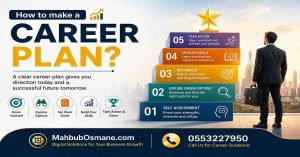
Create a Career Roadmap
Once your goals are defined, turn them into a roadmap.
For example:
Current position
Beginner with basic knowledge
↓
Next stage
Complete foundational education and training
↓
Practical stage
Build projects and gain hands-on experience
↓
Entry-level stage
Obtain an internship or junior position
↓
Development stage
Develop specialized skills and take responsibility for projects
↓
Advanced stage
Move into a senior or specialist role
↓
Leadership stage
Develop management and strategic skills
↓
Long-term stage
Become a manager, consultant, entrepreneur, or recognized specialist
This approach makes your career goal easier to understand.
Identify the Skills You Need
A career plan becomes useful when it identifies specific skills.
Divide your skills into several categories.
Technical skills
These are skills directly related to your profession.
Examples include:
- Programming
- SEO
- Accounting
- Graphic design
- Data analysis
- Video editing
- Financial modeling
- Project management
- Digital advertising
- Engineering software
Communication skills
Almost every career requires communication.
Develop skills such as:
- Writing
- Speaking
- Presentation
- Listening
- Negotiation
- Professional email communication
- Client communication
Problem-solving skills
Employers value people who can identify problems and develop practical solutions.
Improve your ability to:
- Analyze situations
- Identify root causes
- Compare alternatives
- Make decisions
- Test solutions
- Learn from mistakes
Leadership skills
Leadership is not only for managers.
You can begin developing leadership by:
- Taking responsibility
- Organizing projects
- Helping colleagues
- Communicating clearly
- Making decisions
- Handling conflicts
- Managing deadlines
Career competency models also identify areas such as teamwork, planning, organizing, creative thinking, problem-solving, communication, adaptability, professionalism, and lifelong learning as important workplace competencies.
Conduct a Skill Gap Analysis
A skill gap analysis compares where you are now with where you need to be.
Create three categories:
Skills I already have
List your current abilities.
Skills I need to improve
List skills where you have basic knowledge but need more practice.
Skills I need to learn
List skills that you currently do not possess.
For example:
Target career: SEO Specialist
Already have:
- Basic SEO knowledge
- Writing
- Keyword research
Need to improve:
- Technical SEO
- Analytics
- SEO reporting
- Content strategy
Need to learn:
- Advanced technical auditing
- Structured data
- Automation
- Advanced SEO tools
Now your career plan becomes much more practical.
Build a Learning Plan
After identifying skill gaps, determine how you will close them.
Your learning plan might include:
- University education
- Professional courses
- Online training
- Certifications
- Books
- Workshops
- Webinars
- Mentorship
- Practical projects
- Internships
- Job shadowing
- Industry events
Career development resources also emphasize professional development, training, continuing education, professional groups, reading, job shadowing, and certifications as ways to broaden knowledge and skills.
However, do not collect certifications simply to make your resume longer.
Choose education that supports your career objective.
Gain Practical Experience
Knowledge is valuable, but experience makes your skills more credible.
If you are a student or beginner, look for ways to gain practical experience.
You can:
- Complete internships.
- Volunteer.
- Work on personal projects.
- Freelance.
- Participate in competitions.
- Help small businesses.
- Build sample projects.
- Contribute to professional communities.
- Work part-time in a related field.
For example, someone who wants to become a web developer can create websites.
Someone interested in marketing can build sample campaigns.
Someone interested in accounting can practice financial reporting.
Someone interested in graphic design can create a portfolio.
Practical experience gives you evidence that you can apply what you have learned.
Build a Professional Portfolio
A portfolio can be extremely valuable, particularly for careers where your work can be demonstrated.
A portfolio may include:
- Projects
- Case studies
- Designs
- Articles
- Websites
- Marketing campaigns
- Research
- Presentations
- Data analysis
- Programming projects
- Videos
- Client work
Do not simply list what you did.
Explain the problem, your approach, and the result.
For example:
Instead of:
“Worked on SEO.”
Write:
“Conducted keyword research, improved on-page optimization, created a content structure, and monitored organic traffic growth.”
Specific evidence is more persuasive than vague statements.
Create a Strong Resume
Your resume should support your career goal.
Avoid creating one generic resume for every possible job.
Instead, tailor your resume toward your target role.
Highlight:
- Relevant experience
- Relevant skills
- Achievements
- Projects
- Education
- Certifications
- Professional development
When describing experience, focus on results rather than simply listing responsibilities.
CareerOneStop recommends emphasizing relevant accomplishments and using specific information such as numbers, percentages, budgets, or measurable outcomes when possible.
For example:
Weak:
“Managed social media accounts.”
Stronger:
“Managed social media campaigns across multiple platforms and increased audience engagement through targeted content and performance analysis.”
The second statement communicates more value.
Develop Your Professional Online Presence
Today, your professional identity can extend beyond your resume.
Depending on your industry, consider building:
- A professional LinkedIn profile
- A personal website
- An online portfolio
- Professional social media profiles
- A GitHub profile
- A professional writing portfolio
- Industry-specific profiles
Your online presence should communicate:
- Who you are
- What you do
- What skills you have
- What results you have achieved
- What type of opportunities you are seeking
Keep your information consistent across platforms.
Build a Professional Network
Networking is an important part of career development.
Networking does not mean asking everyone for a job.
It means developing genuine professional relationships.
You can network through:
- Industry conferences
- Professional associations
- Workshops
- Training programs
- Alumni communities
- Local business events
- Online communities
- Professional meetups
- Mentorship programs
When networking, focus on learning and relationship building.
Ask professionals about:
- Their career journey
- Required skills
- Industry challenges
- Career opportunities
- Common mistakes
- Recommended learning resources
Informational interviews can be particularly useful when exploring career options. CareerOneStop’s career-change guidance, for example, recommends conducting informational interviews as part of researching potential occupations.
Find a Mentor
A mentor can help you see your career from a more experienced perspective.
A good mentor can help you:
- Identify weaknesses
- Evaluate opportunities
- Develop professional skills
- Avoid common mistakes
- Understand industry expectations
- Build confidence
- Improve decision-making
Your mentor does not have to work in exactly the same organization or position you want.
The most important thing is relevant experience and willingness to provide constructive guidance.
Plan Your Job Search
If your career plan includes finding employment, create a structured job-search strategy.
Determine:
- Which positions you will apply for
- Which companies interest you
- Which industries you want to target
- Where you will search
- How many applications you will submit each week
- How you will follow up
- How you will prepare for interviews
Do not measure success only by the number of applications.
Measure the entire process.
For example:
- Applications submitted
- Interviews received
- Interviews completed
- Networking conversations
- Skills improved
- Resume improvements
- Portfolio projects completed
This helps you identify where your job search needs improvement.
Prepare for Interviews
Career planning should include interview preparation.
Research common questions for your target profession.
Prepare examples demonstrating:
- Problem-solving
- Leadership
- Teamwork
- Communication
- Adaptability
- Technical ability
- Professional achievements
- Handling difficult situations
Use real examples whenever possible.
A useful approach is to explain:
Situation → Task → Action → Result
This gives your answers structure and helps employers understand the value you created.
Plan Your Financial Goals
Career planning should not ignore money.
Your career affects your financial future.
Consider:
- Desired income
- Cost of education
- Certification costs
- Relocation costs
- Transportation
- Professional equipment
- Emergency savings
- Retirement planning
- Family responsibilities
- Business investment
Your financial goals may influence your career choices.
For example, someone supporting a family may prefer a stable job while developing a side business gradually.
Someone early in their career may accept a lower starting salary in exchange for strong learning opportunities.
The right decision depends on individual circumstances.
Consider Work-Life Balance
A successful career is not only about salary or job title.
Consider the life you want outside work.
Ask:
- How many hours do I want to work?
- Do I want flexible working arrangements?
- How important is location?
- Do I want to travel for work?
- How much stress am I comfortable with?
- How much time do I want for family?
- Do I want to work weekends?
- Do I prefer predictable or changing schedules?
A career that pays well but consistently conflicts with your priorities may not be the right career for you.
Create a One-Year Career Plan
A one-year plan can make a long-term career objective easier to execute.
First few months
Focus on:
- Self-assessment
- Career research
- Goal setting
- Identifying skill gaps
- Selecting learning resources
Following months
Focus on:
- Skill development
- Practical projects
- Certifications
- Portfolio development
- Networking
Later in the year
Focus on:
- Job applications
- Interviews
- Freelancing
- Professional experience
- Performance evaluation
- Career adjustment
At the end of the year, review your progress and create the next year’s plan.
Create a Five-Year Career Plan
A five-year plan provides a broader perspective.
You might define:
Year one: Build foundational skills.
Year two: Gain professional experience.
Year three: Develop specialization.
Year four: Take on larger responsibilities.
Year five: Move into a senior, management, consulting, or entrepreneurial role.
Do not treat this as a rigid contract.
A five-year plan is a direction, not a guarantee.
Create a Career Backup Plan
Good career planning includes alternatives.
Your primary career may not develop exactly as expected.
You may encounter:
- Industry changes
- Economic downturns
- Job losses
- Changing personal priorities
- Technology disruption
- Relocation
- Unexpected opportunities
Create alternative options.
For example:
Primary: SEO specialist
Alternative: Content strategist
Alternative: Digital marketing consultant
These roles may share transferable skills.
A backup plan gives you flexibility without abandoning your overall professional direction.
Review Your Career Plan Regularly
Your career plan should not be created once and forgotten.
Review it regularly.
A monthly review can focus on immediate actions.
A quarterly review can examine progress.
An annual review can reconsider your broader career direction.
Ask yourself:
- What did I accomplish?
- What did I learn?
- Which goals remain incomplete?
- What skills improved?
- What opportunities appeared?
- What mistakes did I make?
- What feedback did I receive?
- Has my career interest changed?
- What should I stop doing?
- What should I start doing?
- What should I continue doing?
Career development is an ongoing process. Lifelong learning models emphasize continuously developing skills, responding to changing work demands, and using feedback to improve.
Do Not Be Afraid to Change Your Career Plan
One of the biggest misconceptions about career planning is that changing your plan means you failed.
It does not.
Your first career choice may not be right.
You may discover a new industry.
You may develop an unexpected skill.
You may find that a particular profession does not match your personality.
You may discover a business opportunity.
Changing direction can be a sign of learning.
The key is to make changes based on evidence rather than impulsive decisions.
Before making a major career change, research the new field, understand the required skills, talk to people working in that industry, and evaluate the financial and professional consequences.
Common Career Planning Mistakes
Choosing a career only because of salary
Money matters, but salary should not be the only consideration.
A high-paying career that does not match your abilities, interests, or preferred lifestyle may become difficult to sustain.
Following other people’s expectations
Your family, friends, teachers, or colleagues may have opinions about your career.
Their advice can be valuable, but ultimately you must live with your professional decisions.
Trying to plan your entire life
You do not need to know exactly what your career will look like 30 years from now.
Focus on the next meaningful step.
Ignoring skill development
A degree alone may not be enough for many modern careers.
Develop practical and transferable skills alongside formal education.
Collecting too many certifications
Certifications can be useful, but they should support your career objective.
Quality is more important than quantity.
Avoiding practical experience
Reading about a career is different from doing the work.
Gain practical experience whenever possible.
Having no measurable goals
“I want to be successful” is not a measurable career goal.
Define what success means to you.
Never reviewing the plan
Industries change.
Your interests change.
Your circumstances change.
Review your plan and update it.
A Simple Career Planning Template
You can create your own career plan using the following structure.
Current situation
- Current education:
- Current job:
- Current experience:
- Current skills:
- Current strengths:
- Areas for improvement:
Career interests
- Industries I am interested in:
- Roles I am interested in:
- Problems I enjoy solving:
- Activities I enjoy:
Primary career goal
- Target role:
- Target industry:
- Desired level:
- Target timeline:
Skills required
- Technical skills:
- Communication skills:
- Leadership skills:
- Analytical skills:
- Other professional skills:
Skill gaps
- Skills I need to improve:
- Skills I need to learn:
- Experience I need:
Learning plan
- Courses:
- Books:
- Certifications:
- Mentorship:
- Practical projects:
Experience plan
- Internship:
- Freelance work:
- Volunteer work:
- Personal projects:
- Current employment:
Networking plan
- Professionals to connect with:
- Events to attend:
- Professional communities:
- Mentors to approach:
Career goals
- Short-term:
- Medium-term:
- Long-term:
Financial goals
- Target income:
- Education budget:
- Career investment:
- Savings target:
Review schedule
- Monthly review:
- Quarterly review:
- Annual review:
How to Make Your Career Plan More Realistic
A career plan should challenge you without becoming unrealistic.
One way to improve your plan is to divide every major objective into smaller actions.
For example:
Goal: Become a digital marketing specialist.
Instead of leaving the goal as a statement, create actions:
- Learn SEO fundamentals.
- Study keyword research.
- Learn analytics.
- Practice content optimization.
- Create sample projects.
- Build a portfolio.
- Improve communication.
- Connect with industry professionals.
- Apply for relevant positions.
- Track interview performance.
- Continue professional development.
This converts an abstract ambition into an actionable roadmap.
Focus on Transferable Skills
Transferable skills are useful across multiple careers.
Examples include:
- Communication
- Leadership
- Research
- Problem-solving
- Project management
- Customer service
- Sales
- Writing
- Data analysis
- Teamwork
- Time management
- Adaptability
Developing transferable skills gives you more career flexibility.
For example, strong communication and project management skills can be useful in marketing, consulting, technology, sales, operations, and management.
Learn to Measure Career Progress
Career progress should not be measured only by job titles.
You can measure:
- Skills acquired
- Projects completed
- Income growth
- Responsibilities gained
- Certifications achieved
- Professional relationships developed
- Portfolio quality
- Leadership experience
- Job satisfaction
- Industry knowledge
- Professional reputation
Sometimes you may remain in the same job title while gaining valuable experience and responsibility.
That can still represent meaningful career growth.
Use Technology to Support Your Career Plan
Modern technology can make career planning easier.
You can use digital tools to:
- Track goals
- Research careers
- Compare job descriptions
- Organize learning
- Build portfolios
- Track applications
- Practice interviews
- Manage networking contacts
- Monitor professional development
Artificial intelligence tools can also help brainstorm career options, analyze job descriptions, identify skill gaps, improve resumes, practice interview questions, and create learning plans.
However, AI should support your decision-making rather than replace it.
You should verify important career information and combine AI-generated suggestions with research, professional advice, and real-world experience.
Build a Personal Career Development System
Instead of thinking about career planning as a document, think of it as a system.
Your system can have five parts:
Direction
Where do I want to go?
Skills
What do I need to learn?
Experience
How will I demonstrate my abilities?
Relationships
Who can help me learn and discover opportunities?
Review
Am I moving in the right direction?
This simple framework can help you stay focused.
Career Planning for Students
Students should begin career planning before graduation.
You do not need to know your exact profession immediately.
Start by:
- Exploring industries
- Identifying interests
- Developing useful skills
- Talking to professionals
- Completing internships
- Participating in projects
- Building a portfolio
- Learning communication skills
- Researching job requirements
The earlier you begin exploring possibilities, the more time you have to experiment.
Career Planning for Fresh Graduates
Fresh graduates often face the challenge of having qualifications but limited practical experience.
Focus on:
- Building a strong resume
- Developing practical skills
- Creating projects
- Completing internships
- Networking
- Improving interview skills
- Applying strategically
- Accepting entry-level opportunities that provide meaningful experience
Your first job does not have to be your final career destination.
It should ideally help you develop skills and experience for the next stage.
Career Planning for Working Professionals
If you already have a job, your career plan can focus on advancement.
Ask:
- What position do I want next?
- What skills does that role require?
- What results do successful people in that role achieve?
- What responsibilities can I take on now?
- What training would help me?
- Who can mentor me?
- What projects can demonstrate my ability?
You can then create a development plan around these questions.
Career Planning for Career Changers
Changing careers requires additional research.
Start by identifying transferable skills from your current profession.
For example, a sales professional may have transferable skills in:
- Communication
- Negotiation
- Customer relationships
- Business development
- Presentation
- Persuasion
Those skills may transfer into marketing, account management, consulting, recruiting, or business development.
Research your target occupation and identify the additional skills you need.
Career-change guidance commonly recommends assessing existing skills, researching new occupations, conducting informational interviews, targeting resumes, and developing relevant professional connections.
Career Planning for Entrepreneurs
Entrepreneurs also benefit from career planning.
Your plan might include:
- Developing business skills
- Learning sales
- Learning marketing
- Understanding finance
- Building a network
- Developing leadership
- Finding mentors
- Building a customer base
- Creating systems
- Hiring employees
- Expanding into new markets
Entrepreneurship is itself a career path, but it requires continuous learning and adaptation.
The Most Important Principle: Take Action
A perfect career plan is useless if you never execute it.
You do not need to have everything figured out before taking the first step.
Start with one action.
Complete one course.
Talk to one professional.
Build one project.
Apply for one relevant position.
Improve one skill.
Update your resume.
Attend one industry event.
The objective is progress.
Over time, small actions compound into meaningful career development.
Final Thoughts
Creating a career plan is not about predicting your entire professional future.
It is about creating direction.
A strong career plan starts with understanding yourself. You need to identify your interests, strengths, weaknesses, values, and preferred working environment. Then you need to research potential careers, understand market requirements, choose a direction, set realistic goals, identify skill gaps, gain experience, build professional relationships, and continuously evaluate your progress.
Your career plan should be flexible.
The world of work changes. Industries evolve. Technology creates new opportunities. Job requirements change. Your own interests and priorities may also change.
Therefore, do not be afraid to update your plan.
The most successful career strategy is not necessarily the one that predicts everything correctly. It is the one that helps you make better decisions, develop valuable skills, recognize opportunities, and continue moving forward.
Start by asking yourself three simple questions:
Where am I now?
Where do I want to go?
What do I need to do next?
Once you can answer those questions honestly, you have the foundation for a meaningful career plan.
Your career is a long journey, not a single decision. Build your plan, take consistent action, learn from experience, adjust when necessary, and keep developing yourself.
The clearer your direction and the stronger your commitment to continuous learning, the better prepared you will be to build a career that supports both your professional ambitions and the life you want to create.
Ready to Turn Google Ranking Factors Into Real Business Growth?
Understanding Google ranking factors is only the first step. The real advantage comes from knowing how to translate those factors into a measurable SEO and digital marketing strategy that improves visibility, attracts qualified visitors, generates leads, and supports long-term business growth.
At MahbubOsmane.com, we help ambitious businesses build stronger digital foundations and compete more effectively in search and across digital channels. Our expertise covers Professional SEO, AdOps, Content Writing, Website Development, Graphic Design, Video Editing, and complete Digital Marketing services.
Our approach combines strategic planning, technical execution, high-quality content, conversion-focused websites, performance marketing, and continuous optimization. Whether your business is targeting customers in Saudi Arabia, the UAE, Qatar, Kuwait, the USA, the UK, Canada, Germany, Lithuania, or Bangladesh, we can develop a digital strategy around your market, audience, competition, and business objectives.
Why Businesses Choose MahbubOsmane.com
We bring an established freelance track record to every project. Our team has completed 700+ jobs with 5-star feedback on Upwork, demonstrating years of hands-on experience working with businesses and delivering digital marketing solutions. We are also available through Hubstaff Talent, giving international businesses another trusted channel for discovering and working with our remote digital professionals.
Our goal is not simply to increase website traffic. We focus on building sustainable digital assets and marketing systems that can contribute to visibility, qualified leads, customer acquisition, brand authority, and revenue growth.
Our Professional Digital Services
Professional SEO — Technical SEO, on-page SEO, off-page SEO, local SEO, eCommerce SEO, keyword research, content strategy, SEO audits, Google Search visibility, and ongoing optimization.
AdOps & Performance Marketing — Google Ads, Meta Ads, PPC management, campaign optimization, conversion-focused advertising, tracking, reporting, and performance improvement.
Content Writing — SEO content, website copy, blog articles, landing-page content, business content, product content, and conversion-focused copywriting.
Website Development — Professional, responsive, user-friendly websites designed with performance, usability, SEO, security, and business objectives in mind.
Graphic Design — Business graphics, social media creatives, advertising designs, branding materials, website graphics, banners, and other visual assets.
Video Editing — Professional video editing for marketing campaigns, social media, promotional content, YouTube, advertisements, and business communications.
Digital Marketing — Integrated digital marketing strategies designed to connect SEO, paid advertising, content, websites, social media, creative assets, and conversion optimization into one cohesive growth system.
Let’s Build Your Next Digital Growth Strategy
If your website is struggling to rank, your advertising campaigns are not delivering the expected returns, your content is not generating leads, or your digital presence needs a complete transformation, now is the right time to take action.
Tell us about your business, your target market, your current challenges, and your growth goals. We will help you identify the right digital marketing priorities and create a practical strategy around them.
Whether you are a growing company in Saudi Arabia or the GCC, an established business in the USA, UK, Canada, Germany, or Lithuania, or a company operating in Bangladesh, MahbubOsmane.com is ready to become your long-term digital growth partner.
Start a Conversation With Our Team
Saudi Arabia — WhatsApp available:
+966 54 948 5900 / +966 55 322 7950
Bangladesh — WhatsApp available:
+880 1716 988953
Email:
hi@mahbubosmane.com / mahbubosmane@gmail.com
Website:
www.MahbubOsmane.com
Ready to improve your search visibility, strengthen your digital presence, and turn more online opportunities into business results? Contact MahbubOsmane.com today and let’s build a strategy designed around your business goals.
Frequently Asked Questions About Google Ranking Factors
What are Google ranking factors?
Google ranking factors are signals and characteristics that Google’s search systems may use to determine which pages should appear for a particular search query and in what order. These can include content relevance, helpfulness, page experience, links, technical accessibility, mobile usability, and many other signals. Google does not publish a single complete list of all ranking factors, and the importance of individual signals can vary depending on the search.
How many Google ranking factors are there?
There is no official fixed number of Google ranking factors. Google’s search systems use many signals and systems to evaluate pages, and these systems are continuously updated. Instead of focusing on a specific number of ranking factors, businesses should concentrate on creating useful content, maintaining a technically healthy website, satisfying search intent, building authority, and providing a strong user experience.
Is high-quality content still important for Google rankings?
Yes. High-quality content remains an important part of successful SEO. Content should provide useful, original, relevant, accurate, and sufficiently comprehensive information for the searcher’s needs. Simply producing a large quantity of articles is not enough. Businesses should focus on creating content that genuinely helps users solve problems, answer questions, compare options, or make informed decisions.
Does keyword usage affect Google rankings?
Keywords remain useful because they help search engines understand the subject and relevance of a page. However, effective SEO is not about repeatedly inserting the same keyword into a page. Businesses should naturally use relevant terms, related concepts, headings, titles, descriptions, and supporting information while keeping the content readable and useful. Keyword stuffing can create a poor experience and is not a sustainable SEO strategy.
How important is search intent for SEO?
Search intent is extremely important because successful search results should satisfy what users are actually trying to accomplish. A person searching for “how to create a career plan” wants educational information, while someone searching for “SEO agency in Riyadh” may be looking for a service provider. Your content should match the intent behind the target query rather than simply targeting a keyword.
Do backlinks still matter for Google rankings?
Links can still be an important part of SEO because they can help search engines discover pages and understand relationships between websites and content. However, the quality and relevance of links are more important than simply accumulating a large number of backlinks. Businesses should focus on earning relevant, trustworthy links through useful content, digital PR, partnerships, industry resources, and genuine authority-building activities.
Can a website rank on Google without backlinks?
Yes, it is possible for pages to rank without having a large backlink profile, particularly for less competitive queries or when the content strongly satisfies search intent. However, backlinks can become more important in competitive industries and markets. A strong SEO strategy should not depend entirely on links but should combine content quality, technical SEO, relevance, authority, and user experience.
Does website speed affect Google rankings?
Website performance can influence search visibility and user experience. Google has page experience systems and Core Web Vitals that help evaluate aspects of loading performance, responsiveness, and visual stability. Improving website speed can also reduce frustration for visitors and potentially improve engagement and conversions. However, speed should be viewed as one part of a broader SEO strategy rather than the only ranking factor.
What are Core Web Vitals?
Core Web Vitals are a set of user-experience metrics used to assess important aspects of webpage performance. They focus on loading performance, interactivity, and visual stability. The current Core Web Vitals include Largest Contentful Paint, Interaction to Next Paint, and Cumulative Layout Shift. Businesses should monitor these metrics and work to provide a fast, responsive, and stable experience across devices.
Does mobile-friendliness affect Google rankings?
Mobile usability is important because Google primarily uses the mobile version of website content for indexing and ranking. A website should therefore work properly on smartphones and tablets, provide readable text, offer usable navigation, and make important content accessible on smaller screens. A poor mobile experience can also negatively affect conversions even when the website receives search traffic.
Does HTTPS help a website rank higher?
HTTPS provides encrypted communication between a website and its visitors and is an important part of website security. Google has also identified HTTPS as a ranking signal. Although switching from HTTP to HTTPS alone is unlikely to transform a website’s rankings, businesses should use HTTPS as part of a secure and technically sound website infrastructure.
How does technical SEO affect Google rankings?
Technical SEO helps search engines crawl, understand, index, and access a website effectively. Important areas include site architecture, crawlability, indexability, canonicalization, XML sitemaps, redirects, structured data, mobile usability, website performance, and security. Technical problems can prevent otherwise excellent content from performing properly in search results.
What is on-page SEO?
On-page SEO involves optimizing elements within your website to make pages more relevant, understandable, useful, and accessible to both users and search engines. It can include titles, headings, content structure, internal links, URLs, images, metadata, keyword relevance, search intent, and overall content quality. Effective on-page SEO combines optimization with a strong user experience.
How important are title tags for SEO?
Title tags help communicate the subject of a webpage to search engines and users. A clear and relevant title can improve how your page is understood and can influence whether users choose your result in the search results. Titles should accurately describe the page and naturally incorporate the primary topic when appropriate rather than being written solely to manipulate rankings.
Do meta descriptions directly affect Google rankings?
Meta descriptions are not generally considered a direct Google ranking factor. However, they can influence how a search result is presented and may affect whether users decide to click on it. A compelling, accurate meta description can therefore support organic search performance indirectly by making the result more appealing to relevant searchers.
Does internal linking help SEO?
Yes. Internal linking can help search engines discover and understand pages within a website while also helping users navigate related information. A well-planned internal linking structure can distribute contextual relevance throughout the website and help important pages receive appropriate visibility. Links should be useful and naturally connected to the surrounding content.
Does domain age affect Google rankings?
Domain age by itself is not a reliable shortcut to higher Google rankings. An older domain may have accumulated useful content, links, brand recognition, and other signals over time, but simply owning a domain for many years does not automatically make it authoritative. A newer website can compete successfully by building high-quality content, technical quality, relevance, and genuine authority.
Does social media activity directly improve Google rankings?
Social media signals such as likes, shares, and followers are not generally treated as direct traditional Google ranking factors. However, social media can indirectly support SEO by increasing content exposure, generating referral traffic, attracting potential backlinks, building brand awareness, and helping businesses reach audiences who may later search for the brand or its content.
Does user experience affect SEO?
User experience is an important consideration in modern SEO. Google evaluates various aspects of page experience, while users themselves determine whether a website is useful, trustworthy, easy to navigate, and satisfying. A good website should load efficiently, work on mobile devices, provide clear navigation, make information easy to find, and avoid intrusive or frustrating elements.
Can AI-generated content rank on Google?
Content created with AI can potentially appear in Google search results if it is genuinely useful, original, accurate, relevant, and created in accordance with Google’s policies. The important consideration is the quality and purpose of the content rather than simply whether AI was involved in its creation. Businesses should review AI-assisted content carefully for accuracy, originality, expertise, clarity, and value before publishing.
How often should a website publish new content for SEO?
There is no universal publishing frequency that guarantees higher Google rankings. Publishing more content is not automatically better. Businesses should prioritize useful, high-quality content that addresses meaningful topics and search needs. A consistent publishing schedule can help organizations build topical depth and maintain their websites, but quality and relevance should come before publishing volume.
How long does it take for SEO changes to improve Google rankings?
SEO results can take weeks or months depending on the website, competition, industry, technical condition, content quality, authority, search demand, and the changes implemented. Some improvements may be recognized relatively quickly, while competitive keywords can require sustained effort over a much longer period. SEO should therefore be treated as a long-term investment rather than an overnight marketing tactic.
What should businesses do if their Google rankings suddenly drop?
A sudden ranking decline should be investigated rather than immediately assuming that one particular ranking factor is responsible. Businesses should review Google Search Console data, technical changes, indexing issues, website migrations, content changes, algorithm updates, manual actions, lost links, competitor activity, and changes in search intent. Identifying the actual cause is essential before making major SEO changes.
Should businesses hire a professional SEO agency to improve Google rankings?
Businesses may benefit from professional SEO assistance when they lack the technical expertise, internal resources, time, or strategic experience required to manage SEO effectively. A professional SEO team can help with technical audits, keyword research, content strategy, on-page optimization, link development, local SEO, analytics, reporting, and ongoing optimization. The right agency should focus on sustainable growth rather than promising guaranteed Google rankings.
What is the best way to improve Google rankings in 2027?
The best approach is to build a comprehensive SEO strategy rather than searching for a single ranking-factor shortcut. Businesses should create genuinely useful content, satisfy search intent, maintain strong technical SEO, optimize for mobile users, improve website performance, build relevant authority, strengthen internal linking, maintain accurate business information where applicable, monitor search performance, and continuously improve based on data. SEO success comes from combining these activities into a consistent long-term strategy.
Internal Resources
- Building a successful career starts with a clear career plan that connects your skills, goals, and professional ambitions.
- Developing valuable professional skills can help you become more competitive in today’s changing job market.
- A strong personal development strategy can support continuous learning and long-term career growth.
- Professionals can strengthen their opportunities by building an effective personal brand and establishing a credible online presence.
External Resources
- The U.S. Bureau of Labor Statistics provides detailed information about occupations, education requirements, job outlooks, and career opportunities.
- CareerOneStop offers career exploration, training, job-search, and professional development resources.
- LinkedIn can help professionals build their professional network, discover career opportunities, and showcase their experience.
About the Author
Mahbub Osmane – Digital Marketing Expert
Mahbub Osmane is a Digital Marketing Expert with extensive experience in SEO, content strategy, website development, digital advertising, AdOps, and online business growth. Through his practical experience working with businesses and professionals, he shares actionable insights designed to help readers improve their digital presence, develop valuable skills, and make informed professional decisions.
As the founder of MahbubOsmane.com, Mahbub focuses on delivering practical digital marketing strategies that help businesses strengthen their online visibility, attract relevant audiences, and achieve sustainable growth across international markets.
Email: hi@mahbubosmane.com
Mobile (KSA): +966 54 948 5900
Mobile (Bangladesh): +880 1716 988953
Address: 2282 7284 Al Malawi Southern 1, As Sulimaniyah Dist, Makkah 24236, Saudi Arabia
Website: https://mahbubosmane.com/