
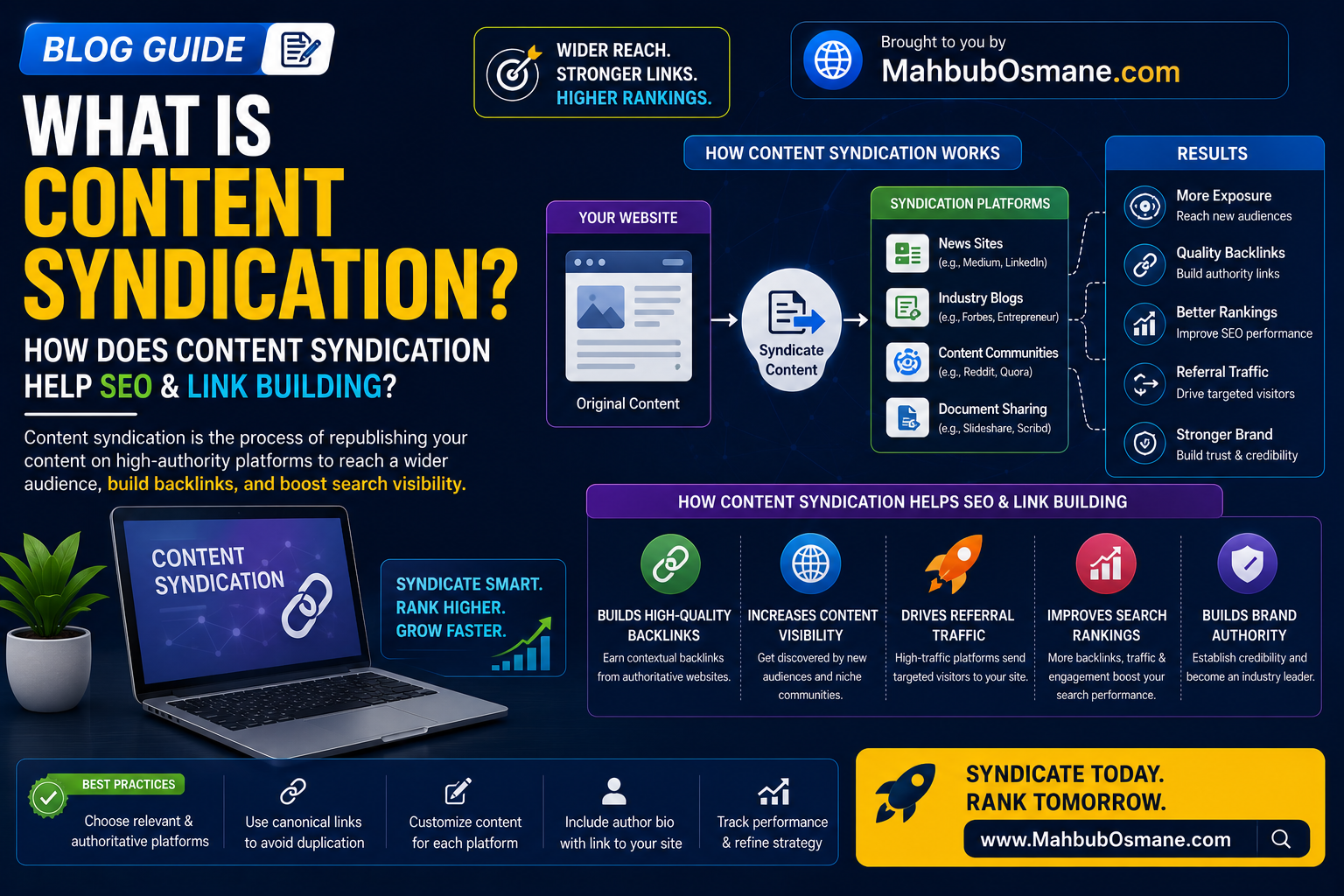
What is Content Syndication? How does Content Syndication help SEO & Link Building?
Imagine putting hours of intense research, writing, and design into a masterpiece of a blog post, only for it to be read by a handful of people. You hit publish, promote it on social media for a day or two, and then watch it slowly sink into your blog archives.
This is the central frustration of modern content marketing. The internet is incredibly loud, and even if your content is truly outstanding, standing out on a new or moderately trafficked website is a steep uphill battle.
What if, instead of waiting months for Google to notice your page, you could instantly drop that exact same article in front of an established audience of hundreds of thousands of readers? And what if doing so could simultaneously supercharge your search engine optimization (SEO) and bring in authoritative backlinks?
That is the power of Content Syndication.
Done correctly, content syndication is a powerful multiplier for your digital marketing. Done incorrectly, however, it can trigger duplicate content issues and accidentally cause your syndication partners to outrank your original piece.
This comprehensive guide breaks down exactly what content syndication is, how it transforms your SEO and link-building efforts, and the step-by-step frameworks needed to execute a flawless syndication strategy for MahbubOsmane.com.
Demystifying Content Syndication: What Is It?
At its core, content syndication is the process of republishing your original content—whether it is a blog post, an infographic, a video, or an interactive tool—on one or more third-party websites.
Think of it like a traditional newspaper column or a television show. A show like Friends originally aired on NBC, but it was later syndicated to hundreds of other networks globally. The content didn’t change; it was simply redistributed to tap into different, larger, or more diverse audiences.
In the digital landscape, digital publishers are constantly hungry for high-quality content to keep their readers engaged. By syndicating your content, you enter a mutually beneficial arrangement: they get excellent material for free (saving them content creation costs), and you get exposure to an audience you otherwise wouldn’t have reached.
Syndication vs. Guest Posting vs. Content Aggregation vs. Scraping
Because the digital marketing world is filled with overlapping jargon, it is critical to understand what content syndication is not. Let’s break down the key differences:
-
Content Syndication: You take a piece of content that already exists on your own website and republish it—word for word, or slightly edited—on another website with clear attribution.
-
Guest Posting: You write a completely new, exclusive piece of content specifically for a third-party website. It requires fresh research and writing effort, and you typically cannot publish that same text on your own blog later.
-
Content Aggregation: An automated process where a website pulls snippets, headlines, or RSS feed summaries from multiple external blogs into one central feed. It does not republish the full article.
-
Scraping: An unauthorized, illegal, or unethical practice where a bot or a malicious webmaster copies your content without permission or attribution. This is content theft, not syndication.
The Core Mechanics: How Content Syndication Works
To understand the relationship between content syndication, SEO, and link building, you must first master the technical mechanics that keep search engines happy. When the same piece of content lives on multiple URLs across the web, search engines face a dilemma: Which version should they index and display to searchers?
If left unguided, search engines like Google will pick whichever version they perceive as the most authoritative. If your content is syndicated on a massive publication like Business Insider, Medium, or Search Engine Journal, Google will almost always rank their version above your original blog post because their overall domain strength is significantly higher.
To prevent this, digital marketers rely on technical directives to tell search crawlers exactly who owns the original asset.
The Canonical Tag (rel="canonical")
The canonical tag is your absolute best defense against duplicate content issues. It is an HTML element placed in the <head> section of a webpage that points search engines to the “master” or preferred version of a page.
When a partner syndicates your content, their page should feature a canonical tag that points directly back to your original URL. It looks like this in the HTML code:
HTML
<link rel="canonical" href="https://mahbubosmane.com/blogs/your-original-post/" />When Google’s bots crawl the syndicated piece on the partner’s site, they read this tag and say, “Got it. This is just a copy. We will pass all the ranking power, trust, and credit back to the original version at MahbubOsmane.com.”
The Noindex Tag (rel="noindex")
In some scenarios, a syndication partner may not be able or willing to implement a cross-domain canonical tag due to CMS limitations or editorial policies. The next best alternative is a noindex directive.
This meta tag tells search engines not to display the syndicated page in search results at all:
HTML
<meta name="robots" content="noindex, follow" />By using noindex, follow, the partner site keeps the page visible to their direct human audience, allows search engines to follow any internal links within the text, but prevents the page from competing with your original post in the Search Engine Results Pages (SERPs).
Direct In-Text Attribution
Beyond technical code, structural, human-readable attribution is standard practice. Every syndicated piece should clearly state its origin at the very beginning or end of the text. For example:
“This article originally appeared on MahbubOsmane.com and has been republished with permission.”
This contextual link serves a dual purpose: it signals clarity to human readers and provides a clean, contextually relevant backlink for the search engine crawlers.
How Content Syndication Supercharges Your SEO
For a long time, standard SEO advice was rigid: Never publish duplicate content, or Google will penalize you. While it is true that manipulative, low-quality scraping or spamming will harm a site, Google does not penalize strategic, transparent content syndication. In fact, when handled correctly, content syndication becomes a powerful ally to your organic search performance.
Accelerated Indexation
For newer or smaller websites, getting Googlebot to frequently crawl and index fresh content can be a slow process. When you syndicate an article to a high-authority domain that is crawled by search engines thousands of times a day, your content acts as a map.
The deep in-text links and canonical paths on the high-frequency site force search engines to quickly follow those links back to your original domain, leading to faster discovery and indexation of your overall website.
Brand Visibility and Entity Building
Modern search engines do not just look at keywords and backlinks; they look at entities (brands, people, concepts) and their relationships. Google wants to see that your brand or author profile is widely recognized as an authority within your specific niche.
When your name, brand, and unique insights appear across a dozen reputable industry blogs, you are reinforcing your brand’s digital footprint. Over time, search algorithms associate your brand name with high-level topics, boosting your overall organic visibility for broad industry searches.
The Referral Traffic Multiplier
SEO isn’t just about driving traffic from the search bar; it’s about building sustainable streams of qualified visitors.
When an article is syndicated to a site with an active, highly targeted readership, you are capturing users at the peak of their interest. Readers who value your insights will click the attribution links to explore your site, sign up for your newsletter, or check out your services. This referral traffic often boasts lower bounce rates and higher conversion rates because the user has already vetted your expertise on a platform they trust.
The Growth Engine: Content Syndication & Link Building
Link building remains one of the foundational pillars of search engine algorithms. Google views high-quality backlinks as “votes of confidence” from the rest of the web. The challenge? Traditional link building—like cold email outreach, broken link building, and resource page pitching—can be incredibly time-consuming and often yields low response rates.
Content syndication shifts your link-building strategy from a linear grind to a highly scalable framework.
Traditional Outreach: 1 New Article Written ➔ Pitch 100 Editors ➔ Maybe 1-2 Links Earmed
Content Syndication:  1 Core Asset Written  ➔ Syndicate to 5 Partners ➔ 5+ Direct Links + Massive Reach
Direct Backlink Acquisition (Contextual Links)
Every time a partner republishes your post, they naturally include links back to your source domain. These aren’t just low-value footer or sidebar links; they are highly valuable, contextual, in-body links. Because these links are surrounded by highly relevant topic text, search engines assign them significant weight, passing link equity (or “link juice”) directly to your blog post.
The Link Equity Cascade (Canonical Pass-Through)
This is where the magic of the rel="canonical" tag comes into play. When a third-party site applies a canonical tag pointing to your site, search engines actively attribute the equity of that page to your URL.
If other random bloggers, researchers, or journalists happen to discover your content on that large platform and link to their syndicated version, a substantial portion of that newly generated link equity flows directly through the canonical link back to your original post.
Creating a “Linkable Asset” Loop
When you consistently create high-quality, comprehensive resources—such as industry data reports, deep tutorials, or original infographics—they naturally become linkable assets.
By syndicating these assets to high-visibility platforms, you vastly increase the odds that independent webmasters will find your charts, data points, or unique quotes and reference them in their own content, sparking an ongoing chain reaction of organic, natural backlinks.
The Content Syndication Matrix: 3 Core Approaches
Not all content syndication is handled the same way. Depending on your goals, resources, and current brand authority, your syndication mix will fall into three distinct buckets: Self-Syndication, Free/Earned Partnerships, and Paid Syndication.
Approach A: Self-Syndication (Owned & Operated Platforms)
This is the easiest, lowest-friction entry point for any blog. Self-syndication involves manually republishing your own blog posts on open-publishing platforms where you control the profile.
-
Medium: A massive publishing network that allows you to import your blog posts directly. Medium’s import tool automatically applies a
rel="canonical"tag pointing back to your original source URL, making it incredibly SEO-friendly. -
LinkedIn Articles: A cornerstone for B2B marketers. By publishing comprehensive versions of your blog posts as full-length LinkedIn Articles (not just short timeline updates), you can command thought leadership directly in front of your professional network.
-
Substack: You can repurpose your comprehensive guides into targeted newsletter entries to build a dedicated, direct subscriber base.
Approach B: Earned & Partner-Based Syndication
This requires building human relationships with other publishers, editors, and webmasters in your vertical. It involves pitching your top-performing content to external blogs that routinely run syndicated material.
-
Niche-Specific Blogs: Independent websites within your industry that have larger or complementary audiences. For instance, a digital marketing agency might partner with a web design firm to cross-syndicate relevant pieces.
-
Authority Multi-Author Platforms: Major industry platforms (e.g., Business 2 Community, Social Media Today) that actively seek high-quality contributions from active field practitioners.
Approach C: Paid Syndication Networks
If you have a marketing budget and want to scale your content amplification rapidly, paid syndication networks are an effective route. These networks display your content across premium media sites as “recommended reading” or “native ads.”
-
Outbrain & Taboola: The dominant giants in native discovery. They place your headlines and thumbnail graphics at the bottom of high-traffic news outlets like CNN, BBC, or Time Magazine.
-
Zemanta: A programmatic native advertising platform that gives you fine-tuned control over which niche platforms host your sponsored content links.
Blueprint for Execution: Step-by-Step Syndication Workflow
To ensure your syndication efforts yield maximum link equity and traffic without running into canonical errors, follow this structured, chronological workflow.
How to Find Untapped Syndication Partners
Finding websites that are open to content syndication requires smart, tactical research. Instead of guessing, use these advanced search operator strings directly in Google to uncover sites that already make a habit of republishing high-quality content.
Advanced Google Search Strings
Copy and paste these exact combinations into your search bar, replacing [niche keyword] with terms related to your industry (e.g., SEO, Digital Marketing, E-commerce, Web Development):
-
"[niche keyword]" AND "originally appeared on" -
"[niche keyword]" AND "republished with permission" -
"[niche keyword]" AND "syndicated from" -
"[niche keyword]" AND "originally published at"
These footprints immediately bring up articles that have been pulled from other sources, revealing exactly which websites in your industry maintain active syndication agreements.
The Competitor Backlink Reverse-Engineering Method
Another strategy is to monitor your direct competitors’ footprints. If a competitor is regularly securing placements on high-end blogs, you can uncover their entire syndication network using a backlink analytics tool like Ahrefs, Semrush, or Moz.
| Step | Action | Tool / Insight |
| 1 | Identify 3–5 core competitors who actively produce high-end content. | Competitive Analysis |
| 2 | Drop their domain into a backlink explorer and filter by “In Content” or body links. | Link Footprint Discovery |
| 3 | Search their backlink anchor text for phrases like “republished from” or “appeared first on.” | Identifying Footprints |
| 4 | Extract those domains into a clean outreach list and pitch them your top asset. | Active Partner Prospecting |
Avoiding the Pitfalls: Common Risks & How to Fix Them
While content syndication offers tremendous upside, it is not without risks if executed carelessly. Let’s examine the primary pitfalls and how to steer clear of them.
Pitfall A: The Outranking Phenomenon
-
The Risk: You syndicate your post to a massive domain with millions of monthly visitors. The partner fails to put a canonical tag pointing back to you. Because their site is so powerful, Google ranks their version page-one for your target keywords, while your original article is pushed down to page three or four.
-
The Fix: Make cross-domain canonical links an absolute, non-negotiable term of your syndication agreement. If a publisher refuses, walk away or ask for a strict
noindextag. Protect your core search footprint above all else.
Pitfall B: Over-Syndication and Brand Dilution
-
The Risk: You syndicate every single short, daily update you write to 20 different low-tier websites. Instead of looking like an industry leader, your content feels spammy, repetitive, and ubiquitous in a low-value way.
-
The Fix: Be highly selective with your “syndication-worthy” assets. Only syndicate your deep, definitive, evergreen pillars—the absolute best representations of your knowledge. Keep your quick news updates, opinion commentary, or personal case studies exclusive to your own blog.
Pitfall C: Broken Internal Navigation Loops
-
The Risk: A reader encounters your article on an external platform, loves it, clicks an internal link you placed in the body text, and encounters a broken 404 page because the URL structure wasn’t copied cleanly or used relative instead of absolute paths.
-
The Fix: Always hardcode your links as absolute URLs (e.g.,
[https://mahbubosmane.com/blogs/target/](https://mahbubosmane.com/blogs/target/)) rather than relative paths (/blogs/target/). Test all hyperlinked text carefully inside the partner’s draft environment before giving the green light to publish.
Content Syndication Checklist for MahbubOsmane.com
Before kicking off any syndication campaign, print out or save this handy operational checklist to ensure every asset is fully optimized for maximum SEO return and zero technical duplicate issues.
-
[ ] Asset Validation: Is this post thorough, highly actionable, and completely evergreen?
-
[ ] Primary Indexation: Has the article been live on your blog long enough to show up as fully indexed in Google Search Console?
-
[ ] Absolute Hyperlinks: Are all internal links within the article body formatted as absolute URLs pointing back to key service or content pages?
-
[ ] Partner Verification: Has the prospective syndication partner been verified for real organic traffic and clean editorial standards?
-
[ ] Technical Accord: Has the editor explicitly agreed in writing to use a cross-domain
rel="canonical"tag or anoindextag? -
[ ] Attribution Design: Is there a clear, reader-facing anchor text link acknowledging your blog as the original creator?
-
[ ] Performance Audit: Set a calendar reminder 14 days post-launch to review referral traffic and new backlink generation profiles using your preferred SEO toolkit.
Conclusion: Turning Content into a Scalable Asset
Content syndication shifts your perspective on content creation. Instead of viewing a blog post as a single publication event, you begin to see it as an adaptable, scalable asset designed for long-term distribution.
By strategically sharing your top-performing, evergreen assets with larger, highly engaged platforms, you circumvent the limitations of a growing audience. You protect your brand’s organic equity through ironclad canonical tags, generate authoritative contextual backlinks, and build predictable streams of targeted referral traffic directly back to your site.
Start small: set up your self-syndication channels on Medium and LinkedIn this week. Once comfortable with the workflow and technical directives, begin identifying high-value partner sites in your vertical to scale your outreach, amplify your message, and accelerate your organic search growth.
Scale Your Organic Growth with a Trusted Digital Marketing Partner
Managing content syndication, technical cross-domain SEO, and high-velocity link building requires specialized expertise. If your business wants to dominate search results and acquire qualified leads across Saudi Arabia, the UAE, Qatar, Kuwait, the USA, the UK, Canada, Germany, Lithuania, or Bangladesh, partner with an agency that delivers proven, measurable revenue growth.
At MahbubOsmane.com, we bridge the gap between creative execution and technical performance. We specialize in providing end-to-end digital growth strategies tailored for ambitious mid-market brands and corporate enterprises worldwide:
-
Professional SEO & Digital Marketing: Dominating international markets through data-driven search strategies, strategic link building, and flawless technical optimization.
-
Enterprise Content Writing: Creating high-end, authority-driven digital assets designed for syndication, lead generation, and high-frequency keyword rankings.
-
Advanced Web Development & AdOps: Designing lightning-fast, secure, conversion-optimized platforms paired with programmatic yield optimization.
-
Corporate Graphic Design & Video Editing: Producing crisp, premium visual assets that capture attention across diverse global audiences.
Proven Enterprise Reliability & Elite Freelance Credentials
We don’t just promise performance—we have spent years documenting it. Our track record stands as a testament to our commitment to client satisfaction and operational excellence:
-
700+ Completed Contracts: Successfully delivered high-impact digital initiatives on Upwork.
-
100% Five-Star Feedback: A flawless elite performance record verified by global organizations.
-
Fully Vetted Global Talent: Available for structured contract arrangements via Hubstaff Talent.
Initiate Your Global Growth Strategy Today
Let our team transform your digital presence into a highly predictable client acquisition framework. Reach out directly through our dedicated regional channels or use the direct secure messaging gateway below to book a comprehensive performance consultation.
-
Saudi Arabia Corporate Lines:
+966549485900|+966553227950 -
Bangladesh & International Line:
+8801716988953 -
Direct Corporate Email: hi@mahbubosmane.com or mahbubosmane@gmail.com
-
Secure Web Portal: www.MahbubOsmane.com
FAQ
What is the exact definition of digital content syndication?
Content syndication is an online distribution strategy where a copy of an original piece of content (such as a blog post, article, video, or infographic) is republished on one or more third-party websites with direct attribution to the original creator.
Will syndicating my articles cause a Google duplicate content penalty?
Google does not have a formal “duplicate content penalty” for syndicated material. Google explicitly states that syndication is a normal web practice. However, if technical signals like canonical tags are missing, search engines might choose to show the partner’s version over yours, which can impact your organic traffic.
What is a cross-domain canonical tag and why does it matter?
A cross-domain canonical tag (rel="canonical") is a snippet of HTML code placed on the syndication partner’s webpage that points directly back to your original source URL. It instructs search engine crawlers that your page is the master copy, passing all ranking power and indexing authority back to your site.
How long should I wait after publishing on my blog before syndicating?
You should wait until your original post is fully crawled and indexed by search engines. This usually takes anywhere from a few hours to a few days. You can verify this by checking the URL inside Google Search Console. Syndicating too quickly increases the risk of the partner’s site being indexed as the original source.
Can content syndication actually help my website rank higher?
Yes. When authority sites syndicate your content, they pass link equity (SEO authority) back to your domain through canonical tags and in-text hyperlinks. This strengthens your overall domain authority, making it easier for your original pages to rank higher in search results.
What is the difference between guest posting and content syndication?
Guest posting requires writing a completely unique, brand-new article specifically for a third-party website, meaning you cannot use that text on your own blog. Content syndication involves taking an article that you have already published on your own blog and republishing it elsewhere.
Should I syndicate the full article or just a snippet?
Both methods work, but publishing the full article generally performs better for audience engagement on platforms like Medium or LinkedIn. If you are dealing with a partner who is hesitant about canonical tags, syndicating a partial summary or preview with a “Read the full article at MahbubOsmane.com” link is the safer alternative.
Is self-syndication on platforms like Medium and LinkedIn effective for B2B?
It is highly effective. Self-syndication allows you to get your insights directly in front of targeted professional networks. Medium even includes a built-in import tool that automatically applies the correct cross-domain canonical tag back to your original blog post.
Can syndication partners outrank my original blog post?
Yes, this happens if the syndication partner has a massive domain authority and fails to use a rel="canonical" or rel="noindex" tag. In these cases, search engines may view their version as the definitive copy and rank it above your own website.
What should I do if a publisher refuses to add a canonical tag?
If a high-value publisher refuses to use a canonical tag, request that they add a meta name="robots" content="noindex" tag to the page instead. This allows their human audience to read the article while keeping it completely invisible to search engines, protecting your original rankings.
How does content syndication scale my link-building efforts?
Traditional link building requires pitching dozens of individual webmasters for a single link. Content syndication allows you to secure a handful of high-authority, contextual backlinks simultaneously whenever a partner syndicates your content, creating a far more scalable acquisition loop.
What is the link equity cascade in syndication?
The link equity cascade occurs when third-party bloggers or researchers discover your syndicated article on a massive media platform and link to it. Because the partner site has a canonical tag pointing to your site, a significant portion of that newly generated link authority flows straight back to your original URL.
Are paid syndication networks like Taboola or Outbrain good for SEO?
Paid syndication networks are exceptional for driving massive volumes of referral traffic and brand visibility, but the links generated through their recommendation widgets are generally non-searchable or contain nofollow attributes, meaning they do not directly pass SEO link equity.
Should I syndicate every single blog post I write?
No. You should only syndicate your absolute best, evergreen, and most comprehensive content. Syndicating short news updates, highly time-sensitive topics, or lower-quality posts can dilute your brand footprint and won’t offer much value to third-party publishers.
How do I find blogs that are open to syndicating my content?
You can use advanced Google search operators like "[niche keyword]" AND "originally appeared on" or "[niche keyword]" AND "republished with permission". These search queries will instantly reveal websites within your vertical that already have a habit of republishing external work.
Do I need to modify my article text before syndicating it?
While not strictly mandatory, making slight modifications to the introduction or headline can help the content better match the specific tone and audience formatting of your syndication partner, improving click-through and engagement rates.
Why should I use absolute URLs instead of relative URLs in my syndicated text?
Relative URLs (e.g., /blogs/seo-tips) will break when copied over to an external site, resulting in frustrating 404 errors for readers. Hardcoding absolute URLs (e.g., [https://mahbubosmane.com/blogs/seo-tips](https://mahbubosmane.com/blogs/seo-tips)) ensures all your internal links redirect perfectly back to your target pages.
How do I track the success of my content syndication campaigns?
You can track success by monitoring referral traffic trends and goal conversions within Google Analytics. Additionally, use SEO platforms like Ahrefs, Semrush, or Google Search Console to monitor the growth of new incoming backlinks and improvements in your target keyword positions.
Internal Resources
-
The Ultimate Guide to Search Engine Optimization: Master the foundational technical, on-page, and off-page pillars required to scale organic traffic before distributing your content assets.
-
Blog Commenting Service for SEO & Quality Backlinks: Discover how manual, niche-relevant contextual interactions safely diversify your backlink profile alongside syndication campaigns.
-
SEO & Digital Services Case Study: Review advanced enterprise frameworks, local visibility playbooks, and structural optimization models executed across international markets.
External Resources
-
Google Search Central: Consolidate Duplicate URLs: Read Google’s official stance on external page replication, index management, and deploying canonical link markers accurately.
-
Ahrefs: Advanced Link Building Fundamentals: Learn the structural metrics that search engine crawlers measure when passing page authority through contextual referral networks.
-
HostPapa Search Strategy: Managing Duplicate Content: Dive deep into how modern search engine algorithms and web crawlers filter, categorize, and rank syndicated versions of identical textual blocks.
About the Author
Mahbub Osmane is a digital marketing expert who helps businesses build effective online strategies, including selecting and managing the right social media channels for growth. With hands-on experience across platforms and markets, Mahbub shares practical, actionable insights to help businesses connect with their audience and grow their brand presence.
Contact information Email: hi@mahbubosmane.com Website: https://mahbubosmane.com/ Mobile: +966 54 948 5900 (KSA) / +880 1716 988953 (BD) Address: 2282 7284 Al Malawi Southern 1, As Sulimaniyah Dist, Makkah 24236, Saudi Arabia