
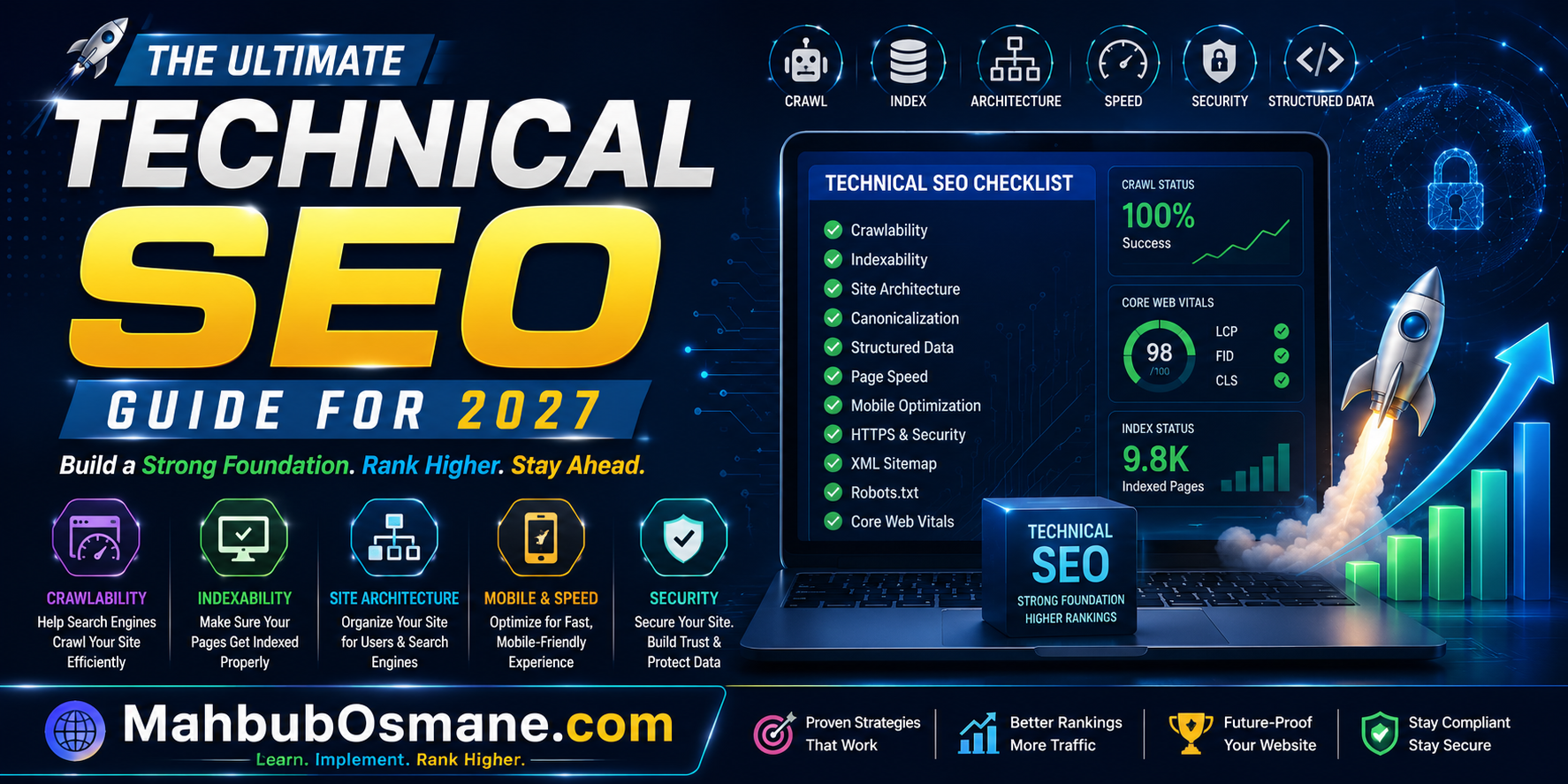
The Ultimate Technical SEO Guide For 2027
Search Engine Optimization has undergone a seismic shift. As web standards evolve, AI-driven search experiences dominate search engine results pages (SERPs), and generative engines consume content directly through autonomous agents, Technical SEO remains the bedrock of online visibility. Without a flawless technical foundation, even the most authoritative content will fail to rank, get crawled efficiently, or be synthesized by modern Search Generative Experience (SGE) engines and Answer Engines.
Whether you manage an enterprise e-commerce platform with millions of URLs, a high-traffic media site, or a fast-growing SaaS platform, this definitive guide provides the technical blueprint required to win in 2027 and beyond.
Table of Contents
-
The State of Technical SEO in 2027
-
Crawlability & Rendering Architecture
-
Indexation Governance & Crawl Budget Optimization
-
Modern Site Architecture & URL Structuring
-
Performance Engineering & Core Web Vitals (INP Focus)
-
Advanced Schema Markup & Knowledge Graph Integration
-
Internationalization & Multi-Regional SEO (Hreflang)
-
Log File Analysis & Server-Side Telemetry
-
Technical SEO Auditing Framework & Tools
-
Future-Proofing: Preparing for Autonomous AI Agents
The State of Technical SEO in 2027
Historically, technical SEO focused primarily on basic XML sitemaps, simple 301 redirects, meta robots tags, and basic site speed tweaks. Today, search engines do not merely match keywords; they evaluate user experience, real-time interactivity, security, rendering efficiency, and semantic relational data across complex entity graphs.
Key shifts shaping technical SEO today include:
-
Generative & Answer-Engine Indexing: Search engines like Google, Bing, Perplexity, and OpenAI Search deploy hyper-efficient crawling fleets. Web scrapers now extract structured micro-data and semantic entities directly to feed Large Language Models (LLMs).
-
Interaction to Next Paint (INP) Maturity: INP replaced First Input Delay (FID) as the primary responsiveness metric in Google’s Core Web Vitals framework. Minimizing main-thread blocking and long JavaScript tasks is no longer optional.
-
JavaScript-Heavy Frameworks: Dynamic web applications built with React, Next.js, Vue, Nuxt, and Svelte require deliberate server-side rendering (SSR), static site generation (SSG), or incremental static regeneration (ISR) to avoid rendering deferrals and indexation bottlenecks.
-
Strict Crawl Budgets for Large Sites: With the sheer volume of web content expanding exponentially, search engines have tightened crawl budgets. Search bots aggressively drop low-value, duplicate, or slow-loading pages from their rendering pipelines.
Crawlability & Rendering Architecture
Before search engines can index or rank your content, they must discover, crawl, and render your pages. If a search engine bot cannot efficiently process your site’s codebase, your content remains invisible.
The Two-Wave Rendering Process
Googlebot processes web pages in two distinct waves:
-
Wave 1 (Initial Crawl): Googlebot fetches the HTML response. If the content is visible in the raw HTML response, it is parsed and indexed immediately.
-
Wave 2 (Deferred Rendering): If the page relies heavily on client-side JavaScript (CSR) to inject DOM content, Googlebot queues the page for rendering when compute resources become available. This delay can range from a few minutes to several days or weeks.
[Raw HTTP Request] ---> [Wave 1: Parse HTML & Index static text]
                                |
                   (If Client-Side Rendering needed)
                                |
                                v
               [Wave 2: Render Queue (WRS)] ---> [Execute JS] ---> [Index Rendered DOM]
Server-Side Rendering (SSR) vs. Client-Side Rendering (CSR)
To eliminate rendering latency, your technical stack must deliver full, structured HTML directly upon initial HTTP requests.
| Rendering Method | Execution Location | SEO Impact & Crawl Speed | Best Use Cases |
| Client-Side Rendering (CSR) | Browser / Client | Poor: Delays indexation; risk of partial rendering. | Internal dashboards, gated portals |
| Server-Side Rendering (SSR) | Server (per request) | Excellent: Instant HTML delivery; full bot visibility. | High-volume dynamic e-commerce, news |
| Static Site Generation (SSG) | Build Time | Optimal: Ultra-fast, minimal server overhead. | Blogs, documentation, marketing sites |
| Incremental Static Regeneration (ISR) | Hybrid (Background) | Optimal: Fast static delivery with cached revalidation. | Large scale e-commerce, real estate |
Optimizing robots.txt Directives
Your robots.txt file serves as the traffic controller for web crawlers. A misplaced directive can eliminate an entire domain from search indices.
Key Principles for Modern robots.txt Governance:
-
Never block CSS or JavaScript files: Search engine rendering engines require full access to stylesheets and scripts to calculate visual layouts and mobile friendliness.
-
Do not use
robots.txtto hide sensitive data: Blocking a URL inrobots.txtprevents crawling, but does not prevent indexation if external links point to that URL. Usenoindexheaders or HTTP authentication for security. -
Explicitly manage AI scrapers: Manage generic AI scrapers versus search crawlers intentionally.
HTTP
# Modern Standard robots.txt Example
User-agent: *
Allow: /
Disallow: /api/
Disallow: /checkout/
Disallow: /cart/
Disallow: /*?sort=
Disallow: /*?dir=
Disallow: /search?

# Sitemap declaration
Sitemap: https://mahbubosmane.com/sitemap.xml
Sitemap: https://mahbubosmane.com/sitemap-news.xml
Indexation Governance & Crawl Budget Optimization
Crawl budget refers to the number of URLs search engine bots will crawl on your web server during a given timeframe. It is determined by Crawl Capacity Rate (how fast your server can respond without degrading) and Crawl Demand (how popular and frequently updated your pages are).
Crawl Budget = Server Capacity (Response Times) × Content Demand (Freshness & Authority)
Eliminating Crawl Waste & Duplicate Content
Crawl waste drains your server resources and prevents search engine bots from discovering high-value money pages.
Primary Causes of Crawl Waste:
-
Faceted Navigation & URL Parameters: E-commerce filter combinations (
?color=red&size=xl&sort=price_asc) create thousands of thin, duplicate URL variations. -
Session IDs & Tracking Parameters: Appending
?utm_source=or?jsessionid=directly to internal navigational links. -
Soft 404 Errors: Pages that return a
200 OKHTTP status code despite displaying a “Product Not Found” or “Page Empty” message. -
Infinite Crawl Traps: Poorly coded calendars, endless pagination loops, or relative link mistakes (
/category/subcategory/subcategory/).
Canonicalization Best Practices
The rel="canonical" tag instructs search engines which single authoritative URL represents a set of identical or closely similar pages.
HTML
<!-- Proper Self-Referential Canonical Tag -->
<link rel="canonical" href="https://mahbubosmane.com/blogs/technical-seo-guide/" />
Canonical Implementation Rules:
-
Use Absolute URLs: Always specify full URLs including protocol (
https://) and domain name. -
Self-Referential Canonicals: Every canonical page should explicitly point to itself.
-
Cross-Domain Canonicalization: Use cross-domain canonicals when syndicating content across multiple owned properties.
-
Match Directives: Ensure canonicalized pages do not return
404errors, carrynoindexdirectives, or redirect via 301.
Managing HTTP Response Codes
A robust HTTP response strategy maintains search engine trust and preserves link equity.
+-----------------------------------------------------------------------+
|                       HTTP STATUS CODES CHEATSHEET                     |
+-----------------------------------------------------------------------+
| 200 OK           | Ideal status for canonical, indexable content.      |
| 301 Moved        | Permanent redirect; passes ~95-100% link equity.   |
| 302 Found        | Temporary redirect; use sparingly for short tests.  |
| 404 Not Found    | Missing resource; clean up internal links.         |
| 410 Gone         | Permanently removed; forces faster index removal.  |
| 503 Unavailable  | Temporary server failure; preserves index positions.|
+-----------------------------------------------------------------------+
Modern Site Architecture & URL Structuring
Site architecture defines how pages connect, share link equity (PageRank), and guide users and search bots through logical hierarchies.
The Flat Architecture Principle
Maintain a flat depth hierarchy where no critical content page is more than 3 to 4 clicks away from the root homepage.
                   [ Homepage ]
                        |
      +-----------------+-----------------+
      |                                   |
[ Category 1 ]                      [ Category 2 ]
      |                                   |
+-----+-----+                       +-----+-----+
|           |                       |           |
[Sub-Cat A] [Sub-Cat B]             [Sub-Cat C] [Sub-Cat D]
      |                                   |
 [ Product ]                         [ Product ]
SILOing & Topic Cluster Internal Linking
Organize content around central pillar topics supported by detailed cluster articles. Pass internal link equity purposefully through contextual anchor texts rather than generic navigation links.
Internal Linking Rules:
-
Contextual Relevance: Link related cluster articles back to their parent pillar page using keyword-rich, descriptive anchor text.
-
Avoid “Nofollow” on Internal Links: Using
rel="nofollow"on internal site links wastes PageRank. Use clean internal linking structures instead. -
Breadcrumbs: Implement structured JSON-LD BreadcrumbList markup alongside visual breadcrumbs on every interior page.
JSON
{
  "@context": "https://schema.org",
  "@type": "BreadcrumbList",
  "itemListElement": [{
    "@type": "ListItem",
    "position": 1,
    "name": "Home",
    "item": "https://mahbubosmane.com"
  },{
    "@type": "ListItem",
    "position": 2,
    "name": "Blogs",
    "item": "https://mahbubosmane.com/blogs"
  },{
    "@type": "ListItem",
    "position": 3,
    "name": "Technical SEO Guide 2027",
    "item": "https://mahbubosmane.com/blogs/technical-seo-guide"
  }]
}
Performance Engineering & Core Web Vitals (INP Focus)
User experience metrics are heavily weighed by search engine ranking algorithms. Core Web Vitals establish quantifiable thresholds for speed, visual stability, and interactivity.
Core Web Vitals Thresholds Breakdown
| Metric | Full Name | Good Threshold | Needs Improvement | Poor |
| LCP | Largest Contentful Paint | ≤ 2.5s | 2.5s – 4.0s | > 4.0s |
| INP | Interaction to Next Paint | ≤ 200ms | 200ms – 500ms | > 500ms |
| CLS | Cumulative Layout Shift | ≤ 0.1 | 0.1 – 0.25 | > 0.25 |
Optimizing Interaction to Next Paint (INP)
INP measures overall page responsiveness by tracking the latency of all click, tap, and keyboard interactions throughout a user’s session.
Actionable Strategies to Eliminate High INP Latency:
-
Break Up Long Tasks (>50ms): Use
requestIdleCallback()orsetTimeout()to yield main-thread execution back to the browser during complex JavaScript calculations. -
Minimize Heavy Event Listeners: Avoid binding un-throttled scroll or resize handlers directly to window events.
-
Reduce JavaScript Bundle Size: Code-split bundles based on route components so users only download the script needed for the current viewport.
-
Defer Non-Critical Third-Party Scripts: Defer tag managers, analytics scripts, and chat widgets until after main content execution finishes.
JavaScript
// Example: Yielding to the main thread in modern JS
function yieldToMainThread() {
  return new Promise(resolve => {
    if ('scheduler' in window && 'yield' in window.scheduler) {
      window.scheduler.yield().then(resolve);
    } else {
      setTimeout(resolve, 0);
    }
  });
}

async function processLargeDataset(items) {
  for (let i = 0; i < items.length; i++) {
    performTask(items[i]);
    if (i % 100 === 0) {
      await yieldToMainThread(); // Yields execution, preventing INP spikes
    }
  }
}
Optimizing Largest Contentful Paint (LCP)
LCP measures when the largest visual element (hero image, video block, or main heading) becomes visible in the viewport.
Technical LCP Enhancements:
-
Preload Critical Images: Inject high-priority preload tags in the document
<head>for primary hero banners. -
Modern Image Formats: Convert standard PNG/JPEG assets into AVIF or WebP formats to reduce payload size by up to 80%.
-
Set
fetchpriority="high": Force immediate retrieval of critical visual assets. -
Implement HTTP/3 over QUIC: Accelerate connection handshakes and remove head-of-line blocking.
HTML
<!-- Optimizing the Hero LCP Image -->
<link rel="preload" fetchpriority="high" as="image" href="/images/hero-banner.avif" type="image/avif" />
Advanced Schema Markup & Knowledge Graph Integration
Structured data provides search engines and generative AI agents with direct, machine-readable facts about your organization, products, and articles. By structuring data through Schema.org in JSON-LD format, you help build domain authority inside global Knowledge Graphs.
       [ Search Engine / AI Entity Extraction ]
                        |
  +---------------------+---------------------+
  |                                           |
[ Schema JSON-LD ]                     [ Unstructured HTML ]
(Explicit Entity Data)                 (Implicit Text Parsing)
  |                                           |
  +------------------+------------------------+
                     |
         [ Knowledge Graph Node ]
Entity Graph Schema Implementation Example
Below is a comprehensive multi-entity schema block connecting an Article, an Organization, and an Author into a single contextual graph.
JSON
<script type="application/ld+json">
{
  "@context": "https://schema.org",
  "@graph": [
    {
      "@type": "Organization",
      "@id": "https://mahbubosmane.com/#organization",
      "name": "MahbubOsmane.com",
      "url": "https://mahbubosmane.com",
      "logo": {
        "@type": "ImageObject",
        "url": "https://mahbubosmane.com/assets/logo.png"
      },
      "sameAs": [
        "https://twitter.com/mahbubosmane",
        "https://www.linkedin.com/in/mahbubosmane"
      ]
    },
    {
      "@type": "WebPage",
      "@id": "https://mahbubosmane.com/blogs/technical-seo-guide/#webpage",
      "url": "https://mahbubosmane.com/blogs/technical-seo-guide",
      "name": "The Ultimate Technical SEO Guide For 2027",
      "isPartOf": {
        "@id": "https://mahbubosmane.com/#website"
      }
    },
    {
      "@type": "TechArticle",
      "@id": "https://mahbubosmane.com/blogs/technical-seo-guide/#article",
      "isPartOf": {
        "@id": "https://mahbubosmane.com/blogs/technical-seo-guide/#webpage"
      },
      "headline": "The Ultimate Technical SEO Guide For 2027",
      "description": "Comprehensive blueprint covering technical SEO, INP optimization, crawl budgets, schema graphs, and rendering architecture.",
      "inLanguage": "en-US",
      "mainEntityOfPage": "https://mahbubosmane.com/blogs/technical-seo-guide",
      "datePublished": "2026-08-01T08:00:00+00:00",
      "dateModified": "2026-08-03T10:00:00+00:00",
      "publisher": {
        "@id": "https://mahbubosmane.com/#organization"
      },
      "author": {
        "@type": "Person",
        "name": "Mahbub Osmane",
        "url": "https://mahbubosmane.com/about"
      }
    }
  ]
}
</script>
Internationalization & Multi-Regional SEO (Hreflang)
Expanding globally requires serving localized content to the right regional users without causing cross-border duplicate content penalties.
Rules for Flawless hreflang Deployments
-
Reciprocal Implementation: If Page A links to localized Page B via
hreflang, Page B must contain a returninghreflangtag pointing back to Page A. -
Self-Referential Links: Every page must include an
hreflangtag referencing itself alongside localized variations. -
Include
x-default: Define anx-defaultURL to handle unmatched regions or language selectors. -
Use ISO Standards: Language codes must follow ISO 639-1 format and optional region codes must follow ISO 3166-1 Alpha-2.
HTML
<!-- Example Hreflang Tags in HTML <head> -->
<link rel="alternate" hreflang="en-us" href="https://mahbubosmane.com/blogs/technical-seo-guide" />
<link rel="alternate" hreflang="en-gb" href="https://mahbubosmane.com/uk/blogs/technical-seo-guide" />
<link rel="alternate" hreflang="bn-bd" href="https://mahbubosmane.com/bn/blogs/technical-seo-guide" />
<link rel="alternate" hreflang="x-default" href="https://mahbubosmane.com/blogs/technical-seo-guide" />
Log File Analysis & Server-Side Telemetry
Log files contain raw truth regarding how search engine crawlers interact with your web infrastructure.
       [ Web Server (Nginx / Apache / Cloudflare) ]
                           |
               (Writes Raw Request Logs)
                           |
                           v
    [ Access Logs (IP, User-Agent, Status Code, Bytes) ]
                           |
               (Ingestion & Parsing Tool)
                           |
                           v
  [ Telemetry Insights: Crawl Spikes, Errors, Frequencies ]
Critical Log File Analysis Metrics
-
Crawl Frequency by Directory: Identify high-priority subdirectories versus forgotten legacy sections.
-
Status Code Distribution (3xx, 4xx, 5xx): Monitor redirect chains, missing pages, or server stress signals.
-
Orphan Page Discovery: Locate pages indexed or crawled by bots that lack internal link access.
-
Crawl Response Time Trends: Correlate slow server response times (TTFB > 800ms) with drops in bot crawl activity.
Bash
# Example Nginx log entry format tracking search bots
66.249.66.1 - - [03/Aug/2026:14:32:10 +0000] "GET /blogs/technical-seo-guide HTTP/2.0" 200 45212 "-" "Mozilla/5.0 (compatible; Googlebot/2.1; +http://www.google.com/bot.html)"
Technical SEO Auditing Framework & Tools
Regular audits ensure that code updates, infrastructure changes, and content additions do not introduce technical regression.
Stage 1: Crawl & Discovery   --> Run Screaming Frog / Deepcrawl on initial DOM & rendered DOM
Stage 2: Validation           --> Check status codes, canonicals, hreflang loops, robots.txt
Stage 3: Performance Analysis --> Run PageSpeed Insights API batch test for INP/LCP/CLS
Stage 4: Verification         --> Validate Schema JSON-LD via Google Rich Results Test API
Stage 5: Remediation          --> Prioritize dev tickets based on ROI & business impact
Essential Technical SEO Tooling Stack
| Category | Primary Tools | Core Purpose |
| Enterprise Crawlers | Screaming Frog, Lumar (Deepcrawl), Sitebulb | Structural analysis, canonical audits, JavaScript rendering tests |
| Log Analyzers | Loggly, ELK Stack (Elasticsearch, Logstash, Kibana) | Analyzing real-time crawler behavior and bandwidth metrics |
| Performance Testing | Google PageSpeed Insights, WebPageTest, Lighthouse | Measuring Core Web Vitals, INP diagnostic traces, waterfall charts |
| Schema Validation | Schema.org Validator, Google Rich Results Test | Testing JSON-LD syntax, entity connections, and rich snippet eligibility |
| Monitoring & Telemetry | Google Search Console, Bing Webmaster Tools, Datadog | Indexation status, coverage issues, real-time server response alerts |
Future-Proofing: Preparing for Autonomous AI Agents
As search engines transform into conversational answer engines, optimizing for Generative Engine Optimization (GEO) and AI agents requires specific technical adjustments.
Technical Protocols for AI Readiness:
-
Optimize HTTP/2 & HTTP/3 Protocol Handshakes: Ensure fast multiplexed network connections so automated engines can read your resources effortlessly.
-
Expose Clean API & Markdown Endpoints: Provide lightweight structured endpoints or semantic feed structures to enable agentic systems to parse your knowledge base efficiently.
-
Maintain High E-E-A-T Signal Wiring: Combine verified author entity markup (
Person), clear publisher credentials (Organization), and explicit citation references across all technical content. -
Implement Robust Edge Caching: Utilize Cloudflare Workers, Fastly VCL, or AWS CloudFront functions to perform dynamic rendering and cache revalidation directly at the edge, reducing origin server load to near zero.
Conclusion & Action Plan
Mastering technical SEO requires continuous maintenance, strategic execution, and modern architecture. To keep your site optimized for search engine bots and AI answer engines:
-
Audit your rendering setup: Transition heavy client-side JavaScript applications to SSR or ISR.
-
Protect your crawl budget: Eliminate parameter loops, audit canonical directives, and fix 4xx/5xx status code leaks.
-
Optimize for Core Web Vitals: Focus on main-thread efficiency to bring INP under 200ms and LCP under 2.5s.
-
Expand structured data: Build connected JSON-LD Knowledge Graphs linking authors, organizations, articles, and products.
-
Monitor continuously: Analyze server log files weekly to trace bot interactions and spot indexation regressions early.
Scale Your Global Visibility with Enterprise-Grade Digital Excellence
In a search landscape dominated by AI-driven algorithms, complex rendering requirements, and strict Core Web Vitals, a passive digital strategy is no longer enough. To capture market share across competitive global hubs—whether in Saudi Arabia, the UAE, Qatar, Kuwait, the USA, the UK, Canada, Germany, Lithuania, or Bangladesh—your business requires an integrated, high-performance execution partner.
At MahbubOsmane.com, we bridge technical precision with creative authority. We help ambitious enterprises, dynamic startups, and industry leaders dominate organic search and drive sustainable, full-funnel revenue growth.
Why Global Brands Choose MahbubOsmane.com
Trust is earned through measurable results and consistent excellence. Our elite track record speaks for itself across premier global freelance platforms:
-
Proven Upwork Excellence: Over 700+ successfully completed jobs backed by 100% 5-star feedback from satisfied international clients.
-
Verified Expertise on Hubstaff Talent: Recognized for transparent reporting, agile deployment, and uncompromised quality.
-
End-to-End Digital Capabilities: A unified powerhouse delivering full-spectrum digital marketing and creative services under one roof.
Full-Spectrum Digital Services Built for Growth
We deliver comprehensive, end-to-end solutions tailored to your market’s exact demands:
+-----------------------------------------------------------------------------------+
|                            OUR SERVICE CAPABILITIES                               |
+-----------------------------------------------------------------------------------+
| 🚀 Professional SEO & Technical Audits | Core Web Vitals, Schema & Rendering Architecture|
| 📈 AdOps & Paid Acquisition           | Multi-channel PPC, Meta, Google & Programmatic   |
| ✍️ High-Impact Content Writing         | SEO-optimized, E-E-A-T aligned authoritative copy|
| 💻 Custom Website Development          | Fast, responsive SSR/ISR web application stacks  |
| 🎨 Enterprise Graphic Design           | Brand identity, UI/UX, and marketing collateral  |
| 🎬 Professional Video Editing          | Engagement-focused short & long-form video assets|
| 🌐 Full 360° Digital Marketing        | Multi-market scaling strategy & data analytics    |
+-----------------------------------------------------------------------------------+
Ready to Dominate Your Market? Let’s Talk.
Whether you need a complete technical SEO overhaul, a high-converting web application, or a multi-country paid acquisition strategy, our team is ready to deliver.
Direct Contact Channels (WhatsApp Available on All Lines)
-
Saudi Arabia Office: +966549485900 / +966553227950
-
Bangladesh Office: +8801716988953
-
Direct Emails: hi@mahbubosmane.com | mahbubosmane@gmail.com
-
Official Website: www.MahbubOsmane.com
💬 Chat Directly on WhatsApp Now
FAQ
What is Technical SEO and why does it matter more than ever in 2027?
Technical SEO focuses on the infrastructure and backend elements that allow search engines and AI systems to crawl, render, index, understand, and serve your content efficiently. In 2027, with the continued rise of AI Overviews, generative engines, and multi-modal search, technical foundations determine whether your content is even eligible for visibility. Strong technical SEO ensures crawlability, fast performance, clean indexation, and machine-readable structure—without which high-quality content remains invisible.
How have AI Overviews and generative search changed Technical SEO priorities?
AI-driven features rely heavily on clean HTML, accurate structured data, fast rendering, and clear entity signals. Pages that depend excessively on client-side JavaScript, contain crawl barriers, or lack proper schema are frequently skipped or poorly understood by AI systems. Technical SEO now includes optimizing for both traditional crawlers and large language model (LLM) bots to maximize citation potential in generative results.
What are the current Core Web Vitals thresholds and how should sites optimize for them?
The primary metrics remain Largest Contentful Paint (LCP under 2.5 seconds), Interaction to Next Paint (INP under 200 ms), and Cumulative Layout Shift (CLS under 0.1). Optimization involves efficient resource loading, modern image formats, reduced third-party script impact, proper caching, and minimizing layout shifts. These signals continue to act as ranking tiebreakers and influence user experience signals used by both search engines and AI systems.
Should websites allow or block AI crawlers such as GPTBot, ClaudeBot, and PerplexityBot?
Most sites benefit from allowing reputable AI crawlers in robots.txt so their content can be considered for citations and training-related visibility. Blocking them can reduce exposure in generative answers. However, sites with sensitive content, strict licensing, or high crawl costs may selectively restrict certain bots. Always monitor server logs and use tools to manage bot traffic intelligently.
What is an llms.txt file and is it necessary in 2027?
llms.txt is an emerging convention (similar in spirit to robots.txt) that provides guidance to AI crawlers about preferred content, priority pages, and usage policies. While not yet a universal standard enforced by all engines, implementing a clear llms.txt helps communicate site structure and preferences to generative systems and is increasingly recommended as part of AI-readiness technical setups.
How critical is JavaScript SEO and server-side rendering in 2027?
Very critical. Search engines and AI systems prefer content available in the initial HTML response. Heavy reliance on client-side rendering can delay or prevent full content discovery. Best practice is progressive enhancement, server-side or hybrid rendering for core content, and ensuring that important text, links, and structured data are present without requiring JavaScript execution.
Does structured data (schema markup) still provide value after changes to rich results?
Yes. While some rich result types (such as widespread FAQ expansions) have been reduced, structured data remains essential for helping both traditional search engines and AI systems understand entities, relationships, authors, products, and content type. Proper schema improves content comprehension, eligibility for remaining rich features, and citation quality in generative answers.
What are best practices for implementing and maintaining canonical tags?
Use self-referencing canonicals on primary pages, ensure consistency between canonical tags, internal links, and sitemaps, and avoid chains or conflicts. For large or parameterized sites, implement clear rules so that the preferred version is always signaled. Regularly audit for canonical mismatches, as these can waste crawl budget and dilute ranking signals.
How should XML sitemaps be managed for optimal crawl efficiency?
Keep sitemaps clean, up-to-date, and under size limits. Include only canonical, indexable URLs with accurate lastmod dates when helpful. Use sitemap indexes for large sites, separate sitemaps by content type when beneficial, and submit them via Search Console and equivalent tools. Remove outdated or non-indexable URLs promptly to guide crawlers effectively.
Why does site architecture matter for Technical SEO in 2027?
A logical, shallow, and hierarchical structure improves crawl efficiency, distributes internal PageRank (or equity), clarifies topical relationships, and helps both users and AI systems understand content hierarchy. Flat or overly deep architectures, orphan pages, and poor internal linking can leave valuable content under-crawled or poorly understood.
What are the most common indexation problems and how can they be fixed?
Common issues include accidental noindex tags, robots.txt blocks, soft 404s, duplicate content without proper canonicals, and crawl budget waste on low-value pages. Fixes involve auditing Coverage/Indexing reports, cleaning robots.txt and meta robots, consolidating duplicates, improving internal linking to important pages, and monitoring log files for crawl patterns.
Is HTTPS still important, and what additional security signals matter?
HTTPS remains a baseline requirement and ranking signal. Beyond that, sites should maintain valid certificates, implement strong security headers where appropriate, avoid mixed content, and protect against common vulnerabilities. Trust and security signals continue to influence both traditional rankings and how AI systems evaluate source reliability.
How should sites approach mobile-first indexing and mobile usability?
Google continues to use the mobile version of content for indexing and ranking in most cases. Ensure responsive design (or dynamic serving done correctly), fast mobile performance, readable text without zooming, properly sized tap targets, and that all important content and structured data appear on the mobile version. Regular mobile usability checks remain essential.
What is the best way to handle faceted navigation and potential duplicate content?
Use canonical tags, robots meta, or parameter handling in Search Console to guide crawlers toward preferred versions. Avoid indexing every possible filter combination. Implement clean URL structures, consider noindex or disallow for low-value parameter pages, and ensure internal linking prioritizes the most useful faceted or filtered views.
How does internal linking support Technical SEO goals?
Strategic internal linking helps distribute crawl equity, surfaces important pages, establishes topical hierarchy, and reduces orphan content. In 2027 it also aids AI systems in understanding site structure and entity relationships. Focus on contextual, descriptive anchor text and logical pathways from high-authority pages to key content.
Why is log file analysis valuable for Technical SEO?
Server log analysis reveals exactly how search engine and AI bots crawl your site—what they visit, how frequently, which status codes they receive, and where crawl budget is wasted. This data often uncovers issues invisible in Search Console alone and helps prioritize technical fixes that improve crawl efficiency and indexation.
What is Generative Engine Optimization (GEO) and how does it connect to Technical SEO?
GEO focuses on making content discoverable, understandable, and citable by generative AI systems. Technical SEO forms its foundation: clean HTML, accurate schema, fast rendering, proper bot access, clear entity markup, and strong site architecture all increase the likelihood that AI engines will retrieve and reference your content accurately.
How often should a comprehensive Technical SEO audit be performed?
Most sites benefit from a full technical audit at least quarterly, with continuous monitoring of Core Web Vitals, indexation status, crawl errors, and bot activity. High-change or large enterprise sites may need more frequent reviews. After major site migrations, redesigns, or platform updates, an immediate deep audit is essential.
What other page experience and performance signals should Technical SEO address beyond Core Web Vitals?
Beyond LCP, INP, and CLS, consider overall load times, Time to First Byte, efficient caching strategies, image and font optimization, reduced third-party impact, accessibility basics, and stable visual experience. These factors influence both ranking signals and the quality of the experience that AI systems and users encounter.
How can sites future-proof their Technical SEO for ongoing algorithm and AI changes?
Maintain clean, standards-compliant code, prioritize server-rendered or easily crawlable content, keep structured data accurate and up-to-date, monitor official documentation and bot behavior, implement flexible bot management, and treat technical health as an ongoing process rather than a one-time project. Sites with solid fundamentals adapt more quickly to new ranking systems and generative features.
External Resources
-
Core Web Vitals & INP Technical Documentation: Learn more about main-thread execution and Interaction to Next Paint optimization guidelines directly on Google Web Dev Core Web Vitals Documentation.
-
Official Google Search Central & Indexing Rules: Review Google’s official crawlers, HTTP status handling, and rendering pipelines via Google Search Central Developer Documentation.
-
Schema.org Structured Data Specifications: Access full schema type definitions, JSON-LD context rules, and properties at Schema.org Official Documentation.
-
W3C Internationalization & Hreflang Standards: Review language and region tag specifications on the W3C Internationalization (i18n) Portal.
-
Google Rich Results Validation Tool: Validate your structured data syntax using the Google Rich Results Test.
Internal Resources
-
Professional SEO Services: Turn technical insights into real rankings with our enterprise MahbubOsmane Professional SEO Services.
-
AdOps & Paid Acquisition Solutions: Scale your paid growth alongside organic strategy via our MahbubOsmane AdOps & PPC Management.
-
SEO Content Writing Services: Fuel your technical framework with high-E-E-A-T content using our MahbubOsmane Content Writing Services.
-
Custom Website & App Development: Upgrade your site architecture and speed with our MahbubOsmane Web Development Services.
-
Schedule a 1-on-1 Consultation: Book an expert technical SEO or digital marketing audit directly on our MahbubOsmane Contact Page.
About the Author
Mahbub Osmane is a digital marketing expert who helps businesses build effective online strategies, including selecting and managing the right social media channels for growth. With hands-on experience across platforms and markets, Mahbub shares practical, actionable insights to help businesses connect with their audience and grow their brand presence.
Contact information Email: hi@mahbubosmane.com Website: https://mahbubosmane.com/ Mobile: +966 54 948 5900 (KSA) / +880 1716 988953 (BD) Address: 2282 7284 Al Malawi Southern 1, As Sulimaniyah Dist, Makkah 24236, Saudi Arabia