
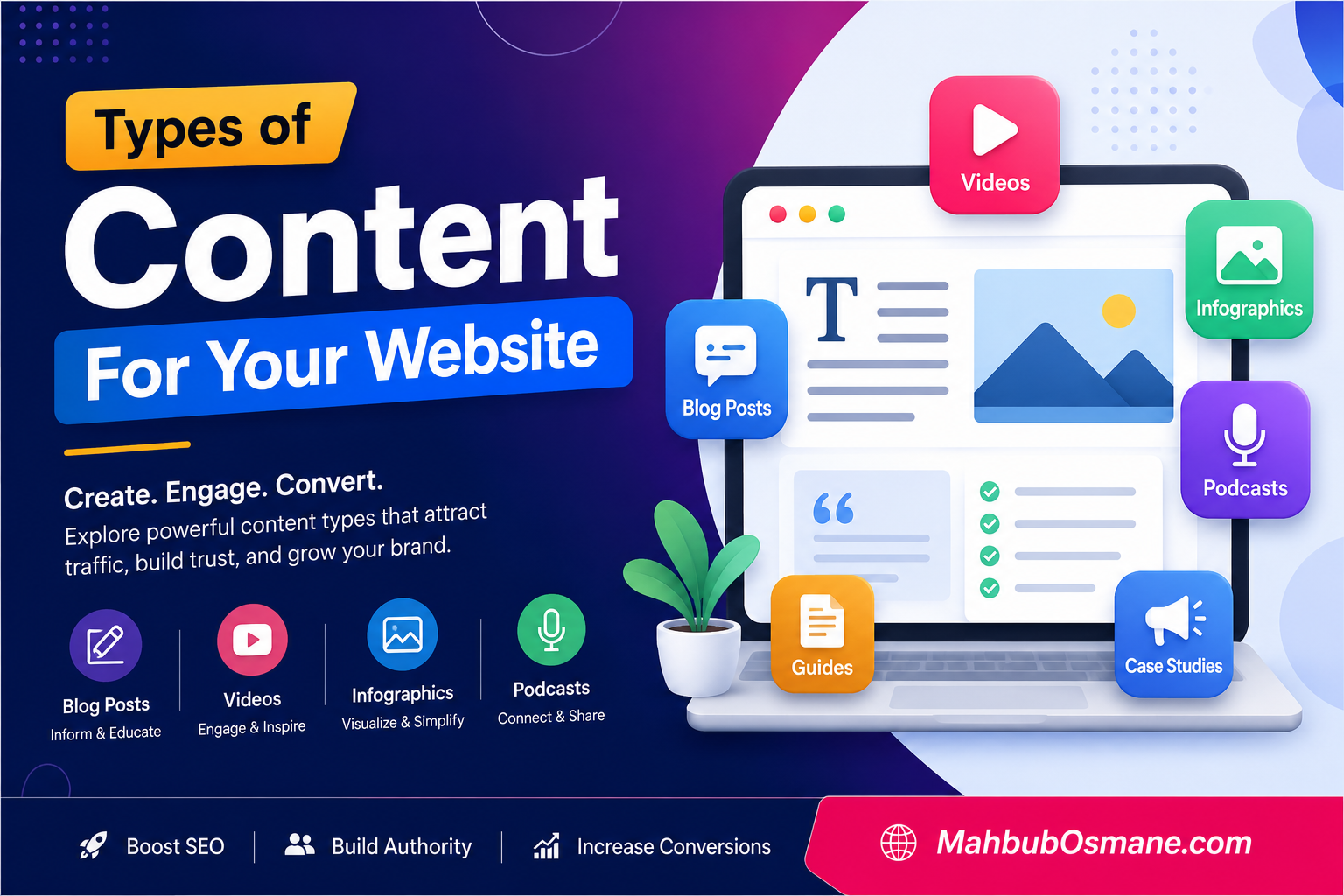
Types of Content for Your Website
In digital marketing, content isn’t just text on a screen—it’s the primary engine driving organic traffic, building brand authority, and converting casual visitors into loyal customers. Whether you run an e-commerce store, a B2B SaaS platform, a professional agency, or a personal blog, the specific types of content you publish determine how search engines rank your site and how effectively you connect with your audience.
Publishing the same format repeatedly—like standard 500-word blog posts—leads to content fatigue and missed opportunities across the buyer’s journey. High-performing websites rely on a balanced mix of written, visual, interactive, audio, and downloadable assets tailored to specific audience intent.
This guide breaks down every major website content type, analyzing how each format works, when to use it, its SEO and conversion benefits, and actionable best practices to build a high-ROI content strategy.
Core Written Content Types
Written content forms the foundation of search engine optimization (SEO) and information delivery. Search engines crawl text to understand topic relevance, contextual depth, and user intent.
                  ┌─────────────────────────────────────┐
                  │        Written Website Content      │
                  └──────────────────┬──────────────────┘
                                     │
       ┌─────────────────┬───────────┴───────────┬─────────────────┐
       ▼                 ▼                       ▼                 ▼
 ┌───────────┐    ┌─────────────┐         ┌─────────────┐    ┌───────────┐
 │   Blog    │    │ Comprehensive│         │ Case Studies│    │  Landing  │
 │   Posts   │    │   Guides    │         │ & Whitepapers│    │   Pages   │
 └───────────┘    └─────────────┘         └─────────────┘    └───────────┘
A. Educational Blog Posts & How-To Articles
Blog posts are the cornerstone of top-of-funnel (TOFU) organic search strategies. They answer common questions, address pain points, and target specific long-tail keywords.
-
Primary Goal: Drive organic search traffic, build top-of-mind awareness, and answer informational queries.
-
Ideal Search Intent: Informational (
How to...,What is...,Tips for...). -
Average Word Count: 1,200 – 2,500 words.
-
Key SEO Benefit: Broad keyword targeting and frequent freshness signals for search engines.
Best Practices for Blog Posts
-
Solve one specific problem: Avoid covering broad topics superficially. Focus on actionable solutions.
-
Optimize for readability: Use short paragraphs (2–3 sentences), clear H2 and H3 subheadings, and bullet points.
-
Include clear internal links: Guide readers from informational blog posts to related product pages, service landing pages, or deeper guides.
B. Long-Form Ultimate Guides & Pillar Pages
Ultimate guides (or cornerstone content) are comprehensive, highly authoritative resources that thoroughly cover a broad parent topic. Pillar pages often link out to smaller “cluster” articles that dive into subtopics.
-
Primary Goal: Establish topical authority, secure high-authority backlinks, and dominate broad, competitive search queries.
-
Ideal Search Intent: Comprehensive Informational (
Ultimate guide to...,Complete framework for...). -
Average Word Count: 3,000 – 7,000+ words.
-
Key SEO Benefit: High backlink potential, strong topical authority signals, and internal linking hub structure.
Topical Authority Tip: Create a central pillar page for your primary keyword (e.g., Digital Marketing) and link out to 10 supporting cluster articles (e.g., SEO Basics, Email Copywriting, PPC Bidding). This topical hub signals subject mastery to Google algorithms.
C. Case Studies & Success Stories
Case studies tell real-world stories about how your product, service, or solution helped a specific customer overcome a challenge and achieve measurable results.
-
Primary Goal: Build trust, validate social proof, and push bottom-of-funnel (BOFU) prospects toward conversion.
-
Ideal Search Intent: Commercial / Investigational (
[Company Name] customer results,[Industry] case study). -
Format Framework:
-
The Challenge: What roadblock was the client facing?
-
The Solution: Which specific strategy, tool, or service was implemented?
-
The Results: Data-driven metrics (e.g., “Increased organic leads by 184% in 90 days”).
-
D. Whitepapers & Industry Research Reports
Whitepapers are formal, research-driven documents that present deep data, industry benchmarks, or technical solutions. They are typically offered as gated content requiring an email address to download.
-
Primary Goal: Lead generation, B2B authority building, and executive-level audience engagement.
-
Key Advantage: Highly effective for B2B brands with long sales cycles requiring multi-stakeholder approval.
E. Product & Service Landing Pages
Landing pages are high-intent conversion engines designed to showcase your offerings, communicate unique value propositions, and drive immediate user action (purchases, quote requests, or sales calls).
| Element | Description | SEO & Conversion Impact |
| Hero Headline | Clear, value-focused proposition | Immediate clarity reduces bounce rate |
| Social Proof | Client logos, reviews, trust badges | Reduces purchase anxiety and builds trust |
| Feature/Benefit Grid | Concise breakdown of what sets you apart | Matches transactional search intent |
| Primary CTA | Single, focused call-to-action button | Directs users without distracting options |
Visual Content Types
Visual content aids comprehension, increases dwell time, and makes dense information accessible. Pages with strong visual assets experience significantly higher engagement and lower bounce rates.
A. Infographics
Infographics translate complex data sets, statistics, or multi-step processes into visually digestible graphic formats.
-
Why They Work: People process visual information substantially faster than text alone. Infographics are among the most shared and embedded content assets on the web.
-
SEO Benefit: High potential for earning natural editorial backlinks when other websites embed your graphic and credit your page with a link.
B. Custom Diagrams & Screenshots
Generic stock photos add minimal educational value. Annotated screenshots, custom flowcharts, and technical diagrams directly illustrate complex concepts.
-
Best Use Cases: Technical tutorials, software walkthroughs, architectural diagrams, and step-by-step guides.
-
Image SEO Checklist:
-
Save files using descriptive names (
content-marketing-funnel-diagram.pnginstead ofIMG_9042.png). -
Compress images (WebP format) to maintain fast page load speeds.
-
Write descriptive
alttags for accessibility and image search indexing.
-
Video Content Types
Video is one of the highest-converting content formats available online. Integrating video onto your website increases dwell time—a key user engagement signal for search engines.
                          ┌───────────────────────────┐
                          │   Website Video Content   │
                          └─────────────┬─────────────┘
                                        │
         ┌──────────────────────────────┼──────────────────────────────┐
         ▼                              ▼                              ▼
  ┌──────────────┐              ┌──────────────┐               ┌──────────────┐
  │ Explainer &  │              │  Product &   │               │ Testimonial  │
  │ Brand Videos │              │ Demo Videos  │               │ & Case Videos│
  └──────────────┘              └──────────────┘               └──────────────┘
A. Product Demos & Feature Walkthroughs
Product videos give visitors a clear look at how a physical product looks or how a software platform functions in real time.
-
Primary Function: Eliminate purchase friction on e-commerce product pages and SaaS sales pages.
-
Impact: Product videos can increase landing page conversion rates by up to 80%.
B. Explainer & Animated Videos
Explainer videos offer short (60–120 second) high-level introductions that break down complex value propositions or industry challenges.
-
Placement: Above the fold on landing pages or homepage hero sections.
-
Key Objective: Quickly communicate What problem you solve, How you solve it, and What the customer should do next.
C. Customer Video Testimonials
Authentic recorded interviews with real clients discussing their success build immediate credibility that written text alone cannot replicate.
Interactive Content Types
Static content informs, but interactive content engages. Interactive tools actively involve users, delivering tailored outputs based on their inputs.
A. Interactive Calculators & Tools
Calculators help users estimate ROI, project costs, calculate mortgage rates, or evaluate potential savings directly on your page.
-
Examples: ROI Calculators, Mortgage Repayment Estimators, Calorie/Macro Calculators, SEO Audit Tools.
-
Why They Perform: They attract massive organic search traffic, generate consistent backlinks, and keep users engaged on your site for extended sessions.
B. Quizzes & Self-Assessments
Interactive quizzes guide users through a series of questions to deliver personalized recommendations or diagnostic reports.
-
Primary Benefit: Highly effective for lead generation. Users gladly submit their email address to receive personalized quiz results or detailed diagnostic reports.
Audio & Downloadable Content Types
Gated downloads and audio streams help build direct relationships with your audience outside of search engine algorithms.
A. Podcasts & Embedded Audio
Embedding audio versions of articles or streaming hosted podcast episodes directly on your website creates multi-modal landing pages catering to listeners on the go.
B. eBooks, Templates & Checklists
Downloadable assets give users immediate, practical value they can reference offline.
-
Checklists & Cheat Sheets: Quick-reference step-by-step PDF lists that help users execute a task efficiently.
-
Templates & Frameworks: Pre-formatted spreadsheets, slide decks, or documents (e.g., Editorial Calendar Spreadsheet, SEO Audit Template).
Mapping Content Types to the Content Marketing Funnel
To convert traffic into revenue, you need the right content format at each stage of the buyer’s journey.
The table below breaks down which content formats work best across each funnel stage:
| Funnel Stage | Buyer State & Mindset | Recommended Content Types | Primary Goal |
| Top of Funnel (TOFU) | Discovering a problem or seeking general information |
• Educational Blog Posts
• Infographics
• Short How-To Videos
• Ultimate Pillar Guides |
Drive organic traffic, build brand awareness |
| Middle of Funnel (MOFU) | Evaluating solutions and comparing options |
• eBooks & Whitepapers
• Interactive Calculators
• Comparison Guides
• Expert Webinars |
Capture leads, nurture prospects via email |
| Bottom of Funnel (BOFU) | Preparing to make a purchasing decision |
• Customer Case Studies
• Live Product Demos
• Pricing & Comparison Pages
• Testimonials |
Drive conversions, close sales |
| Post-Purchase (Retention) | Maximizing value from purchase |
• Product Knowledge Bases
• Video Tutorials
• Customer Onboarding Guides |
Reduce churn, increase customer lifetime value |
How to Build a Balanced Website Content Strategy
Publishing random content formats without a unified framework leads to fragmented messaging and inconsistent traffic growth. Follow this structured roadmap to execute a balanced content calendar:
Summary Checklist for Website Content Creation
Before publishing any new content asset on your website, verify that it meets these baseline content standards:
-
[ ] Clear Search Intent Alignment: Does this asset directly answer what the searcher is looking for?
-
[ ] Scannable Formatting: Are there short paragraphs, descriptive H2/H3 headings, and structured lists?
-
[ ] Visual Enhancement: Does the page include custom graphics, diagrams, or embedded media to support the text?
-
[ ] Strategic Call to Action: Is there a clear next step for the reader (download a resource, read a related article, or request a quote)?
-
[ ] Technical & On-Page SEO: Are title tags, meta descriptions, image alt texts, and internal links fully optimized?
Publishing a diverse, high-quality mix of website content builds topical authority with search engines and delivers real value to your audience at every step of their journey.
Take Your Website Content Strategy to the Next Level with MahbubOsmane.com
Publishing high-impact website content isn’t just about writing words—it’s about crafting a cohesive digital ecosystem that ranks on search engines, engages buyers, and turns casual visitors into paying clients.
If your website isn’t delivering the traffic, leads, or conversions your business deserves, MahbubOsmane.com is here to scale your brand.
Why Global Brands Trust MahbubOsmane.com
We are a full-service digital marketing agency helping growing businesses and enterprise brands across Saudi Arabia, UAE, Qatar, Kuwait, USA, UK, Canada, Germany, Lithuania, and Bangladesh dominate their industries online.
When you partner with us, you are backed by proven global excellence:
-
700+ Completed Jobs with 5-Star Feedback on Upwork.
-
Top-vetted, elite talent verified on Hubstaff Talent.
-
Full-funnel digital growth strategies tailored to your target market.
Our 360° Digital Growth Services
Whether you need to build a high-converting website or run multi-channel organic and paid campaigns, our expert team delivers end-to-end solutions:
-
Professional SEO Services: On-page, technical, off-page, and topical authority frameworks to dominate Google SERPs.
-
Content Writing & Strategy: SEO-optimized long-form blog posts, pillar pages, landing page copy, and whitepapers that convert.
-
Website Development: Fast, responsive, custom-coded web development designed for user experience and seamless conversions.
-
AdOps & Performance Marketing: Data-driven PPC, Meta Ads, and display advertising management for maximum ROI.
-
Graphic Design & Video Editing: High-converting visual assets, custom infographics, explainer videos, and social media media.
-
Complete Digital Marketing Solutions: Tailored end-to-end strategies to capture market share locally and internationally.
Ready to Scale Your Revenue? Let’s Talk Today!
Stop letting your competitors take your traffic. Get in touch with our team today for a custom digital growth audit and consultation.
-
Saudi Arabia Offices:
+966549485900/+966553227950(WhatsApp Enabled) -
Bangladesh Office:
+8801716988953(WhatsApp Enabled) -
Email Us:
hi@mahbubosmane.com|mahbubosmane@gmail.com -
Official Website: www.MahbubOsmane.com
💬 Chat & Call Us on WhatsApp Now
FAQ
What are the main types of content every website should have?
A balanced website content strategy incorporates a mix of written content (blog posts, landing pages, ultimate guides), visual assets (infographics, diagrams, screenshots), video media (product demos, explainer videos, video testimonials), interactive tools (calculators, assessments, quizzes), and downloadable assets (eBooks, checklists, whitepapers). Covering multiple formats ensures you engage users with different learning preferences while serving various stages of the buyer’s journey.
How does publishing different types of content improve SEO?
Search engines reward websites that demonstrate depth, relevance, and user engagement. Varied content types help target diverse search intents—from long-tail informational queries via blog posts to transactional queries via service pages. Additionally, visual and interactive assets earn valuable backlinks and increase overall dwell time on your site, both of which serve as positive organic ranking signals.
How do I choose the best content format for my business goals?
Your choice of content format should be guided by your target audience’s specific intent and where they sit in the sales funnel. Use educational blog posts and infographics for top-of-funnel brand awareness, interactive calculators and eBooks for middle-of-funnel lead generation, and case studies, testimonials, and detailed landing pages for bottom-of-funnel conversions.
What is the ideal word count for blog posts and long-form guides?
Standard educational blog posts typically perform best between 1,200 and 2,500 words. Comprehensive ultimate guides and pillar pages often range from 3,000 to over 7,000 words. Rather than aiming for arbitrary word counts, focus on providing thorough, high-quality answers that satisfy the searcher’s intent without unnecessary filler.
Why is video content essential for modern website engagement?
Video content communicates information quickly and holds visitor attention far better than text alone. Incorporating video—such as product walkthroughs or explainer videos—can significantly boost landing page conversion rates, lower bounce rates, and extend session duration, signaling to search engine algorithms that your page delivers high-value information.
How do interactive tools like calculators generate higher conversions?
Interactive tools provide immediate, customized utility to visitors based on their personal inputs (such as estimated ROI or project costs). Because these tools solve an immediate numerical or practical problem, users spend more time interacting with your site and are much more willing to submit their contact information to save or download their personalized results.
What is the difference between top-of-funnel (TOFU) and bottom-of-funnel (BOFU) content?
Top-of-funnel content focuses on answering general informational questions and educating readers who are just discovering a problem or topic (e.g., “What is Digital Marketing?”). Bottom-of-funnel content addresses buyers who are ready to make a decision, showcasing specific product features, pricing, competitive comparisons, and verified client success stories (e.g., “Case Study: How We Grew Organic Revenue by 200%”).
How often should I audit and update existing website content?
It is recommended to perform a thorough content audit every 6 to 12 months. Updating existing pages with refreshed statistics, improved visuals, internal links, and expanded sections prevents information decay, improves keyword rankings, and signals search engine crawlers that your domain remains actively maintained.
What role do case studies play in driving website conversions?
Case studies act as powerful social proof by proving that your solution yields real, measurable outcomes. By outlining a past client’s initial challenges, your implemented solution, and hard data metrics of the final result, you alleviate purchase anxiety for bottom-of-funnel prospects.
How can gated content build an email subscriber list?
Gated content—such as whitepapers, actionable checklists, or downloadable eBooks—offers high-value, exclusive knowledge in exchange for a user’s contact information (such as name and business email). This gives you direct permission to nurture those leads via automated email sequences over time.
How can I optimize images and infographics for search engines?
Optimize visual assets by saving files with descriptive, keyword-rich names (e.g., website-content-strategy-diagram.png), compressing images into fast-loading WebP formats, and adding detailed alt text to assist screen readers and help search engines properly index your media.
What is content repurposing and why is it valuable?
Content repurposing involves taking a primary content asset and adapting it into multiple formats across different platforms. For instance, a 4,000-word pillar guide can be transformed into a downloadable PDF summary, a series of short social posts, an infographic, a podcast topic, and a short explainer video, maximizing your return on content investment.
How does interactive content improve website dwell time?
When visitors engage with quizzes, self-assessments, or dynamic diagrams, they spend significantly more time interacting on your page compared to passively reading text. Increased dwell time sends strong positive signals to search engines regarding your content’s quality and user satisfaction.
What makes a service or product landing page high-converting?
High-converting landing pages combine a clear headline, explicit unique value propositions, scannable feature grids, prominent trust markers (client logos, review badges), and a single, focused call-to-action (CTA) that leaves no room for reader confusion.
Should small businesses focus on written, video, or visual content first?
Small businesses should prioritize written core content first—specifically foundational landing pages and targeted how-to blog posts—to establish initial organic search visibility and search engine indexing. Once organic authority begins to build, expanding into visual infographics and simple short-form videos will accelerate visitor conversion rates.
How do internal links support a website’s content structure?
Internal links guide human visitors to relevant deeper pages while helping search engine spiders discover new URLs and comprehend the structural hierarchy of your content clusters. Linking informational blog posts directly to commercial product or service pages guides traffic seamlessly toward conversion.
How can audio content or embedded podcasts benefit a website?
Embedded audio versions of blog posts and hosted podcasts cater to on-the-go audience members who prefer listening over reading. This multi-modal approach enhances overall page accessibility, keeps users engaged on the page longer, and opens up new audience acquisition channels.
What is a content cluster and how does it relate to pillar pages?
A content cluster is an SEO structural architecture where a broad master page (the pillar page) links to and receives links from multiple related, subtopic pages (cluster posts). This interlinked network demonstrates deep topical authority to search engines, boosting search rankings across the entire topic cluster.
External Resources
-
Learn how search engines crawl, index, and rank web pages by reading the official Google Search Central Documentation.
-
For deeper strategies on building high-converting landing pages and pillar posts, explore the HubSpot Marketing Blog.
-
Stay updated on advanced search engine optimization and topical authority frameworks at The Moz Blog.
-
Discover industry trends, search algorithm changes, and digital advertising strategies on Search Engine Land.
Internal Resources
-
Discover how our tailored Professional SEO Services can help your website rank on Google’s first page.
-
Need high-converting pillar posts and long-form guides? Check out our expert Content Writing Services.
-
Learn more about custom, fast-loading site designs on our Website Development Page.
-
Get in touch with our expert team directly via our Contact Us page for a personalized growth audit.
About the Author
Mahbub Osmane is a digital marketing expert who helps businesses build effective online strategies, including selecting and managing the right social media channels for growth. With hands-on experience across platforms and markets, Mahbub shares practical, actionable insights to help businesses connect with their audience and grow their brand presence.
Contact information Email: hi@mahbubosmane.com Website: https://mahbubosmane.com/ Mobile: +966 54 948 5900 (KSA) / +880 1716 988953 (BD) Address: 2282 7284 Al Malawi Southern 1, As Sulimaniyah Dist, Makkah 24236, Saudi Arabia