
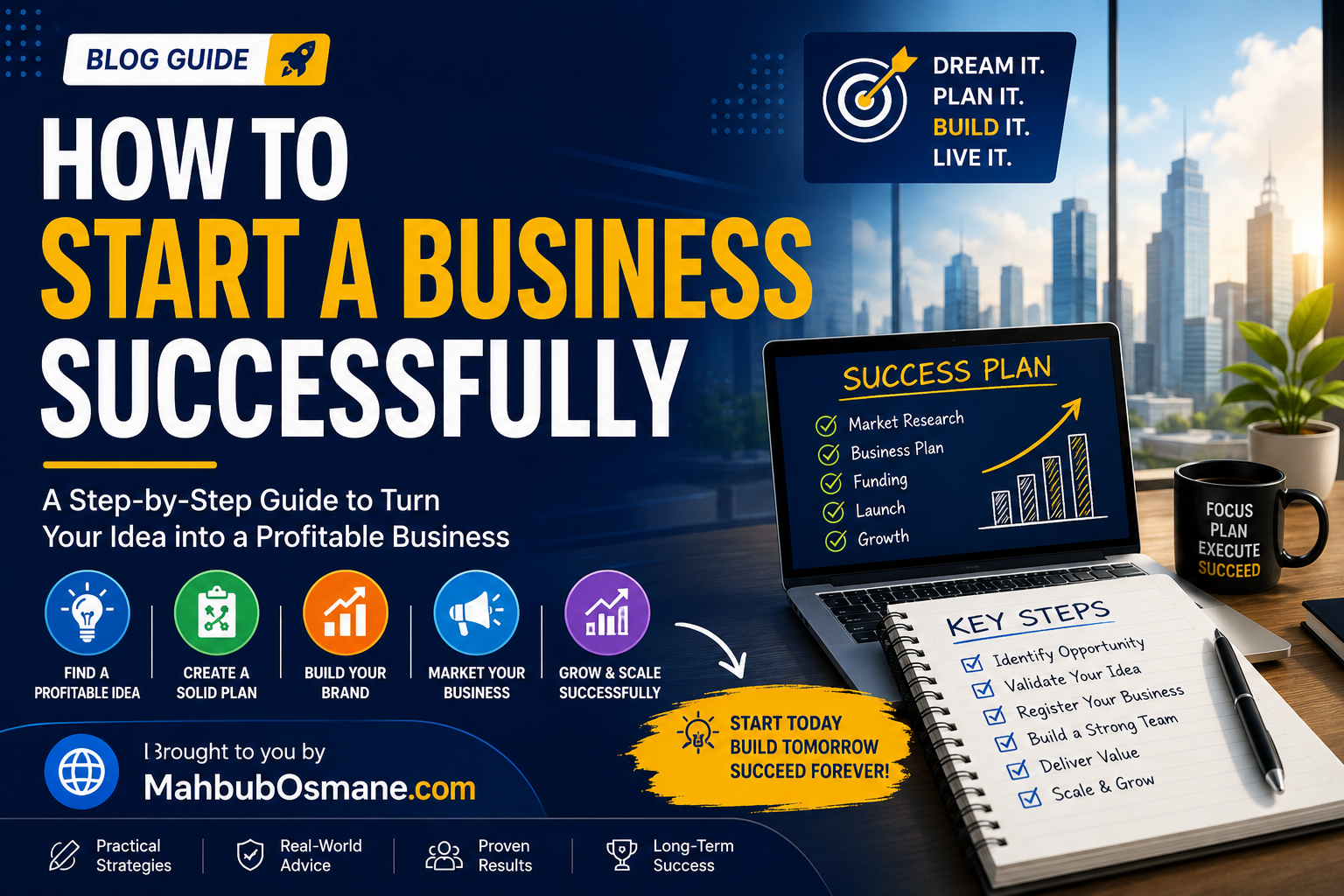
How To Start a Business Successfully
Starting a business is one of the most thrilling, terrifying, and deeply rewarding journeys you can undertake. It is the ultimate expression of autonomy—an opportunity to turn an abstract idea into a living, breathing entity that creates value, employs people, and solves real-world problems.
But let’s skip the romanticized startup myths. You don’t need a sleek Silicon Valley office, millions in seed funding, or a revolutionary idea that alters human consciousness to build a highly successful company. What you do need is a repeatable, disciplined system.
According to the data, roughly 20% of new businesses fail in their first year, and about 50% falter by year five. Businesses rarely fail because the founder lacked passion; they fail because they ran out of cash, built something nobody actually wanted, or skipped the foundational mechanics of execution.
This comprehensive guide is designed to help you beat those odds. Whether you want to launch a local service company, an e-commerce brand, a freelance agency, or a high-growth tech startup, this step-by-step framework will guide you from a blank page to your first profitable year.
Validating the Idea (Finding Product-Market Fit)
Every business starts with an idea, but not every idea is a viable business. The most common trap new founders fall into is falling in love with their solution rather than the problem. To build a successful company, you must invert your focus: become obsessed with the problem, and let the market dictate the solution.
The Intersection of Viability
A winning business idea lives at the intersection of three distinct pillars:
-
Your Expertise/Passion: What are you good at? What do you have unique insights into?
-
Market Demand: Are people actively searching for a fix to this problem?
-
Willingness to Pay: Does the problem hurt badly enough that people will hand over hard-earned money to make it go away?
    [ Passion & Skills ]  <--->  [ Market Demand ]
              \                   /
               \                 /
                [ Willingness to Pay ]
                         |
                 ( The Sweet Spot )
De-risking via Market Research
Before investing thousands of dollars or months of your life, you need to validate your assumptions. Market research shouldn’t be an abstract academic exercise. Focus on three actionable areas:
-
Analyze Competitors: If there are no competitors, be highly skeptical. A total lack of competition usually means there is no market. Look at your direct competitors (companies doing exactly what you want to do) and indirect competitors (companies solving the same problem differently). Read their 1-star reviews on Google, Trustpilot, or Amazon. What are they messing up? Where are they leaving customers frustrated? That gap is your entry point.
-
Conduct “Problem Interviews”: Talk to at least 10 to 15 people who fit your ideal customer profile. Do not ask them, “Would you buy my product?” (People will lie to be polite). Instead, ask: “What is the hardest part about [insert your domain]?” and “How do you currently try to solve this problem, and what do you hate about that solution?”
-
Run a Smoke Test: Build a simple, single-page website using tools like Carrd, Webflow, or WordPress. Explicitly detail your product or service offering and include a clear call-to-action (e.g., “Join the early access waitlist” or “Pre-order now for 20% off”). If you can drive traffic to that page through organic social media or a tiny ad spend and convert visitors into email sign-ups or pre-orders, you have verified real human interest.
Defining Your Value Proposition & Business Model
Once you know a problem exists, you need to articulate exactly how you will solve it better than anyone else, and how your business will generate sustainable revenue.
The Minimum Viable Product (MVP)
Avoid the temptation to build a flawless, fully-featured version of your product right out of the gate. LinkedIn founder Reid Hoffman famously noted: “If you are not embarrassed by the first version of your product, you’ve launched too late.”
Your MVP should be the absolute stripped-down version of your idea that still delivers core value to the user.
-
If you’re starting a software company, your MVP might be a basic tool built on no-code infrastructure.
-
If you’re starting a cleaning service, your MVP is you, a vacuum, and a simple booking sheet.
-
If you’re starting an e-commerce brand, your MVP might be a curated selection of three core products rather than a catalog of fifty.
The purpose of the MVP is to start the feedback loop with real customers as fast as humanly possible.
Choosing Your Revenue Engine
How exactly will your business make money? Your business model dictates your cash flow cycles, your margins, and how you scale. The major modern models include:
-
Value-Based Pricing (Services): Charging a flat or hourly fee based on the direct outcome you provide (e.g., consulting, copywriting, digital marketing).
-
E-commerce / Direct-to-Consumer (DTC): Manufacturing or sourcing physical products and selling them via an online storefront directly to consumers.
-
Subscription / SaaS (Software as a Service): Charging a recurring monthly or annual fee for continuous access to a product or service. This is highly prized by investors due to its predictable recurring revenue.
-
Marketplace: Acting as a middleman connecting buyers and sellers, taking a percentage fee from each transaction (e.g., Uber, Airbnb, Fiverr).
Writing a Lean Business Plan
Do not spend three weeks writing a dense, 50-page business plan that will sit in a drawer gathering dust. In the early stages of a business, agility is everything. Instead, use a Lean Business Plan framework that maps out the vital architecture of your company on a single page.
Focus on filling out these nine essential blocks:
| Block | Core Focus | Key Question to Answer |
| 1. The Problem | Customer Pain Points | What are the top 3 problems your target audience faces? |
| 2. Target Customer | User Archetype | Who exactly has this problem? Define their demographics and psychology. |
| 3. Unique Value Prop | Your Edge | What makes your solution different, compelling, and worth paying for? |
| 4. The Solution | Your Product/Service | What are the core features of your MVP that solve the stated problems? |
| 5. Marketing Channels | Reaching the Market | How will you find, attract, and acquire your first 100 customers? |
| 6. Revenue Streams | Monetization | How will you price your product? What are the payment terms? |
| 7. Cost Structure | Outflows | What are your fixed expenses (software, rent) and variable costs? |
| 8. Key Metrics | Tracking Success | What numbers actually matter? (e.g., lifetime value, acquisition cost). |
| 9. Unfair Advantage | Defendability | What do you have that cannot be easily copied or bought by competitors? |
Legal Formation, Licensing, and Structuring
Now it’s time to make it official. Ignoring the legal and administrative foundations can lead to catastrophic tax penalties or personal liability down the road. Take the time to set up your corporate fortress correctly.
Choose the Right Legal Entity
The structure you choose impacts everything from your daily operations to how much tax you pay, and how much personal risk you shoulder.
-
Sole Proprietorship: The simplest, default structure if you just start doing business under your own name. Warning: There is zero legal separation between you and the business. If the business gets sued or defaults on a debt, your personal assets (home, car, savings) are at risk.
-
Limited Liability Company (LLC): The sweet spot for most small businesses and startups. It treats the business as a separate legal entity, protecting your personal assets from business liabilities while keeping taxes simple via “pass-through” taxation (profits are taxed on your personal tax return).
-
C-Corporation: Necessary if you plan to seek venture capital funding, issue stock options to early employees, or eventually take the company public. It is subject to more complex administrative rules and potential double taxation, but it offers the strongest shield for owners.
Business Registration & Tax Setup
Once your structure is decided, complete these four bureaucratic steps:
-
Register Your Business Name: Secure your legal name with your state or national business registry. If you are operating under a name different from your legal entity name, file a DBA (“Doing Business As”).
-
Get an EIN (Employer Identification Number): Think of this as a social security number for your business. It’s issued for free by the IRS (or your country’s equivalent revenue agency) and is required to open a business bank account and file corporate taxes.
-
Secure Permits and Licenses: Depending on your location and industry (e.g., food service, brick-and-mortar retail, professional consulting), you may need local city zoning permits, health department approvals, or state professional licenses.
-
Protect Intellectual Property: If your brand identity, logo, or proprietary technology is a major asset, file for trademarks or patents early to prevent copycats from stealing your branding.
Financial Architecture & Cash Flow Management
The number one rule of business survival is simple: Never run out of money. Cash flow is the oxygen of your business. A company can be wildly profitable on paper but still go bankrupt if its cash is tied up in inventory or unpaid invoices when bills come due.
Separate Personal and Business Finances
The absolute first thing you must do after receiving your EIN is open a dedicated Business Checking Account.
Never co-mingle funds. Using your personal debit card for business expenses or depositing client checks into your personal accounts ruins your limited liability protection (a legal concept known as “piercing the corporate veil”) and makes tax season a total nightmare.
Build Your Tech Stack for Finance
Do not rely on messy, manual spreadsheets to track your business health. Implement a clean accounting stack from day one:
-
Accounting Software: Tools like QuickBooks, Xero, or FreshBooks pull transactions directly from your bank account and categorize them automatically.
-
Invoicing & Payments: Use robust payment gateways like Stripe or PayPal to make it frictionless for clients to pay you via credit card or ACH transfer.
-
Expense Management: Tools like Expensify or Ramp help track team receipts and recurring software subscriptions easily.
Understand Your Core Financial Metrics
You don’t need an MBA to run a successful business, but you must master these four essential financial terms:
-
Burn Rate: How much cash your business spends each month to stay alive (rent, payroll, software). If you have $50,000 in the bank and your burn rate is $5,000 a month, you have exactly 10 months of “runway” left to become profitable before you run out of cash.
-
Gross Margin: The percentage of revenue left over after deducting the direct costs of producing your good or service (Cost of Goods Sold, or COGS). High gross margins (70-90%, common in software/digital services) mean you have plenty of room to invest in marketing. Low gross margins (10-30%, common in retail/grocery) mean you must operate at massive volume to survive.
-
Customer Acquisition Cost (CAC): The total amount of money spent on marketing and sales divided by the number of new customers acquired during that period.
-
Lifetime Value (LTV): The total amount of money a single customer is expected to spend with your business over their entire relationship. For a healthy business, your LTV should be at least 3x greater than your CAC.
Brand Identity & Digital Infrastructure
Before you launch your marketing campaigns, you must build a trustworthy digital home. In the modern economy, your website and digital presence act as your primary storefront, customer service desk, and sales closer all in one.
Establishing Your Visual Identity
Keep it clean, professional, and minimal at the start. You don’t need to spend $5,000 on a branding agency.
-
Logo & Assets: Use platforms like Canva, Looka, or hire an affordable freelance designer on 99designs or Upwork to build a clean logo, specify your brand colors (stick to 2-3 matching tones), and choose consistent typography.
-
Domain Name: Buy a domain that is short, easy to spell, and ideally ends in a trusted extension like
.com. If your exact name is taken, consider adding action words (e.g.,get[brand].comoruse[brand].com).
Building a High-Converting Website
Your website should not just be an informational brochure; it needs to be an intentional sales engine. Whether you build it on WordPress, Shopify, Squarespace, or Webflow, ensure it features these essential conversion elements:
Crafting a Go-to-Market (GTM) Strategy
You can build the most incredible product or service in human history, but if nobody knows it exists, your business will fail. A successful launch requires a structured mix of short-term outbound tactics and long-term inbound marketing engines.
Organic Content Marketing & SEO
Content marketing is the process of creating free, highly valuable articles, videos, or resources that solve minor problems for your audience, proving your expertise and naturally steering them toward your paid offerings.
-
Inbound Engine: Write long-form, deeply researched educational guides on your company blog (just like this post).
-
Search Engine Optimization (SEO): Research the exact terms your target audience types into Google using tools like Ahrefs, SEMrush, or Google Keyword Planner. Optimize your website pages so they rank organically for those queries, bringing you free, highly targeted traffic for years to come.
Social Media & Audience Building
Do not try to be everywhere at once. It is far better to dominate a single social media platform where your audience actually hangs out than to be mediocre and spread thin across five platforms.
-
B2B Companies (Business to Business): Focus heavily on LinkedIn. Share behind-the-scenes insights, industry trends, and strategic frameworks to build authority with founders, executives, and decision-makers.
-
B2C Companies (Business to Consumer): Focus on highly visual channels like Instagram, TikTok, and YouTube. Lean heavily into video content showing your product in action, focusing on short-form storytelling and organic user-generated content (UGC).
Outbound Sales & Direct Outreach
If you are running a high-ticket service or consulting business, do not sit around waiting for Google traffic to find you. Take control of your early growth through active outbound prospecting.
-
Cold Email & Social Outreach: Build a highly curated list of 50 to 100 dream clients who perfectly fit your target profile. Send them highly personalized, short messages.
-
The Golden Rule of Outreach: Do not pitch your services in the very first sentence. Instead, highlight a specific problem you noticed in their current workflow and offer a quick, free, low-friction piece of value (e.g., “Hey [Name], I noticed a small bug on your checkout page that might be losing you sales. I made a quick 2-minute video showing how to fix it—mind if I send it over?”).
Scaling Operations, Automation, and Systems
In the early stages of a business, you are the chief cook, dishwasher, and CEO. You do everything. But if you want your business to grow without grinding you into absolute burnout, you must transition from working in your business to working on your business.
Document Standard Operating Procedures (SOPs)
Every time you perform a recurring task more than twice—whether it’s onboarding a new client, publishing a blog post, or reconciling monthly invoices—write down the step-by-step process.
-
Use tools like Loom to record your screen while doing the task, and use Notion or Google Docs to store the text steps.
-
Building a comprehensive library of SOPs ensures that when you are ready to hire your first employee or virtual assistant, you can hand over the keys and have them execute the task perfectly with zero micromanagement.
Automate with Tech Integrations
Before hiring human help, maximize software automation to eliminate repetitive admin tasks.
-
Connect your software ecosystems using integration hubs like Zapier or Make.
-
Set up automations like: When a customer fills out the contact form on our website -> automatically create a profile in our CRM (like HubSpot or Salesforce) -> send a notification to our team Slack channel -> send an automated introductory email to the client with a scheduling link (like Calendly).
Assembling Your Team
When you hit the natural ceiling of your own time and capacity, begin scaling your workforce strategically:
-
Contractors & Freelancers: Start here. Hire freelancers on specialized platforms for discrete projects (graphic design, development, copywriting). This keeps your fixed overhead incredibly low and lets you scale capacity up or down as revenue fluctuates.
-
Key Advisory Support: You don’t need a full-time CFO or general counsel. Retain a qualified Certified Public Accountant (CPA) for monthly tax planning and corporate accounting reviews, and consult a trusted business lawyer to draft your core client contracts and employment agreements.
Summary Timeline: Your First 12 Months
Building a successful business is a marathon, not a sprint. To help you maintain realistic expectations, here is what a healthy, disciplined 12-month timeline looks like for an average startup:
Final Thoughts: The Founder’s Mindset
At the end of the day, strategies, tactics, and tech stacks are just tools. The ultimate factor that determines whether your business succeeds or fails is your own psychological resilience.
Entrepreneurship is a series of extreme highs and crushing lows. There will be days when you feel like you are conquering the world, and days when your biggest client fires you, your software breaks, and cash flow looks tight.
The most successful founders aren’t the ones who never fail; they are the ones who view failure as cheap data. Every rejection, lost sale, or broken process is simply a signpost telling you how to adjust your course. Keep your fixed costs low, listen closely to your customers, protect your cash flow like a hawk, and show up every single day with the discipline to execute the boring fundamentals.
Your dream business isn’t going to build itself. Take the first step today: pick up a single sheet of paper, sketch out your Lean Business Plan, and go talk to your first prospective customer.
Ready to Turn Your Business Vision Into a Market-Leading Reality?
Building a successful business requires an exceptional strategy—but scaling it requires world-class execution. You don’t have to build your digital infrastructure alone. Whether you are establishing a new corporate footprint or accelerating an existing enterprise, MahbubOsmane.com is your trusted global growth partner.
We specialize in engineering high-converting digital ecosystems for ambitious businesses across Saudi Arabia, the UAE, Qatar, Kuwait, the USA, the UK, Canada, Germany, Lithuania, and Bangladesh.
Why Market Leaders Partner With Us
We don’t just provide services; we deliver proven, verifiable results. Our reputation as an elite global digital agency is backed by unmatched industry credentials:
-
700+ Successfully Completed Jobs globally.
-
Flawless 5-Star Feedback track record on Upwork.
-
Top-Tier Top Rated Status and active availability on Hubstaff Talent.
Our End-to-End Growth Stack
From early-stage validation to global market dominance, we provide the exact technical and creative assets your business needs to outperform the competition:
-
Professional SEO & Content Writing: Drive high-intent organic traffic that converts readers into lifelong customers.
-
High-Yield AdOps & Digital Marketing: Optimize your paid acquisition channels to maximize ROI and lower your Customer Acquisition Cost (CAC).
-
Website Development & Graphic Design: Build fast, secure, enterprise-grade digital storefronts paired with stunning, cohesive visual branding.
-
Cinematic Video Editing: Captivate your target audience with high-impact video storytelling optimized for all digital channels.
Secure Your Free Growth Consultation Today
Let’s map out a customized digital strategy to scale your operations, automate your acquisition, and dominate your industry niche. Reach out directly via our official channels below:
-
Global Web Gateway: www.MahbubOsmane.com
-
Corporate Communications: hi@mahbubosmane.com | mahbubosmane@gmail.com
-
Saudi Arabia Office (WhatsApp Available): +966549485900 | +966553227950
-
Bangladesh Office (WhatsApp Available): +8801716988953
FAQ
What are the main steps to starting a business?
Starting a business successfully begins with deep market research to validate a real customer problem. From there, you must design a Minimum Viable Product (MVP), outline a single-page Lean Business Plan, choose a protective legal structure (like an LLC or Corporation), establish dedicated business bank accounts, and deploy a high-converting website paired with an active marketing engine.
How much money do I need to start a business?
The initial capital required depends heavily on your business model. Digital service agencies, freelancing, and software consulting can often launch for less than $500 using basic software, domains, and hosting. Conversely, e-commerce brands, physical retail storefronts, and manufacturing businesses require thousands of dollars upfront to cover inventory, logistics, and legal compliance.
What is a Minimum Viable Product (MVP) and why does it matter?
An MVP is the absolute most basic, stripped-down version of your product or service that still delivers core value to your customer. Launching an MVP matters because it protects you from wasting months of time and thousands of dollars building complex features before verifying that real human beings are actually willing to pay for your solution.
Can I start a business while working a full-time job?
Absolutely. Many modern founders validate their business ideas by “side-hustling” during evenings and weekends. This allows you to test market demand, build your digital infrastructure, and land your first few paying clients without sacrificing the financial security of a steady, full-time salary.
Should I form an LLC or a Sole Proprietorship?
For most small businesses, an LLC (Limited Liability Company) is highly recommended over a Sole Proprietorship. While a Sole Proprietorship is easy to start, it leaves your personal assets completely unprotected if the business gets sued. An LLC establishes a firm legal shield separating your personal savings and home from your corporate liabilities.
How do I register a business name internationally?
You must register your business in the specific country or state where your corporate entity is legally formed. If you plan to serve international clients, you do not need separate registrations in every country; instead, ensure your primary entity is compliant and that you have legally secured your global .com domain name and relevant international trademarks.
What is the most common reason why new businesses fail?
According to data, the primary catalyst for business failure is running out of cash flow, closely followed by building a product for which there is no real market demand. Founders often exhaust their capital on decorative expenses, fancy branding, or unproven product development before validating their customer acquisition channels.
How do I handle corporate accounting without an MBA?
The key is separation and automation. Open a dedicated business checking account immediately and never mix personal and professional funds. Use modern accounting software like QuickBooks or Xero to automatically track expenses, and retain a qualified Certified Public Accountant (CPA) to manage tax strategies and quarterly compliance.
What are the best digital marketing channels for a new startup?
The ideal channel depends completely on where your target audience naturally hangs out. For B2B companies looking for corporate decision-makers, LinkedIn outreach and long-form SEO blog content are highly effective. For B2C brands selling consumer goods, short-form video marketing on platforms like Instagram, TikTok, and YouTube drives the fastest engagement.
What is the difference between an organic and a paid growth strategy?
Organic growth uses Search Engine Optimization (SEO), unpaid social media building, and content marketing to attract customers naturally over time—making it highly cost-effective but slow to scale. Paid growth uses targeted ads (Google Ads, Meta Ads) to buy immediate traffic, offering rapid visibility but requiring continuous financial investment.
How do I calculate my Customer Acquisition Cost (CAC)?
To calculate your CAC, divide your total marketing and sales expenditure during a specific timeframe by the total number of new customers acquired in that exact same period. For example, if you spend $1,000 on digital ads in a month and acquire 10 new clients, your customer acquisition cost is exactly $100 per customer.
What is Lifetime Value (LTV) and why is it critical?
LTV measures the total gross profit or revenue a single customer is expected to generate for your business over the entire duration of their relationship with you. A healthy, scalable company should maintain an LTV that is at least three times greater than its CAC, ensuring your marketing spend remains highly profitable.
When is the right time to hire my first employee or freelancer?
You should look to expand your team when the operational tasks of your business (like invoicing, customer support, or basic fulfillment) are actively preventing you from focusing on high-level growth, strategy, and sales. Start with specialized freelancers to keep overhead low before taking on full-time salaries.
What is an SOP and how does it help scale a company?
An SOP is a Standard Operating Procedure—a documented, step-by-step guide explaining exactly how to execute a recurring task within your company. Documenting your workflows allows you to hand off everyday operations to new employees or virtual assistants, ensuring consistent quality while freeing up your personal time.
Do I need venture capital funding to build a successful startup?
No, the vast majority of highly successful businesses are bootstrapped, meaning the founders fund early growth entirely out of pocket or through early customer revenues. Venture capital is only necessary if you are entering a winner-take-all market that requires millions of dollars in rapid software engineering or hyper-aggressive customer acquisition.
How can a professional agency accelerate my business launch?
A professional digital growth agency handles the heavy lifting of building your technical infrastructure. Instead of spending months trying to learn SEO, copy editing, graphic design, and web development from scratch, an agency provides an elite team to build a polished, fully optimized online presence that attracts high-value leads immediately.
Why should I focus on my business blog and long-form content?
A high-quality business blog establishes your authority, educates prospective buyers, and solves minor problems for your audience before they ever speak to a sales representative. Most importantly, it serves as an asset for Search Engine Optimization (SEO), continually bringing free, high-intent Google traffic to your storefront.
How do I create a website that converts visitors into customers?
A high-converting website avoids excessive text and focuses on a clean visual hierarchy. It features a bold value proposition above the fold, highlights compelling social proof (such as 5-star customer reviews), breaks down the product framework clearly, and includes a completely frictionless call-to-action—like a prominent direct-connect WhatsApp button.
Internal Resources
-
Master the Technical Fundamentals: If you’re building a digital entity from the ground up, learn how to audit your site’s core infrastructure by exploring our complete guide on How to Audit a Website for Technical SEO Issues.
-
Establish Foundational SEO Rules: Learn how to drive long-term organic revenue safely without search engine penalties by reviewing our core manual on White Hat SEO Service & Safe Google Rankings.
-
Scale Your Corporate Web Architecture: Discover how a fully customized visual architecture adds corporate credibility and scales your consumer operations by exploring our overview of Top-Notch Web Development Services.
-
Accelerate Organic Market Reach: Expand your foundational search presence and understand how user experience transforms leads by reading What is SEO? The Ultimate Guide to Search Engine Optimization.
External Resources
-
Incorporate Your Corporate Entity Successfully: Safely file your legal entity structure, secure your EIN, and navigate startup regulations via the official federal business gateway provided by the U.S. Small Business Administration (SBA).
-
Design and Outline a Lean Business Model Canvas: Download, map out, and structure your single-page operational blueprint using the open-source business layout standards developed by Strategyzer.
-
Analyze Early-Stage Startup Failure Benchmarks: Access updated corporate failure statistics, growth tracking, and primary validation datasets published directly by the financial intelligence database CB Insights.
-
Calculate and Balance Core Unit Economics: Access strategic economic definitions and balance your business LTV-to-CAC target models using the expert growth framework publications at the Harvard Business Review (HBR).
About the Author
Mahbub Osmane is a digital marketing expert who helps businesses build effective online strategies, including selecting and managing the right social media channels for growth. With hands-on experience across platforms and markets, Mahbub shares practical, actionable insights to help businesses connect with their audience and grow their brand presence.
Contact information Email: hi@mahbubosmane.com Website: https://mahbubosmane.com/ Mobile: +966 54 948 5900 (KSA) / +880 1716 988953 (BD) Address: 2282 7284 Al Malawi Southern 1, As Sulimaniyah Dist, Makkah 24236, Saudi Arabia