
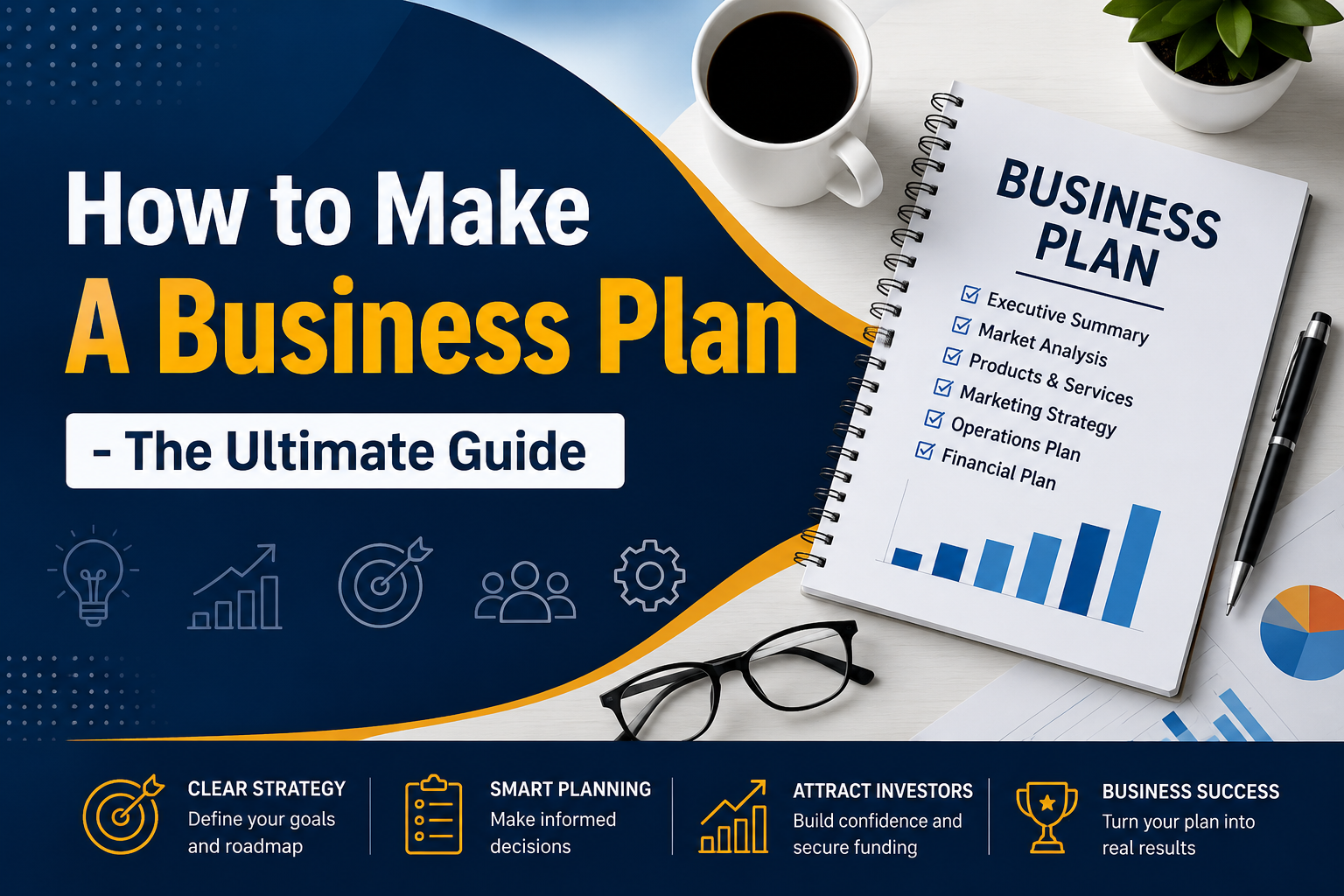
How to Make A Business Plan – The Ultimate Guide
A comprehensive, business-ready business plan is the single most critical asset for transforming an entrepreneurial vision into a thriving enterprise. Far more than a static document required to appease bank loan officers or venture capitalists, a well-structured business plan acts as a dynamic roadmap. It pressure-tests your operational assumptions, exposes financial bottlenecks before they manifest, aligns your leadership team, and maps out a definitive trajectory toward sustainable profitability.
Whether you are launching a high-growth technology startup, opening a brick-and-mortar retail boutique, or scaling a service-based agency, this ultimate guide details the architecture, methodology, and strategic execution required to write a world-class business plan from scratch.
The Strategic Purpose of a Business Plan
Before putting pen to paper, you must understand why you are creating this document. A business plan serves two primary audiences: your internal team and external stakeholders. Internally, it forces you to move from vague ideas to concrete numbers. It acts as an objective reality check on whether your business model can actually generate a profit. Externally, it serves as your calling card for capital. It demonstrates to investors, banks, and potential partners that you possess a deep understanding of your market, your financial realities, and your operational requirements.
Writing a business plan is an exercise in de-risking your future enterprise. By identifying your target demographics, mapping out supply chains, and forecasting cash flows early on, you resolve costly mistakes on paper before spending actual capital in the real world.
Executive Summary: The Definitive Hook
The Executive Summary is the most critical portion of your entire document. Positioned at the very front of the plan but invariably written last, its primary objective is to capture immediate interest and compel investors, lenders, or partners to read further. Think of it as a distilled, high-impact version of your business’s identity, objectives, and financial viability.
┌──────────────────────────────────────────────────────────┐
│                    EXECUTIVE SUMMARY                     │
├──────────────────────────────────────────────────────────┤
│ • The Hook: Clear mission & compelling value prop        │
│ • The Problem: A defined, validated market pain point   │
│ • The Solution: Your unique, scalable offering           │
│ • The Market Opportunity: Total Addressable Market (TAM) │
│ • Financial Trajectory: 3–5 year revenue projections    │
│ • The Ask: Exact capital allocation & funding milestones │
└──────────────────────────────────────────────────────────┘
An effective executive summary must convey a handful of core elements with absolute clarity:
-
The Mission Statement: The overarching purpose of the business and the core values driving its operations.
-
The Problem & Solution: The distinct pain point that exists in the current marketplace and how your product or service elegantly resolves it.
-
Company Overview & Leadership: A brief introduction to your legal structure, location, and the specialized expertise of your founding team.
-
Market Opportunity: A snapshot of your target demographic, total addressable market size, and why the current timing is perfect for entry.
-
Financial Highlights: A high-level overview of projected revenues, expenses, and net profit margins over the next three to five years.
-
The Funding Ask: If you are using the plan to raise capital, the exact amount of funding required and a concise breakdown of how those funds will be utilized.
Keep this section under two pages. It should be punchy, clear, and completely stripped of unnecessary filler or unsubstantiated hype.
Company Description: Mission, Vision, and Legal Framework
The Company Description provides a deeper look into the history, structure, and foundational architecture of your business. This section answers two fundamental questions:
Who are you, and what do you plan to achieve?
Establishing Mission vs. Vision
A business needs both a current operational anchor and a future aspirational target. The Mission Statement focuses on the present day. It defines who the company serves, what it provides, and how it executes its daily work. For example, a software company’s mission might be: “To provide small businesses with accessible, automated accounting software that eliminates manual data entry.”
Conversely, the Vision Statement looks down the line. It establishes what the company intends to become or build in the long term. For the same software company, the vision might be: “To become the primary financial operating system for millions of small enterprises worldwide by 2035.”
Structural and Legal Framework
You must clearly define the business structure you have chosen, as this has massive implications for tax liabilities, personal asset protection, and equity distribution:
-
Sole Proprietorship: The simplest form to set up, but it leaves the owner fully liable for all business debts and obligations.
-
Partnership: Shared ownership between two or more entities, which requires strict partnership agreements to dictate profit splits and exit clauses.
-
Limited Liability Company (LLC): Offers the pass-through tax benefits of a partnership alongside the liability protection of a corporation. This is highly popular for small-to-medium businesses.
-
C-Corporation: A completely separate legal entity owned by shareholders. This structure is essential if you plan to go public or raise institutional venture capital, though it is subject to double taxation.
-
S-Corporation: A special tax status that a corporation or LLC can elect, allowing profits and losses to pass through directly to the owners’ personal income tax returns to avoid double taxation.
Conclude this section with a clear timeline of past milestones—such as prototype completion, successful beta tests, or securing IP patents—alongside an outline of your near-term strategic goals.
Market Analysis: Validating the Opportunity
A brilliant idea is functionally worthless without an accessible market willing to pay for it. The Market Analysis section proves that there is sustained, quantifiable demand for your offering.
                  ┌──────────────────────────────┐
                  │   TOTAL ADDRESSABLE MARKET   │
                  │            (TAM)             │
                  │   The absolute global limit  │
                  └──────────────┬───────────────┘
                                 │
                  ┌──────────────▼───────────────┐
                  │  SERVICEABLE ADDRESSABLE     │
                  │         MARKET (SAM)         │
                  │   Your geographic/reach limit│
                  └──────────────┬───────────────┘
                                 │
                  ┌──────────────▼───────────────┐
                  │    SERVICEABLE OBTAINABLE    │
                  │         MARKET (SOM)         │
                  │   The target realistic share │
                  └──────────────────────────────┘
Quantifying Market Size via TAM, SAM, and SOM
To show a sophisticated understanding of your market, you must break down your target audience into three distinct metrics:
-
Total Addressable Market (TAM): The total market demand for your product or service if you had zero competition and infinite reach.
-
Serviceable Addressable Market (SAM): The specific segment of the TAM that fits within your geographic reach, technological capabilities, or distribution channels.
-
Serviceable Obtainable Market (SOM): The realistic percentage of the SAM that your business can capture within the first three to five years of operation.
Target Market Psychographics and Demographics
Define your ideal customer profile with extreme precision. Avoid sweeping generalizations like “Our target market is everyone aged 18 to 65.” Instead, analyze specific segments:
-
Demographics: Specific age brackets, gender identity, household income levels, education, occupation, and geographic locations.
-
Psychographics: Value systems, lifestyle choices, hobbies, spending behaviors, and specific frustrations with existing market alternatives.
-
B2B Metrics (if applicable): Industry verticals, company size by revenue, employee count, and the exact job titles of the decision-makers you need to pitch.
Competitive Assessment
Identify your direct competitors (those offering the same solution) and indirect competitors (those offering alternative ways to solve the same problem). Use a competitive matrix to compare features, pricing tiers, strengths, weaknesses, and distribution channels.
| Competitor Name | Core Product/Service | Pricing Strategy | Key Market Strengths | Identified Weaknesses / Gaps |
| Competitor A | Premium Enterprise SaaS | High-end, contract-based | Deep market penetration; robust feature set | Complex onboarding; poor customer support |
| Competitor B | No-frills mobile app | Low-cost subscription | Exceptional UI/UX; fast setup | Lacks advanced analytics; weak desktop experience |
| Your Company | Hybrid cloud platform | Mid-tier, value-focused | Seamless onboarding; built-in AI reporting | New to market; building initial brand trust |
Organization & Management: Team Structure and Governance
Investors do not fund ideas; they fund the teams capable of executing those ideas. This section highlights the human capital driving your venture.
Corporate Hierarchy
Provide an organizational chart showing the chain of command, operational departments (such as R&D, Marketing, Sales, Operations, and Finance), and reporting structures. Clearly define who owns key operational decisions.
Founding Team and Key Executives
Highlight the professional biographies of the core leadership team. For each executive, include:
-
Their specific role within the company.
-
Relevant industry experience, past successful exits, or notable corporate achievements.
-
Educational backgrounds, technical credentials, or specialized certifications.
-
The unique skill set they bring that directly supports the business plan’s execution.
Advisory Boards and External Consultants
If your internal team lacks experience in specific areas—such as complex corporate law, international supply chains, or institutional fundraising—detail how you bridge those gaps using external advisors. List your advisory board members, legal counsel, CPA firms, and industry consultants who provide strategic oversight.
Products or Services: Deep Dive into the Value Proposition
This section goes beyond basic features to explain the practical utility, lifecycle, and proprietary advantages of your product or service line.
Defining the Value Proposition
Explain exactly how your product or service improves the customer’s life or business operations. Frame the explanation around benefits rather than just technical specifications. For example, instead of simply stating that a product has “built-in end-to-end 256-bit encryption,” explain that this provides “total data security and peace of mind for clients handling sensitive financial records.”
Product Lifecycle Management
Detail the current stage of development for your offering. Is it an early-stage concept, a functional Minimum Viable Product (MVP), or a fully commercialized asset? Outline your future R&D roadmap, detailing how you plan to introduce updates, expansions, or complementary product lines over time to maximize customer lifetime value (LTV).
Intellectual Property Portfolio
If your business relies on proprietary technology, custom formulations, or distinct branding, detail your strategies for protecting it. Mention any filed or pending patents, registered trademarks, copyrights, or trade secrets that give your business a defensible competitive moat.
Marketing & Sales Strategy: Customer Acquisition and Retention
A superior product will fail if the market does not know it exists. The Marketing & Sales Strategy defines how you will reach your audience, convert leads, and maintain long-term loyalty.
   ┌─────────────────────────────────────────────────────────┐
   │                     AWARENESS                           │
   │ Content Marketing, SEO, Paid Ads, Trade Shows           │
   └────────────────────────────┬────────────────────────────┘
                                │
   ┌────────────────────────────▼────────────────────────────┐
   │                    CONSIDERATION                        │
   │ Lead Magnets, Case Studies, Targeted Email Sequences    │
   └────────────────────────────┬────────────────────────────┘
                                │
   ┌────────────────────────────▼────────────────────────────┐
   │                     CONVERSION                          │
   │ Product Demos, Consultations, Strategic Pricing Offers  │
   └────────────────────────────┬────────────────────────────┘
                                │
   ┌────────────────────────────▼────────────────────────────┐
   │                     RETENTION                           │
   │ Customer Success Programs, Referral Perks, Upsell Cycles│
   └─────────────────────────────────────────────────────────┘
The Marketing Framework
Outline the channels you will use to generate awareness and qualified leads:
-
Content Marketing & SEO: Publishing high-value, keyword-optimized educational material to capture inbound organic traffic.
-
Paid Acquisition: Using targeted ad campaigns on platforms like Google, Meta, or LinkedIn to drive immediate, measurable traffic.
-
Public Relations & Influencer Marketing: Partnering with industry figures or media outlets to build brand authority and trust.
-
Traditional Outbound Channels: Using print media, direct mail, television, or industry trade shows if your target demographic responds better to traditional media.
The Sales Strategy
Once a lead is generated, how do you close the deal? Define your precise sales pipelines:
-
Self-Service E-commerce: Designing frictionless online funnels, automated checkouts, and optimized product pages.
-
Inside Sales Teams: Employing dedicated account executives to conduct product demonstrations, handle objections, and close high-ticket B2B contracts.
-
Channel Partners & Distributors: Partnering with third-party retailers or wholesalers to handle distribution and scale market reach quickly.
Pricing Models
Your pricing strategy should reflect your market positioning and cover all operational costs while remaining profitable. Choose a model that aligns with your business type:
-
Cost-Plus Pricing: Adding a fixed profit margin percentage directly on top of the production cost.
-
Value-Based Pricing: Setting prices based primarily on the perceived value to the customer rather than the cost of production.
-
Penetration Pricing: Entering the market with an aggressively low price point to capture market share quickly, then raising prices later.
-
Freemium/Subscription Pricing: Offering a basic tier for free while gating advanced features, increased storage, or enterprise tools behind recurring monthly or annual fees.
Operational Plan: The Day-to-Day Infrastructure
The Operational Plan details the logistical and physical infrastructure required to run your business day in and day out. It demonstrates that you understand the practical steps needed to deliver your product or service.
Facilities, Logistics, and Supply Chain
-
Physical Locations: Detail your requirements for office space, retail storefronts, manufacturing plants, or warehousing facilities. Include lease terms, geographic advantages, and square footage requirements.
-
Supply Chain Management: Identify your key suppliers for raw materials or inventory. Detail your backup supply plans to mitigate risks from global shipping delays, inventory shortages, or sudden price spikes.
-
Fulfillment & Distribution: Explain how orders will be processed, packaged, and shipped to the end consumer, whether handling fulfillment in-house or using a third-party logistics (3PL) provider.
Technology and Production Infrastructure
List the essential software, machinery, and technical tools required to maintain operational efficiency:
-
Enterprise Resource Planning (ERP) systems and Customer Relationship Management (CRM) tools.
-
Specialized manufacturing equipment, computing infrastructure, or proprietary internal software.
-
Strict quality control measures designed to minimize product defects or service errors.
Financial Plan: The Bedrock of Viability
The Financial Plan translates your operational narrative into concrete numbers. Investors and lenders will review this section closely to check the economic reality of your business model. Your financial projections must flow directly from your marketing and operational assumptions. If you project a 200% revenue increase in year two, your marketing budget or sales team head-count must scale accordingly to support that growth.
Essential Financial Statements
You must provide three key financial statements, projected monthly for the first year and annually for years two through five:
-
The Income Statement (Profit & Loss): Measures revenues, cost of goods sold (COGS), and operating expenses over a specific period, showing whether the business operates at a net profit or loss.
-
The Cash Flow Statement: Tracks the actual movement of cash into and out of the business. This is critical for monitoring cash flow and ensuring the company maintains enough liquidity to cover its short-term liabilities.
-
The Balance Sheet: A snapshot of the company’s financial position at a single point in time, detailing total assets (what you own), liabilities (what you owe), and owner’s equity.
       ┌────────────────────────────────────────────────────────┐
       │                THE BALANCE SHEET EQUITY                │
       ├────────────────────────────────────────────────────────┤
       │                                                        │
       │     ASSETS    =     LIABILITIES   +   OWNER'S EQUITY   │
       │  (What you own)   (What you owe)     (Internal value)  │
       │                                                        │
       └────────────────────────────────────────────────────────┘
Break-Even Analysis
Calculate the exact inflection point where total revenue perfectly matches total operating expenses. To find your break-even point in units, use the following formula:
Capital Requirements and Fund Allocation
If you are using this business plan to secure outside capital, clearly state your financial request. Provide a detailed breakdown of how the funding will be split across different areas:
-
Capital Expenditures (CapEx): Purchasing real estate, heavy machinery, specialized vehicles, or long-term hardware.
-
Working Capital: Covering initial payroll, rent, inventory procurement, and operational costs until the business reaches self-sustainability.
-
Growth Marketing: Funding customer acquisition strategies designed to scale revenue quickly.
Appendix: Supporting Documentation and Due Diligence
The Appendix is the designated home for all supporting evidence, deep-dive data, and legal documentation that would clutter the main body of your plan. This section provides immediate proof for your claims.
What to Include in the Appendix
-
Legal Documents: Articles of Incorporation, business licenses, commercial leases, partnership agreements, and non-disclosure agreements (NDAs).
-
Intellectual Property Docs: Official patent approvals, trademark certificates, and copyright filings.
-
Detailed Market Research: Complete industry reports, third-party data tables, and documented customer validation surveys.
-
Technical Materials: Detailed engineering blueprints, product schematics, software architecture diagrams, and wireframes.
-
Professional Documentation: Full CVs or resumes of the founding team and letters of intent (LOIs) from prospective enterprise clients.
Common Mistakes to Avoid When Writing Your Plan
Even well-researched business plans can fail if they fall into common strategic traps. When drafting your document, remain vigilant against these typical errors:
-
Overly Optimistic Revenue Projections: Avoid projecting exponential growth without a clear, data-backed marketing and sales pipeline to justify the numbers. Be realistic about industry standards and onboarding timelines.
-
Ignoring Competitors: Claiming you have “no competition” is an immediate red flag for investors. It suggests either that you haven’t done adequate market research or that no viable market exists for your product.
-
Vague Operational Metrics: Ensure your plan details exactly who will handle production, how the supply chain functions, and what software stack handles day-to-day work.
-
Misalignment Across Sections: Your financial forecasts must match your marketing narrative. If you claim you will launch an aggressive social media campaign, your expense projections must show the budget allocated for ad spend and creative production.
Ready to Turn Your Business Plan into a Profitable Business?
A great business plan is only the beginning. The real success comes from executing it with the right digital strategy, powerful branding, and consistent online growth.
Whether you’re launching a startup, expanding an existing business, or entering new markets in Saudi Arabia, UAE, Qatar, Kuwait, USA, UK, Canada, Germany, Lithuania, or Bangladesh, MahbubOsmane.com is your trusted digital growth partner.
We help businesses transform ambitious plans into measurable results through:
- ✅ Professional SEO Services
- ✅ Google Ads & AdOps Management
- ✅ High-Converting Content Writing
- ✅ Modern Website Design & Development
- ✅ Creative Graphic Design
- ✅ Professional Video Editing
- ✅ Complete Digital Marketing Solutions
- ✅ Lead Generation & Online Brand Growth
Why Businesses Trust MahbubOsmane.com
Our reputation is built on proven performance and long-term client success.
- ⭐ 700+ successfully completed projects
- ⭐ Consistent 5-Star client feedback on Upwork
- ⭐ Available on Hubstaff Talent
- ⭐ Serving clients across multiple countries and industries
- ⭐ Dedicated to delivering measurable business growth and outstanding customer service
Whether you need to rank higher on Google, generate qualified leads, increase sales, or build a stronger online presence, our experienced team is ready to help.
Let’s Grow Your Business Together
Website: www.MahbubOsmane.com
Email:
WhatsApp & Call (Saudi Arabia):
- +966549485900
- +966553227950
WhatsApp & Call (Bangladesh):
- +8801716988953
Frequently Asked Questions (FAQ) – How to Make a Business Plan
What is a business plan and why is it important?
A business plan is a comprehensive written document that outlines a company’s goals, strategies, market analysis, operational structure, and financial projections. It serves as a roadmap for starting and growing a business, helps secure funding from investors or lenders, guides decision-making, and identifies potential challenges early. Without one, businesses often struggle with direction, resource allocation, and measuring progress.
Who needs a business plan?
Entrepreneurs launching startups, existing small business owners seeking expansion or loans, freelancers turning their side hustle into a company, corporate teams pitching internal projects, and social enterprises all benefit from a business plan. Even solopreneurs can use a simplified version to clarify their vision and operations.
How long should a business plan be?
Traditional business plans are typically 15–30 pages, excluding appendices. Lean or startup versions can be as short as 10 pages or even a one-page executive summary for quick pitches. The length depends on the complexity of the business, audience (e.g., investors prefer detailed financials), and purpose—shorter for internal use, more comprehensive for funding.
What are the essential sections of a business plan?
Key sections include: Executive Summary, Company Description, Market Analysis, Organization and Management, Products or Services, Marketing and Sales Strategy, Funding Request, Financial Projections, and Appendix. These cover the “what,” “why,” “how,” and “how much” of your business.
How do I write an effective Executive Summary?
Write the Executive Summary last, after completing the rest of the plan. Keep it to 1–2 pages, highlighting the business concept, mission, unique value proposition, market opportunity, financial highlights, and funding needs. Make it compelling and concise so readers can grasp the full picture quickly.
What should be included in the Company Description section?
Describe your business legally (structure like LLC or corporation), history, mission, vision, objectives, location, and ownership. Explain the problem your business solves and why it exists. Include any milestones already achieved and long-term goals.
How do I conduct and present Market Analysis?
Research your industry, target market (demographics, psychographics, size, trends), competitors (direct and indirect), and market gaps. Use data from reliable sources like government reports, surveys, or industry associations. Present findings with charts, SWOT analysis (Strengths, Weaknesses, Opportunities, Threats), and realistic market share projections.
What goes into the Organization and Management section?
Detail your organizational structure, key team members’ backgrounds, roles, and expertise. Include advisory board or mentors if applicable. Highlight why your team is qualified to execute the plan. For solo founders, explain how you’ll handle multiple responsibilities or plan to hire.
How do I describe Products or Services?
Clearly explain what you offer, its features, benefits, pricing, lifecycle, intellectual property (patents, trademarks), and how it meets customer needs better than alternatives. Include development status, R&D plans, and any suppliers or production processes.
What makes a strong Marketing and Sales Strategy?
Outline your positioning, branding, pricing strategy, distribution channels, promotional tactics (digital marketing, content, advertising, partnerships), and sales process (funnels, CRM tools, closing techniques). Define customer acquisition cost, lifetime value, and how you’ll build brand loyalty.
How should I approach the Funding Request section?
Specify exactly how much capital you need, how it will be used (e.g., equipment, marketing, working capital), preferred funding type (equity, debt, grants), and repayment terms if applicable. Include future funding rounds and exit strategy for investors.
What financial projections are necessary?
Include income statements, cash flow statements, balance sheets for 3–5 years, break-even analysis, key assumptions, and sensitivity scenarios. Use realistic numbers backed by research. New businesses should add startup cost estimates and monthly projections for the first year.
How important are visuals and appendices in a business plan?
Visuals like charts, graphs, product images, and timelines make the plan more engaging and easier to understand. The appendix holds supporting documents such as resumes, legal agreements, market research data, permits, and detailed financial spreadsheets—keep the main document clean by referencing them.
What are common mistakes to avoid when writing a business plan?
Avoid overly optimistic financials, vague strategies, ignoring competition, poor formatting, inconsistent data, skipping market research, and writing in jargon. Don’t treat it as a one-time document—update it regularly. Failing to tailor it to the audience (e.g., investors vs. internal) is also a frequent error.
Should I use templates or write from scratch?
Templates from sources like SCORE, SBA, or Bplans provide excellent structure and examples, saving time. Customize them heavily to reflect your unique business rather than using generic content. Starting from scratch is better if your model is highly innovative or complex.
How can I make my business plan stand out to investors?
Emphasize a strong value proposition, realistic yet ambitious growth potential, a capable team, clear competitive advantage, thorough risk analysis, and impressive traction (e.g., early sales, prototypes, or partnerships). Use professional design, error-free writing, and a compelling narrative.
How often should I update my business plan?
Review and update it at least annually or whenever major changes occur (new products, market shifts, funding rounds, pivots). Treat it as a living document that evolves with your business to stay relevant for decision-making and external presentations.
Do I need different versions of the business plan?
Yes. Create a full detailed version for internal use and funding applications, a shorter pitch deck (10–15 slides) for presentations, and a one-page executive summary or lean canvas for quick networking. Tailor content and tone to the specific audience.
What tools or software can help create a business plan?
Popular options include LivePlan, Bizplan, Enloop, Microsoft Word/Excel with templates, Google Docs/Sheets for collaboration, Canva for visuals, and specialized tools like Visme or PitchDeck for design. Financial modeling software such as ProjectionHub can help with numbers.
How do I validate my business idea before finalizing the plan?
Conduct customer interviews, surveys, competitor analysis, minimum viable product (MVP) testing, and pre-sales. Use tools like Google Trends, industry reports, or landing page tests to confirm demand and refine assumptions reflected in the business plan.
What is the best way to present or pitch a business plan?
Prepare a polished pitch deck that mirrors the plan’s key points, practice delivering it confidently in 10–20 minutes, anticipate questions on finances and risks, and bring printed or digital copies of the full plan. Focus on storytelling, passion, and data-backed claims during the presentation.
External Resources
- Learn how to create a successful business plan by following the official guidance from the U.S. Small Business Administration (SBA).
- Download a free business plan template from SCORE to organize your startup strategy effectively.
- Explore expert business planning advice, templates, and examples from Bplans.
- Discover practical tips on writing a business plan from the Shopify Business Blog.
Internal Resources
- Before creating a business plan, learn the essential steps involved in Starting a successful business.
- High-quality Content writing builds trust, improves SEO, and increases conversions for your business.
- Promote your new business effectively through strategic Social media marketing campaigns.
- If you’re planning an eCommerce venture, explore our comprehensive guide to reliable Dropshipping suppliers.
About the Author
Mahbub Osmane is a digital marketing expert who helps businesses build effective online strategies, including selecting and managing the right social media channels for growth. With hands-on experience across platforms and markets, Mahbub shares practical, actionable insights to help businesses connect with their audience and grow their brand presence.
Contact information Email: hi@mahbubosmane.com Website: https://mahbubosmane.com/ Mobile: +966 54 948 5900 (KSA) / +880 1716 988953 (BD) Address: 2282 7284 Al Malawi Southern 1, As Sulimaniyah Dist, Makkah 24236, Saudi Arabia