
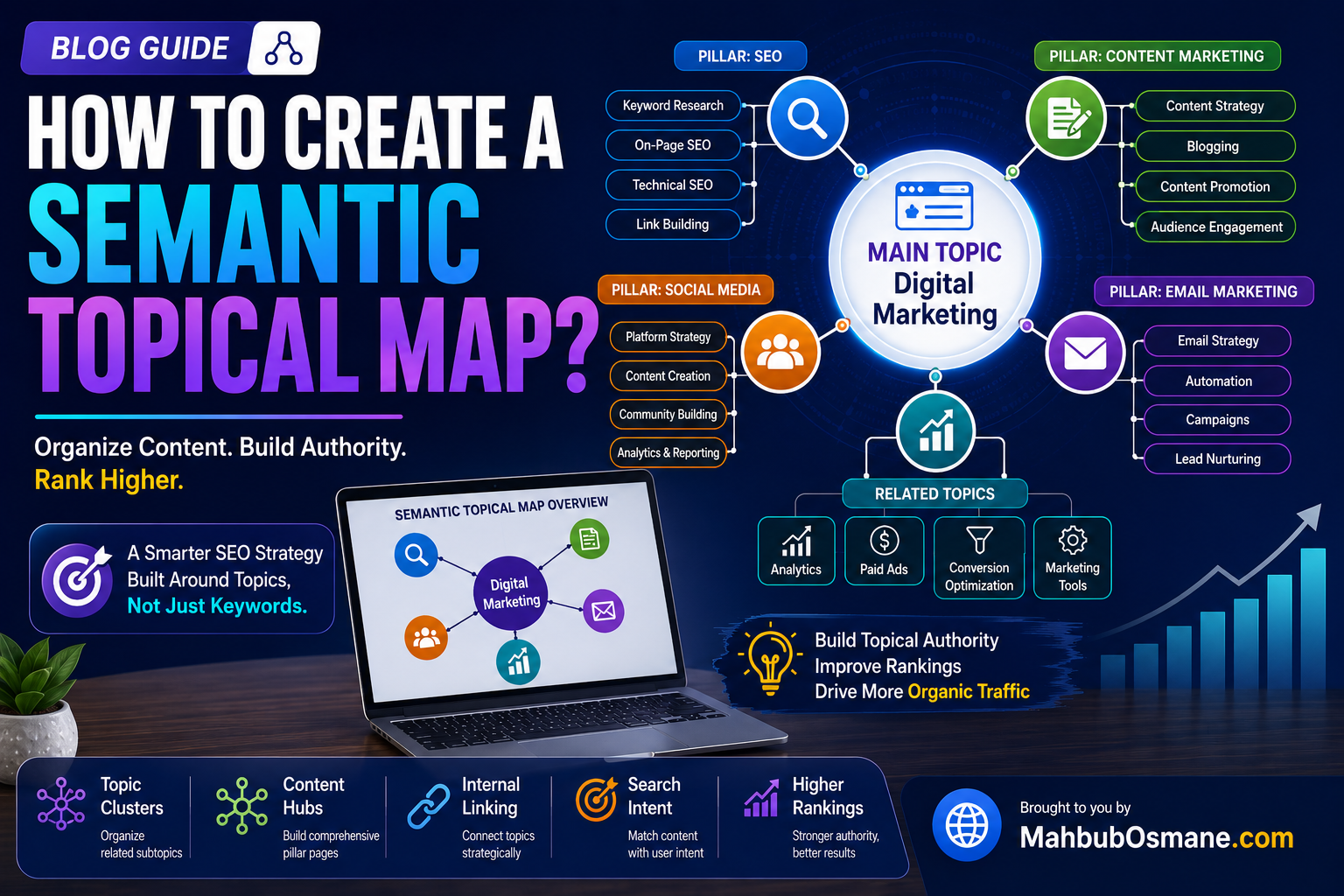
How to Create a Semantic Topical Map?
If you are still trying to rank your website by writing isolated articles targeting individual keywords, you are playing a game that search engines abandoned years ago.
Today, search engines like Google do not just match the string of words in a user’s search query to the string of words on your page. Instead, they try to understand the concepts, real-world entities, and intent behind those words. Google has evolved from a keyword-matching index into a massive, interconnected Knowledge Graph.
To win in modern search engine optimization (SEO), you must build Topical Authority. You cannot achieve this by publishing random high-volume blog posts. You achieve it by organizing, writing, and linking your content according to a structured, logical map of a subject’s entire universe.
This is where a Semantic Topical Map comes in.
In this exhaustive guide, you will learn exactly what a semantic topical map is, the underlying science behind why it works, and a step-by-step blueprint to build your own from scratch.
Deconstructing the Terminology
To build a semantic topical map, we first need to break down its core components: Semantics, Entities, and Topical Authority.
What is Semantics in SEO?
In linguistics, semantics is the study of meaning in language. In SEO, semantic search refers to a search engine’s ability to understand the intent, context, and relationships between terms rather than treating search terms as isolated, literal strings of characters.
When a user searches for “the battery-powered vehicle created by Elon Musk’s company,” Google does not just look for that exact sequence of words. It uses natural language processing (NLP) to translate that query into its underlying entities: Tesla (Company), Electric Vehicle (Product), and Elon Musk (Person). It understands the relationship between them and serves up a page about Tesla cars.
What is an Entity?
An entity is a concept, person, place, thing, or event that is singular, unique, well-defined, and distinguishable.
-
“SEO” is an entity.
-
“Google” is an entity.
-
“Topical Authority” is an entity.
Entities are the building blocks of Google’s Knowledge Graph. Instead of ranking keywords, Google maps how entities connect to one another.
What is a Topical Map?
A topical map is a visual and hierarchical structure that outlines all the subtopics, questions, entities, and concepts required to cover a broad subject exhaustively. It is a roadmap showing how your content will cover a niche so comprehensively that search engines have no choice but to recognize your site as the ultimate authority on the topic.
The Core Benefits of a Semantic Topical Map
Why spend hours or days mapping out a niche when you could just look at a keyword tool and write the highest-volume keyword first?
Future-Proofing Against Algorithm Updates
Google’s search algorithms—from Hummingbird and RankBrain to BERT, MUM, and generative AI search experiences—are designed to understand human context. Sites built on solid semantic maps are structured the way search engines “think.” When core algorithm updates roll out, websites with high topical authority and clear semantic relationships consistently see positive visibility shifts, while keyword-stuffed sites lose ground.
Eliminating Keyword Cannibalization
Keyword cannibalization happens when multiple pages on your website target the exact same search intent, causing them to compete against each other in the search results. A topical map assigns a unique, distinct search intent and semantic boundary to every single page. You know exactly what each page covers and, more importantly, what it doesn’t cover.
Creating an Intuitive Internal Linking Architecture
Internal links are the pipelines of PageRank and topical context throughout your website. A semantic map naturally dictates how your pages should link to one another. Pages within the same sub-cluster link tightly to each other and up to their parent “pillar” page, forming highly optimized, easy-to-crawl content silos.
Maximizing Crawl Budget Efficiency
When search engine bots land on your site, they want to understand its purpose quickly. If they crawl a page about “Affiliate Marketing” and find logical, well-structured links to “Affiliate Networks,” “Passive Income Ideas,” and “How to Build a Niche Site,” the crawler understands your context rapidly. This semantic clarity helps search engines index your content faster and place it in the correct search categories.
The Theory of Semantic SEO (Triples & Ontologies)
To build a truly world-class semantic map, you need to think like a data scientist. At the heart of semantic search is a concept known as Semantic Triples and Ontologies.
The Semantic Triple
A triple is a three-part statement that represents how two entities are connected. It consists of:
For example:
-
Subject:
John Mueller -
Predicate:
works for -
Object:
Google
Or in an SEO context:
-
Subject:
Internal Linking -
Predicate:
distributes -
Object:
PageRank
When search engines read your content, they extract these triples to update their knowledge of the world. Your topical map should be designed to feed the search engines these triples naturally. Your pillar page defines the macro-entities, while your sub-pages define the attributes, tools, history, and micro-entities associated with them.
Defining Your Ontology
An ontology is a formal way of representing properties, relationships, and categories of concepts within a specific subject area. When you map out a topic, you are creating a custom ontology for your website. You are deciding what concepts exist in your niche and how they relate to one another.
Step-by-Step Blueprint to Create a Semantic Topical Map
Let’s move from theory to execution. We will use a concrete example to ground this process: “Email Marketing” as our macro-topic.
Define the Root Entity (The Anchor)
Every topical map starts with a single, highly broad core topic, also known as the Root Entity or Seed Topic. This is the broad theme you want your website (or a massive section of your website) to be known for.
For our example:
Root Entity:
Email Marketing
This is too broad to target with a single article. If you write an 8,000-word post trying to cover everything about email marketing, you will end up with a shallow piece of content that doesn’t rank well for specific, high-intent queries. Instead, this root entity will serve as the anchor for our entire map.
Establish the Primary Categories (The Pillars)
Once you have your root entity, you need to break it down into its natural, high-level divisions. These are your Pillar Categories. Think of these as the major chapters of a textbook on your subject.
To find these, ask yourself: What are the absolute core pillars a person must understand to master the root entity?
For Email Marketing, our primary pillars might look like this:
[Email Marketing] (Root Entity)
  ├── 1. Strategy & Deliverability (Pillar)
  ├── 2. Automation & Workflows (Pillar)
  ├── 3. List Building & Lead Generation (Pillar)
  └── 4. Software & Tools (Pillar)
Conduct Entity-Based Research
Most SEOs begin keyword research by typing their root topic into a keyword tool and exporting the list. That is a mistake. This approach misses the semantic connections search engines care about.
Instead, start your research using non-SEO, entity-rich sources to see how humans and knowledge bases structure this information.
Source A: Wikipedia & Wikidata
Wikipedia is a manual, human-curated knowledge graph. It is one of Google’s primary training grounds for understanding entity relationships.
-
Go to the Wikipedia page for Email Marketing.
-
Look at the Table of Contents. What are the major headings?
-
Look at the blue hyperlinks within the article. What other Wikipedia pages (entities) does it link to? (e.g., Spamming, Opt-in email, Autoresponder, Click-through rate).
-
Scroll to the very bottom of the page and look at the navigation templates (horizontal tables linking to related topics). These are ready-made topical clusters.
Source B: Google Search Console, PAA, & Autocomplete
Search engines tell you exactly what semantic connections they make through search engine results page (SERP) features.
-
People Also Ask (PAA): Search your root entity. Expand 4–5 PAA questions, and watch Google generate more. These represent the logical progression of user intent.
-
Google Autocomplete: Type your root topic followed by different letters (e.g., “Email marketing a…”, “Email marketing b…”) to see common user paths.
-
Related Searches: Scroll to the bottom of the SERP. These are terms Google programmatically deems semantically closest to your query.
Source C: Classic Keyword Research Tools
Now, and only now, do you open tools like Ahrefs, SEMrush, or low-cost alternatives.
-
Input your root entity and pillars.
-
Filter for “Questions” to capture informational intent.
-
Use grouping features (like “Parent Topic” in Ahrefs) to see how the tool clusters variations.
Map Out the Nodes and Sub-Nodes
Now that you have gathered your data, it’s time to build the hierarchy. Each category pillar must be broken down into specific nodes (individual content pages) and, where necessary, sub-nodes (highly specific sub-topics).
Let’s expand Pillar 3: List Building & Lead Generation:
List Building & Lead Generation (Pillar Page)
  ├── Lead Magnets (Sub-Pillar Page)
  │     ├── PDF Guides & Ebooks (Supporting Page)
  │     ├── Templates & Checklists (Supporting Page)
  │     └── Free Mini-Courses (Supporting Page)
  ├── Opt-In Forms (Sub-Pillar Page)
  │     ├── Exit-Intent Popups (Supporting Page)
  │     ├── Inline Forms (Supporting Page)
  │     └── Two-Step Opt-ins (Supporting Page)
  └── Landing Page Optimization (Sub-Pillar Page)
        ├── Landing Page Copywriting (Supporting Page)
        ├── Lead Capture Page Design (Supporting Page)
        └── A/B Testing Landing Pages (Supporting Page)
By organizing your topics this way, you create clean, manageable categories. Each step down the chain addresses a more specific, narrower search intent.
Define Semantic Attributes and Intent for Each Node
A common trap is creating a list of topics that overlap in user intent. To prevent this, build a structured spreadsheet where every node has defined attributes.
Create a spreadsheet with the following columns:
| Column Name | Purpose / Description | Example Data |
| Target Entity | The core subject of the page. | Exit-Intent Popups |
| Search Intent | Informational, Commercial, or Transactional. | Informational / How-to |
| Parent Node | The immediate category page this page belongs to. | Opt-In Forms |
| Target Keywords | Primary and secondary semantically related terms. | how to set up exit intent popup, best exit intent popup triggers |
| Core Entity Attributes | The key sub-concepts that must be discussed to cover the entity comprehensively. | cookie duration, mobile vs desktop triggers, CTA copy |
Create Your Internal Linking Blueprints (The Silo Strategy)
Once your content nodes are established, you must map out how they will link to one another. To do this, we use the Reverse Silo / Hub-and-Spoke internal linking model.
The Flow of Authority (Up and Down)
-
Spokes to Hub: Every supporting page (e.g., Exit-Intent Popups) must link back up to its parent category page (Opt-In Forms) using highly descriptive anchor text.
-
Hub to Spokes: The parent category page (Opt-In Forms) must link down to all of its supporting pages.
-
Cross-Spoke Linking (Horizontal): Supporting pages within the same sub-cluster can link to each other if it makes sense for the user experience (e.g., Exit-Intent Popups linking to Inline Forms).
-
Out-of-Silo Linking: Avoid linking supporting pages directly to unrelated nodes in other silos (e.g., do not link Exit-Intent Popups to SMTP Server Setup unless absolutely necessary for context). This keeps your topical clusters clean and focused.
       [List Building & Lead Gen] (Pillar)
                 ▲    │
                 │    ▼
          [Opt-In Forms] (Sub-Pillar)
            ▲    │        ▲    │
            │    ▼        │    ▼
  [Exit-Intent Popups] ◄─► [Inline Forms] (Supporting Pages)
Practical Tools for Building Topical Maps
You do not need to spend thousands of dollars on enterprise software to build a stellar topical map. You can get started with a combination of free and paid tools.
Visualization Tools
-
Miro or Whimsical: Perfect for creating clean, drag-and-drop mind maps. It allows you to visualize your silos before you write a single word of content.
-
XMind: A powerful, offline desktop mind-mapping tool that handles massive amounts of data without lagging.
Analytical & Semantic Research Tools
-
AlsoAsked.com: Geared toward mining deep “People Also Ask” questions. It groups questions hierarchically so you can see the relationship between different search queries.
-
InLinks.net: An advanced tool designed specifically for semantic SEO and entity mapping. It analyzes your target niche, identifies the core entities, and recommends an internal linking strategy.
-
Thruuu: A brilliant, free SERP analyzer that breaks down the headings, word counts, and structural elements of top-ranking competitor pages.
Google Sheets / Notion
-
Once your visual mind map is finalized, translate it into a structured database. Use spreadsheet formulas to track the progress of each node (e.g., Not Started, Drafted, Published, Indexed).
Formulating Your Content Strategy (Execution)
An outstanding topical map on paper is worthless without a clear, systematic plan to write, optimize, and publish the content. Here is how to turn your map into organic traffic.
The Content Coverage Strategy: Bottom-Up vs. Top-Down
When publishing a new topical map, you have two strategic paths:
Option A: Top-Down (Pillar First)
You write the massive pillar pages first, then slowly publish the supporting child pages over the following weeks.
-
Pros: Establishes the macro-theme of your site early on.
-
Cons: High-volume pillar pages are incredibly competitive and won’t rank on their own without supporting pages and internal links.
Option B: Bottom-Up (Spokes First) — Recommended
You write the highly specific, low-competition supporting pages first. Once all the supporting pieces are live, you publish the master pillar page and tie them all together with your pre-planned internal links.
-
Pros: You start ranking and driving traffic for low-competition, long-tail queries almost immediately. This builds momentum and historical search engine trust.
-
Cons: Requires discipline to hold off on your flashy, high-volume pillar topics until the groundwork is complete.
Writing Content for Semantic SEO (NLP Optimization)
Once you sit down to write an article from your topical map, you must optimize it for modern Natural Language Processing (NLP) engines. This means going beyond standard keyword density.
Optimize Your Headings (H2, H3, H4) for Entity Attribute Coverage
Your headings are strong structural signals for search engine crawlers. Instead of writing generic, playful headers, use your subheadings to declare the attributes of the entity you are discussing.
-
Bad Heading:
Make sure your popups look cool on phones -
Good Heading:
Optimizing Exit-Intent Popups for Mobile Devices
By using the specific entities “Exit-Intent Popups,” “Optimizing,” and “Mobile Devices,” you help search engine bots extract clear, definitive triples from your text.
Implement the “N + 1” Entity Principle
Whenever you write a post about a specific entity, make sure to mention its parent, sibling, and child entities in your copy to provide strong contextual signals.
For example, if your page is about B2B Lead Magnets:
-
Parent Entity: Mention how it fits into your broader
Email List Buildingstrategy. -
Sibling Entity: Briefly compare it to
B2C Lead Magnets. -
Child Entity: Mention specific examples like
WhitepapersandIndustry Reports.
Write Clear Definition Sentences (For Featured Snippets)
Near the top of your page, dedicate a clear, direct sentence to defining your core subject. This makes it incredibly easy for search engine algorithms to pull your text for featured snippets.
Use the classic copula format:
“An [Entity] is a [Category] that [Primary Function].”
Example: “An exit-intent popup is a website overlay designed to capture a visitor’s email address at the exact moment they attempt to navigate away from the page.”
Advanced Semantic Schema Markup
A semantic topical map organizes your content structure on-page. To take it to the next level, you must communicate this structure directly to search engines in their native language: JSON-LD Schema Markup.
While basic schema plugins apply standard Article or BlogPosting markup, advanced semantic SEO utilizes Entity Schema using about and mentions tags. This points search engines directly to the corresponding Wikidata or Wikipedia entries for the entities you are discussing.
Here is an example of what advanced JSON-LD markup looks like for an article about exit-intent popups:
JSON
{
  "@context": "https://schema.org",
  "@type": "BlogPosting",
  "headline": "The Complete Guide to Exit-Intent Popups",
  "description": "Learn how to capture abandoning website traffic using exit-intent popups.",
  "about": [
    {
      "@type": "Thing",
      "name": "Lead Generation",
      "sameAs": "https://en.wikipedia.org/wiki/Lead_generation"
    }
  ],
  "mentions": [
    {
      "@type": "Thing",
      "name": "Web Browser",
      "sameAs": "https://en.wikipedia.org/wiki/Web_browser"
    },
    {
      "@type": "Thing",
      "name": "Conversion Rate Optimization",
      "sameAs": "https://en.wikipedia.org/wiki/Conversion_rate_optimization"
    }
  ]
}
By adding these sameAs URLs to your schema, you remove all ambiguity. Google does not have to guess if your page is about “popups” as a design choice or “popups” as a marketing lead generation strategy—you have declared it explicitly.
Common Mistakes to Avoid When Creating a Topical Map
Building a semantic topical map is a highly rewarding, high-ROI strategy, but it is easy to run into roadblocks along the way. Be mindful of these common pitfalls:
Going Too Deep Too Fast (Topical Bloat)
It is easy to get carried away when mapping a niche. If you are a new website, do not try to build a 200-node topical map right out of the gate. You will stretch your resources too thin, and publishing only 5% of a massive map will not give you topical authority. Start with a smaller, highly focused sub-silo (e.g., 15–20 pages) and build outward as your site gains momentum.
Failing to Update the Map
Niches evolve. New tools are developed, user terminology changes, and search engines update how they associate different concepts. Review and update your topical map every 6 to 12 months to ensure your content coverage remains fresh and complete.
Ignoring the User Experience
Never force internal links or construct awkward, repetitive content silos just to appease search engine crawlers. If an internal link or a sub-topic doesn’t make logical sense to a human reader, do not include it. The ultimate goal of search engine algorithms is to satisfy the user, so user experience should always be your North Star.
Summary and Next Steps
Building a Semantic Topical Map shifts your SEO approach from chasing high-volume keywords to creating a highly structured, authoritative web resource.
To recap the workflow:
-
Define your core root entity.
-
Establish your major category pillars.
-
Conduct entity-based research utilizing Wikipedia, Wikidata, and SERP features alongside classic keyword tools.
-
Build a clean, logical hierarchical map of your topics.
-
Formulate a bottom-up content strategy, beginning with your highly specific, low-competition child nodes.
-
Optimize your writing structure with clear definitions, descriptive headings, and entity relationships.
-
Reinforce your topical structure with logical internal linking and schema markup.
By systematically demonstrating your expertise across every facet of your niche, you will build deep topical authority. This sets up your website to earn sustainable, high-value search visibility that stands the test of time.
Unlock Your Topical Authority: Let the Experts Build Your Semantic SEO Engine
Are you ready to stop chasing fleeting keyword rankings and start dominating your entire industry’s search landscape? Building a semantic topical map is the ultimate differentiator between brands that struggle for organic traffic and brands that command permanent market authority.
But mapping out your entire industry’s ontology, executing entity-based research, and structuring flawless internal linking silos takes deep technical expertise, precision, and time. That is where we come in.
At MahbubOsmane.com, we help ambitious businesses across Saudi Arabia, the UAE, Qatar, Kuwait, the USA, the UK, Canada, Germany, Lithuania, and Bangladesh transform their digital footprint. Whether you need professional SEO architecture, high-performance AdOps, semantic content writing, robust website development, stunning graphic design, or engaging video editing, our global agency delivers results that translate directly to revenue.
Why Leading Brands Trust MahbubOsmane.com
We don’t just preach modern search engine strategy—we execute it at the highest global standards. Our elite freelance track record speaks for itself:
-
Proven Upwork Elite: Over 700+ completed jobs with flawless 5-star feedback from global enterprises and fast-growing startups.
-
Vetted Professionals: Proudly featured and available on Hubstaff Talent, certifying our agency’s transparent, high-integrity work ethic.
-
End-to-End Execution: From initial semantic research to writing optimized content and implementing advanced JSON-LD schema, we manage your entire digital marketing ecosystem.
Ready to Claim Your Niche? Contact Us Today!
Let’s build a high-converting, semantically optimized digital presence for your brand. Get in touch with our team instantly via email, web, or WhatsApp.
-
Email Us: hi@mahbubosmane.com or mahbubosmane@gmail.com
-
Visit Our Website: www.MahbubOsmane.com
-
Direct Phone & WhatsApp Support:
-
Saudi Arabia:
+966549485900or+966553227950(WhatsApp active on both) -
Bangladesh:
+8801716988953(WhatsApp active)
-
🟢 Connect on WhatsApp (Saudi Arabia: +966549485900)
🟢 Connect on WhatsApp (Saudi Arabia: +966553227950)
🟢 Connect on WhatsApp (Bangladesh: +8801716988953)
FAQ
What is a semantic topical map?
A semantic topical map is a structured visual and conceptual representation of an entire subject area. It organizes all the core entities, sub-topics, questions, and relationships associated with a broad theme. Its primary goal is to help search engines understand that your website covers a niche so exhaustively and logically that you deserve to be recognized as a trusted authority on the subject.
How does a topical map differ from traditional keyword research?
Traditional keyword research focuses on finding individual search queries with high search volume and low difficulty, often leading to isolated pages. A topical map, conversely, focuses on entities and concepts. It maps out the systemic relationships between ideas to ensure complete coverage of a subject, ignoring isolated search volume in favor of structural context and search intent.
Why is Google shifting from keywords to entities?
Google transitioned from a string-matching search engine to a semantic search engine to better understand human context. By matching entities (real-world concepts, people, places, and things) in its Knowledge Graph, Google can determine the true intent behind a query. This shift allows the algorithm to serve accurate answers even if the searcher doesn’t use the exact keywords on the page.
What is the difference between a topical map and a content silo?
A content silo is a website architecture method that groups related pages together into folders (e.g., /email-marketing/automation/). A topical map is the semantic blueprint behind the silo. The topical map dictates what content needs to exist and how those pages relate conceptually, while the silo is simply the physical or logical folder structure where that content lives.
How many pages do I need to establish topical authority?
There is no universal number because authority is relative to your competitors and the breadth of your niche. For highly narrow micro-niches, a map of 15 to 30 pages might suffice. For broad, highly competitive niches (like “Personal Finance”), your topical map may require hundreds of pages published over several months to completely cover all semantically relevant entities.
Can I build a topical map for a brand-new website?
Yes, and you absolutely should. Implementing a semantic topical map from day one prevents keyword cannibalization and ensures a flawless internal linking structure. For new websites, it is highly recommended to target a narrow sub-topic within your map first, establish micro-authority there, and then gradually expand to wider circles of the map.
What are the best free tools to create a topical map?
You can build an incredibly powerful topical map using free tools. Use Wikipedia and Wikidata to uncover entity relationships. Use Google’s People Also Ask (PAA) and Google Autocomplete to discover user intent paths. Finally, use visual mind-mapping platforms like Miro, Whimsical, or XMind to map out and organize your nodes.
How do I identify the “root entity” for my business niche?
Your root entity should be the absolute macro-topic that defines your business’s core offering or expertise. It is typically a broad, high-volume term that you cannot easily rank for with a single article. For example, if you sell CRM software, your root entity is “Customer Relationship Management.” If you run a coffee roastery, your root entity is “Coffee Roasting.”
What is a semantic triple, and why does it matter for SEO?
A semantic triple is a data statement formatted as a Subject ➔ Predicate ➔ Object. For example, Email Marketing (Subject) ➔ improves (Predicate) ➔ Customer Retention (Object). Search engines crawl your text looking for these triples to map real-world relationships. Structuring your sentences and content layout to explicitly state these relationships makes your content significantly easier for natural language processing (NLP) algorithms to parse.
How do Wikipedia and Wikidata help in building topical maps?
Wikipedia and Wikidata are heavily relied upon by search engines to populate and refine their own Knowledge Graphs. By analyzing the Wikipedia page for your target topic—looking at its table of contents, internal hyperlinks, and bottom-of-page navigation templates—you can see exactly how human editors and search algorithms categorize your niche’s entities.
What is keyword cannibalization, and how does a topical map prevent it?
Keyword cannibalization occurs when multiple pages on your website compete for the same search query, diluting your organic signals. A semantic topical map assigns a highly specific, unique intent boundary and primary entity to every node in the map. Because each page has a distinct job to do in the ecosystem, you completely eliminate the risk of pages competing against one another.
Should I write pillar pages first or supporting pages first?
We generally recommend a bottom-up approach (supporting pages first). Writing your highly specific, low-competition child pages first allows you to gain quick traffic, indexation, and initial search trust. Once those supporting assets are live, you can launch the comprehensive pillar page and instantly link it to the existing, context-rich supporting pages.
How does search intent affect the structure of a topical map?
Search intent dictates where a node sits on your map. Informational queries (e.g., “how does cold emailing work”) belong on your supporting informational pages. Commercial or transactional queries (e.g., “best cold email software”) belong on your category, tool, or landing pages. A good topical map cleanly separates these intents while linking them logically to guide users down the conversion funnel.
What is the role of schema markup in semantic topical mapping?
Schema markup (JSON-LD) translates the visual structure of your topical map into structured data that search engines can read instantly. By using advanced schema tags like about and mentions pointed directly to Wikidata or Wikipedia URLs, you explicitly state the exact entities your page is discussing, removing any linguistic ambiguity for the crawlers.
How long does it take to see SEO results from a topical map?
For brand-new domains, it can take 3 to 6 months of consistent publishing and indexing to see significant organic momentum. For established domains with existing authority, publishing a new, fully optimized topical cluster can yield noticeable rank improvements and traffic gains within a matter of weeks.
How often should I update or expand my topical map?
Your topical map is a living document. It should be comprehensively audited and updated every 6 to 12 months. This allows you to account for new search trends, update outdated information, address newly emerged entities in your industry, and integrate new long-tail queries that your published pages have started to attract.
Can I use AI tools to build my topical map?
Yes, artificial intelligence is highly useful for brainstorming and structural organization. You can prompt AI to “act as an expert ontologist” and generate lists of child entities, attributes, and semantic triples for your root topic. However, you must always validate the AI’s output using real-world search data, search intent analysis, and competitor reviews to ensure accuracy.
What is the “N+1” entity principle in semantic content writing?
The “N+1” entity principle states that when you write about a specific target entity (N), you must contextualize it by explicitly mentioning its parent entity (the larger category), its sibling entities (related alternative concepts), and its child entities (sub-components or examples). This surrounding context proves to search engines that your page understands the full hierarchy of the subject.
How do internal links distribute topical authority across the map?
Internal links act as conduits for both PageRank and semantic context. By using a strict Hub-and-Spoke model, authority flows smoothly. Child pages link up to support the main parent pillar, the parent page distributes authority back down, and related child pages link horizontally to share contextual relevance. This tight web of internal links signals to crawlers that your cluster is a unified, self-contained knowledge center.
External Resources
-
Google’s Official Patent on the Knowledge Graph: Use this when explaining how Google connects real-world entities.
-
The W3C Semantic Web Standards: Use this when discussing semantic triples ($Subject \rightarrow Predicate \rightarrow Object$) and ontologies.
-
Wikidata Query Service: Use this in the step-by-step entity research section as a tool for mapping entity relations.
-
Schema.org JSON-LD Documentation: Use this in the advanced schema section to validate the semantic code structure.
Internal Resources
-
For SEO Context:
-
“If you want to scale your organic presence further, combine your topical map with our professional SEO Services to dominate local and global search results.”
-
-
For Web Development Context:
-
“A clean topical map requires a flawless technical setup. Make sure your CMS is built correctly by partnering with our expert Web Design and Development team.”
-
-
For Content Writing Context:
-
“Mapping your topics is only half the battle; you also need high-quality execution. Learn how to draft content that ranks with our dedicated Content Writing Service.”
-
-
For Contact/Consultation Context:
-
“Ready to build a custom semantic map for your business? Reach out to us directly through our Contact Page to schedule a strategy session.”
-
About the Author
Mahbub Osmane is a digital marketing expert who helps businesses build effective online strategies, including selecting and managing the right social media channels for growth. With hands-on experience across platforms and markets, Mahbub shares practical, actionable insights to help businesses connect with their audience and grow their brand presence.
Contact information Email: hi@mahbubosmane.com Website: https://mahbubosmane.com/ Mobile: +966 54 948 5900 (KSA) / +880 1716 988953 (BD) Address: 2282 7284 Al Malawi Southern 1, As Sulimaniyah Dist, Makkah 24236, Saudi Arabia