
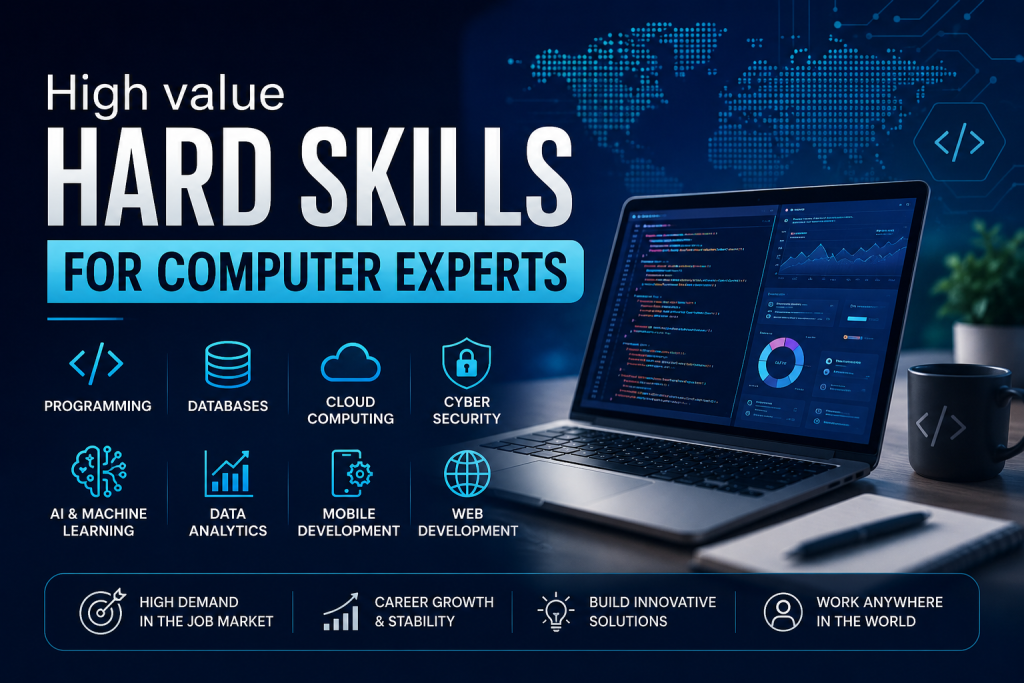
High-Value Hard Skills for Computer Experts
Why Technical Knowledge Alone Is No Longer Enough in the Age of AI
A comprehensive guide for developers, designers, freelancers, and tech entrepreneurs who want to future-proof their careers and build lasting wealth in a world reshaped by artificial intelligence.
The Danger of Being Only a Coder
Let’s be honest about the world we live in today. Artificial Intelligence is learning faster than any human being ever could. It writes code in seconds, designs interfaces in minutes, generates marketing copy on demand, analyzes datasets in moments, and is getting better at all of it every single day. If you are a computer expert who has spent years mastering only one technical domain, that reality should concern you — not paralyze you, but concern you enough to act.
Here is the critical distinction that most people miss: AI does not make skilled people obsolete. It makes narrow people obsolete. The developer who only codes. The designer who only designs. The analyst who only crunches numbers. These are the professionals most vulnerable to displacement. Not because they are not talented — but because the value they offer is increasingly replicable by a machine.
The professionals who will thrive over the next two decades are a completely different breed. They are the ones who combine technical mastery with business acumen, human relationship skills, real-world operational knowledge, and strategic thinking. They use AI as a force multiplier — not as a crutch, and not as a threat.
This article is built around one powerful idea: the most future-proof professional in the AI age is not the best coder — it is the person who can code, sell, lead, operate, and communicate all at once.
In the pages that follow, we will walk through every high-value hard skill that computer experts should build alongside their technical expertise — organized into clear categories, explained with practical depth, and grounded in the reality of today’s GCC market (particularly Saudi Arabia), where the opportunities for multi-skilled tech professionals are enormous.
Part One. Business & Money Skills
Technical people often have a complicated relationship with “business.” Many see it as something separate from their craft — something suited to extroverts and salespeople. This is a costly mistake. Business skills are the engine that converts technical capability into actual wealth. Without them, even the most talented developer remains an employee, always trading time for money, always dependent on someone else to find the clients and set the terms.
1.1 Sales & Negotiation: The Master Skill of the Modern Economy
If you learn only one non-technical skill in your entire career, make it this one: the ability to sell. Not in the manipulative, pushy sense that makes people cringe — but in the deep, human sense of understanding what someone needs, articulating how you can solve it, and confidently asking for the business.
Think about this carefully: a mediocre coder with exceptional sales skills can build a six-figure software agency. An outstanding coder with zero sales ability will spend their entire career on freelance platforms competing on price. The asymmetry is staggering. Sales is the skill that unlocks everything else. It determines your rates, your client quality, your growth trajectory, and ultimately your income ceiling.
Negotiation is the close cousin of sales. Once you can attract interest, you need to be able to negotiate — pricing, scope, timelines, terms. Every dollar you leave on the table in a negotiation is a dollar of value you created but did not capture. Professionals who negotiate well earn substantially more than those who accept the first offer, every single year of their career.
Core areas to master:
- B2B Sales — Understanding how to sell to companies, not just individuals. The buying process is longer, involves multiple stakeholders, and requires a fundamentally different approach.
- Deal Closing — The specific techniques, language patterns, and timing strategies that convert interested prospects into paying clients.
- Negotiation Frameworks — How to anchor prices, handle objections, create win-win outcomes, and walk away when necessary.
- Client Psychology — Understanding buyer motivations, fears, and decision-making patterns so you can communicate in ways that genuinely resonate.
- Pricing Strategy — Moving beyond hourly rates to value-based pricing, retainers, productized services, and equity arrangements.
Real-world example: An average developer who learns B2B sales and closes just three enterprise contracts a year at $15,000 each has effectively doubled or tripled the income of a developer who only codes. The skill compounds every single year.
1.2 Business Development: Opening Doors in the GCC Market
Business development is the art of creating new opportunities — finding partners, building strategic relationships, entering new markets, and turning loose connections into revenue-generating agreements. In the Gulf Cooperation Council (GCC) market, and especially in Saudi Arabia’s rapidly growing Vision 2030 economy, business development is an extraordinarily high-value skill.
The Saudi market rewards relationships. Government contracts, enterprise partnerships, and vendor agreements are heavily influenced by who knows whom. A tech professional who understands how to navigate this ecosystem — who can show up, follow up, and build genuine trust with decision-makers — has an extraordinary advantage over someone who simply submits proposals online and waits.
What to learn:
- Strategic Networking — Building relationships intentionally, with a long-term mindset, not just collecting business cards at events.
- Proposal Writing — Crafting compelling, professional proposals that speak to the business outcomes clients care about, not just technical specifications.
- Partnership Building — Identifying complementary businesses, structuring referral agreements, and creating joint ventures.
- Government & Vendor Communication — Understanding how to communicate effectively in formal, official channels — a critical skill in Saudi Arabia’s public sector.
- CRM Management — Systematically tracking relationships, follow-ups, and deal pipelines so nothing falls through the cracks.
1.3 Financial Literacy: Earning Is Not the Same as Wealth-Building
This is perhaps the most underappreciated skill gap in the tech world. Many highly paid developers and designers have almost no understanding of personal finance, business finance, or investment. They earn well and spend more. They have no clear picture of their profit margins, their tax obligations, or where their money goes. Financial literacy is not about being an accountant — it is about understanding money well enough to make it work for you.
Without financial literacy, income is just a treadmill. You work harder, earn more, and somehow end up in the same place. With financial literacy, every SAR or dollar you earn can be directed strategically — toward investments, toward business growth, toward the kind of financial independence that eventually makes you optional in your own business.
- Cash Flow Management — Understanding the timing difference between income and expenses, and how to maintain liquidity even when business is seasonal.
- Investment Basics — How stocks, real estate, gold, and business equity work, and how to allocate across them based on your risk profile.
- Tax and VAT — In Saudi Arabia, understanding ZATCA regulations and VAT compliance is not optional for any serious business owner.
- Business Finance — Reading a P&L statement, understanding gross vs. net margin, knowing when a project is profitable and when it is not.
- Profit Margin Analysis — Understanding which clients, services, and products actually make money — not just which ones keep you busy.
Part Two: Human-Centered Skills That AI Cannot Replicate
There is a class of skills that becomes more valuable, not less, as AI becomes more capable. These are the deeply human skills — communication, leadership, persuasion, empathy, and the ability to navigate the complexity of real people in real situations. AI can summarize a meeting. It cannot lead one. AI can draft a performance review. It cannot build the relationship that makes feedback actually land. These skills are your moat.
2.1 Public Speaking & Communication: Command the Room
Public speaking is one of the most commonly avoided and most disproportionately rewarded skills in professional life. The ability to stand in front of a group — whether five people in a boardroom or five hundred at a conference — and communicate clearly, confidently, and compellingly opens doors that no amount of technical skill can unlock on its own.
For computer experts working in the GCC market, communication skills have an additional dimension: language. Being fluent in English is table stakes. Arabic fluency — especially local Saudi Arabic dialect — is a genuine superpower. When you walk into a meeting with a Saudi business owner and conduct the conversation in their language, the level of trust you build in minutes would take months to achieve otherwise.
Beyond in-person communication, camera confidence has become an essential professional skill. Online meetings, video pitches, YouTube channels, LinkedIn video posts — the professionals who can communicate naturally and authoritatively on camera have a significant reach advantage in the modern marketplace.
- Presentation Design & Delivery — Creating and delivering presentations that genuinely engage an audience, not just dump information on slides.
- Storytelling — Structuring your message as a narrative with a problem, journey, and resolution. Humans are wired for stories; data alone rarely moves people to action.
- Persuasion & Influence — Understanding the principles of persuasion (reciprocity, authority, social proof, scarcity) and how to use them ethically.
- Arabic & English Communication — Building genuine bilingual capability for the GCC context.
- Camera Confidence — Looking natural, credible, and engaging in video meetings and recorded content.
2.2 Leadership & Team Management: From Individual Contributor to Force Multiplier
In the future economy, a solo developer has a ceiling. A developer who can lead a team of five has five times the ceiling. A developer who can lead twenty-five people, manage complex projects, and build organizational systems has an essentially unlimited ceiling. Leadership is the skill that transforms a talented individual into a business-scale force.
Effective leadership is not about dominance or authority. It is about creating the conditions for a team to perform at its best — clarity of direction, accountability for results, safety to take risks, and a culture where people want to do good work. These are learnable skills, not innate personality traits.
- Talent Acquisition & Hiring — Knowing what to look for beyond a resume, how to structure interviews that reveal real ability, and how to make offers that attract the right people.
- Team Dynamics & Conflict Resolution — Understanding how groups form, how conflict emerges, and how to address it productively before it damages performance.
- SOP Development — Documenting processes so that your business can operate consistently without relying entirely on you personally.
- Decision-Making Under Pressure — Developing frameworks for making good decisions quickly when information is incomplete and stakes are high.
- Delegation — The specific skill of assigning work in a way that develops people while ensuring quality outcomes.
Part Three: Real-World Technical Skills With Massive Market Demand
Software runs the digital world. But the physical world still needs to be built, wired, secured, and maintained. The following technical domains exist at the intersection of the digital and physical — and they are experiencing enormous demand, particularly across the GCC region where infrastructure development is happening at an extraordinary pace.
3.1 Electrical, Networking & Hardware Infrastructure
No matter how sophisticated software becomes, the physical infrastructure it runs on must be designed, installed, and maintained by people with real-world technical skills. Saudi Arabia is currently building entire new cities from the ground up — NEOM, The Line, Diriyah Gate. The demand for skilled infrastructure professionals is not theoretical; it is enormous and immediate.
A software developer who also understands networking infrastructure, CCTV systems, or smart building technology is extraordinarily valuable in this context. They can bridge the gap between the digital software layer and the physical hardware layer — a combination that most specialists on either side of that divide cannot offer.
- CCTV Design & Installation — Designing security camera systems for commercial and residential buildings, including IP-based systems with remote monitoring capabilities.
- Enterprise Networking — Setting up and managing local area networks, VLANs, Wi-Fi infrastructure, and network security for office and commercial environments.
- Server Infrastructure — Physical server setup, rack configuration, cooling systems, and on-premise vs. hybrid cloud integration.
- Fiber Optic Installation — High-speed connectivity infrastructure that is foundational to all modern digital communication.
- Smart Home & Building Automation — Integrating lighting control, HVAC, access control, and entertainment systems into unified intelligent environments.
- Solar Energy Systems — As Saudi Arabia accelerates its renewable energy agenda, solar installation and maintenance skills are entering a period of extraordinary demand.
3.2 Industrial Automation: The Most Powerful Technical Frontier
Industrial automation is where the physical and digital worlds truly merge — and it is one of the most strategically important technical domains of the next two decades. Factories, hotels, logistics centers, hospitals, and smart buildings are all undergoing deep automation. Someone needs to design, program, install, and maintain these systems. That someone could be you.
The combination of AI software expertise and industrial automation hardware knowledge creates one of the most powerful and rare professional profiles in the current market. You become the person who can not only design an automated system but optimize it with machine learning, connect it to cloud dashboards, and explain it to executive stakeholders — all at once.
- PLC Programming — Programmable Logic Controllers are the backbone of industrial automation. Platforms like Siemens S7 and Allen-Bradley are industry standards.
- IoT Architecture — Designing connected device ecosystems that gather real-world data and enable remote monitoring, predictive maintenance, and intelligent responses.
- Robotics Fundamentals — Understanding robotic systems, motion control, and human-robot collaboration in manufacturing environments.
- Sensor Integration — Working with temperature, pressure, motion, vision, and other sensors that convert physical reality into digital data.
- Embedded Systems — Programming microcontrollers and custom hardware that power everything from consumer electronics to industrial machinery.
3.3 Cybersecurity: The Profession That Grows With Every Threat
Every new piece of software that gets written creates new attack surface. Every new IoT device that gets connected to the internet creates a potential entry point. Every new cloud workload that gets deployed requires security architecture. The digital world is expanding rapidly, and the security expertise to protect it is not keeping pace. This gap is your opportunity.
AI can detect patterns in security logs. It cannot replace the expert judgment, creative adversarial thinking, and organizational communication skills required to build and maintain a comprehensive security posture. Cybersecurity is one of the most genuinely future-proof technical careers because the better AI gets at attacking, the more urgently organizations need humans who understand defense.
- Penetration Testing — Ethically attempting to breach systems to identify vulnerabilities before malicious actors do. This is as much a mindset as a skillset.
- Security Architecture — Designing systems from the ground up with security integrated at every layer, not bolted on as an afterthought.
- Cloud Security — Securing workloads on AWS, Azure, and Google Cloud, including IAM configuration, network segmentation, and compliance monitoring.
- Incident Response — The systematic process of detecting, containing, eradicating, and recovering from security incidents.
- SOC Operations — Running a Security Operations Center, managing SIEM tools, and coordinating a team’s response to alerts and threats.
Part Four: High-Income Hybrid Skills
The highest earners in most professional fields are not pure specialists. They are the people who sit at the intersection of two or more domains — who speak the language of both the technical team and the boardroom, who understand both the legal framework and the software architecture, who can think like a product designer and an entrepreneur simultaneously. These hybrid skills command premium compensation precisely because they are rare.
4.1 Legal & Compliance Knowledge: The Ultimate Rare Combination
A technology professional who also understands legal and regulatory frameworks is extraordinarily rare — and extraordinarily valuable. Most tech people have zero understanding of contracts, intellectual property, data privacy law, or regulatory compliance. Most legal professionals have zero understanding of technology systems. The professional who bridges both worlds commands fees that neither specialist alone can justify.
In Saudi Arabia specifically, this combination is even more powerful. The regulatory landscape is evolving rapidly under Vision 2030. ZATCA’s e-invoicing requirements, the Personal Data Protection Law, Nitaqat (Saudization) compliance for businesses, government procurement regulations — navigating this landscape requires both technical understanding and legal knowledge. The consultant who offers both is indispensable.
- Saudi Business Regulations — Understanding the legal framework for operating a business, including foreign ownership rules, Saudization requirements, and sectoral licensing.
- VAT & ZATCA Compliance — Saudi Arabia’s e-invoicing and VAT systems require technical integration as well as regulatory understanding.
- Contract Law Fundamentals — Reading, drafting, and negotiating service agreements, employment contracts, and partnership terms.
- Data Privacy (PDPL) — Saudi Arabia’s Personal Data Protection Law and its implications for software products and data handling.
- Intellectual Property — Understanding how to protect software, content, and brand assets legally.
4.2 Product Thinking: From Builder to Business Owner
Product thinking is the ability to look beyond the technical implementation and ask the most important questions in business: Who is this for? What problem does it solve better than anything else available? How do we monetize it sustainably? What should we build next, and what should we ignore? These questions separate people who build things from people who build businesses.
For a SaaS founder or aspiring entrepreneur, product thinking is not optional — it is the foundation of everything. You can have the best technical team in the world and still fail catastrophically if you are building the wrong product, pricing it incorrectly, or targeting the wrong market. Product thinking is what prevents those failures.
- Market Research & Validation — Testing whether a problem is real and whether your proposed solution is the right one before investing heavily in development.
- User Behavior Analysis — Understanding how people actually use products, not how they say they use them. Tools like heatmaps, session recordings, and cohort analysis reveal the truth.
- UX Thinking — Designing product experiences that are intuitive, satisfying, and aligned with how users naturally think and behave.
- SaaS Monetization Models — Subscription tiers, freemium strategies, usage-based pricing, and how to structure pricing to maximize both conversion and lifetime value.
- Product Roadmap Management — Prioritizing features based on impact, effort, and strategic alignment rather than whoever asked most recently.
Part Five: Real-World Business Opportunities for Computer Experts
Alongside developing new skills, computer experts should seriously consider operating real-world businesses in parallel. AI era aside — offline, human-centered, and operational businesses are becoming more valuable, not less, as the digital world gets noisier and more automated. Here are the most compelling opportunities, especially for those based in or operating in the GCC market.
5.1 Trading & Import Business
The GCC market — particularly Saudi Arabia — has an insatiable appetite for imported goods. Hotel supplies, electronics accessories, smart devices, Islamic products, construction materials, furniture — virtually every product category represents an import opportunity for someone who understands how to source from China, manage customs, and build supplier relationships.
A computer expert entering this space has an enormous structural advantage. While traditional traders are building basic websites and manually managing inventory, you can automate your order management, build professional e-commerce storefronts, run data-driven paid advertising, and implement CRM systems — all at near-zero marginal cost because you can do it yourself. This asymmetry can compound into a significant competitive edge.
5.2 Real Estate & Property Management
Real estate is one of the most reliable wealth-building vehicles in human history, and the Makkah-Madinah corridor is one of the most unique real estate markets on the planet. Year-round religious tourism creates constant demand for short-term accommodation. Long-term demographic growth in the wider Makkah Metropolitan Area creates consistent appreciation pressure on property values.
Property management — particularly short-term rental management — is a natural fit for a tech-savvy entrepreneur. Building a booking management system, implementing dynamic pricing algorithms, automating guest communication, and managing property operations digitally are all areas where technical skills translate directly into operational efficiency and higher margins.
5.3 Hajj & Umrah Services: A Market Unique to the World
For professionals based in or near Makkah, this is potentially the most compelling and underexplored business opportunity available. Millions of pilgrims arrive every year from every country on earth, many of them high-net-worth individuals seeking premium, well-organized experiences. The existing service landscape is fragmented, often low-tech, and frequently disappointing.
A tech entrepreneur who builds a professional VIP Umrah service — with a polished booking system, multilingual support, curated accommodation, seamless transport coordination, and genuinely personal hospitality — is addressing a massive gap in this market. Add WhatsApp automation for communication, a CRM for repeat pilgrim management, and a referral system for international travel agents, and you have the foundation of a highly scalable business.
5.4 Education & Training Business
Human beings will never stop wanting to learn. The demand for skill development is structural — it does not go away in recessions, and it accelerates in periods of technological change like the one we are currently experiencing. An education business built by someone with genuine technical expertise has authenticity that content farms and generic training companies cannot match.
The most effective model today is hybrid: in-person community building combined with scalable online content delivery. Arabic language institutes, IT training centers for students and professionals, kids coding and robotics programs, business skill coaching for entrepreneurs — all of these represent genuine market needs that a tech-literate educator is uniquely positioned to meet.
5.5 Construction Tech & Maintenance Services
Every building needs to be maintained. Every HVAC system needs servicing. Every security system needs monitoring. Maintenance contracts are some of the most reliable recurring revenue streams in business — clients pay consistently for services they cannot easily do without. In the Gulf market, where the building stock is modern and constantly expanding, demand for qualified maintenance services is essentially unlimited.
A tech entrepreneur who builds a maintenance company with a professional service management system — digital work orders, client portals, technician scheduling apps, preventive maintenance tracking — runs circles around traditional operators who still use paper and WhatsApp voice messages. The technology advantage translates directly into service quality, customer satisfaction, and the ability to scale.
Part Six: Language & Networking — Your Silent Multipliers
6.1 Language Skills: The GCC Professional’s Ultimate Advantage
Language is not just a communication tool. In a multicultural market like the GCC, language is a trust-building mechanism, a cultural bridge, and a genuine competitive advantage. The vast majority of expatriate professionals in Saudi Arabia function entirely in English — they live in expat bubbles, interact primarily with other foreigners, and never penetrate the deep local business network that makes or breaks major deals.
The professional who walks into a meeting with a Saudi business owner and conducts the conversation in Arabic — not formal modern standard Arabic, but the actual Najdi or Hijazi dialect spoken in everyday business — earns a level of trust and respect in that single meeting that would take months of formal interaction to achieve otherwise. This is not hyperbole. It is a consistent observation from professionals who have made the investment.
The most powerful language combination for the GCC context:
- English — Essential for international business, technical documentation, and most enterprise-level communication across the GCC.
- Arabic — Your gateway to the local economy, government relationships, and the trust of Saudi decision-makers.
- Bengali — A powerful networking asset within the South Asian professional community in the GCC, which is large, influential, and underserved by professional services.
6.2 Strategic Networking: The Invisible Infrastructure of Opportunity
Networking is perhaps the most consistently underrated skill in every field, including technology. The professional world does not operate primarily on meritocracy. It operates on relationships. The client who could transform your business will not find you through SEO. The investor who believes in your vision will not discover you through cold email. The partner who complements your skills perfectly will not appear through a job board.
The most successful professionals in every field have one thing in common: they know the right people, and the right people know them. This does not happen by accident. It happens through consistent, genuine, long-term investment in relationships — showing up, adding value before expecting return, following through on commitments, and building a reputation as someone worth knowing.
In practical terms: attend industry events consistently. Be active on LinkedIn with genuine insight, not just promotional content. Join business associations and chambers of commerce. Organize small gatherings that bring interesting people together. Be the person who connects others. Over five to ten years, a well-tended network becomes the single most valuable professional asset you own.
Part Seven: Your Personalized Learning Roadmap
Not all of these skills are equally urgent for every professional. The following table maps your current role to the highest-priority skills that will create the most leverage in the shortest time.
| Your Current Role | Priority Skills to Add | Business Direction |
| Developer / Engineer | Sales, Product Thinking, Cybersecurity | Software Agency or SaaS Product |
| UI/UX Designer | Branding, Psychology, Video Storytelling | Design Studio or Creative Agency |
| Digital Marketer | Analytics, Business Finance, AI Automation | Performance Marketing Agency |
| Freelancer | Negotiation, Agency Ops, Leadership | Productized Service Business |
| SaaS Founder | Enterprise Sales, Legal Compliance, Leadership | Scalable SaaS or Consulting |
| IT Support Professional | Networking, CCTV, Smart Systems | Managed IT Services Company |
Part Eight: What AI Replaces, What It Amplifies
To calibrate your learning priorities correctly, you need a clear-eyed understanding of what artificial intelligence is actually doing to the labor market. The narrative is more nuanced than most people realize, and the nuance matters.
AI is actively replacing:
- Repetitive execution tasks — Code that follows clear patterns, documents that follow templates, reports that aggregate structured data.
- Low-judgment work — Tasks where the output is largely predetermined and the primary skill involved is speed and accuracy of execution.
- Generic content creation — Articles, social posts, and marketing copy that do not require deep brand expertise or genuine creative insight.
- Basic data analysis — Pulling numbers, creating charts, identifying trends in structured datasets.
AI is actively amplifying:
- Strategic operators — Professionals who know which questions to ask, which problems to prioritize, and how to deploy AI tools to produce 10x output with the same time investment.
- Entrepreneurs and business builders — People who can identify market gaps, assemble resources, and execute on opportunities. AI accelerates every step of this process.
- Leaders and managers — AI helps with information synthesis, communication drafting, and decision support — but the judgment, values, and accountability of leadership remain entirely human.
- Relationship builders — Trust, empathy, reputation, and genuine human connection are properties of people, not systems. The more AI handles transactional communication, the more valuable authentic human relationships become.
- Domain experts with communication skills — The expert who can also explain, teach, and persuade is enormously more valuable than the expert who cannot. AI tools make expertise more accessible, but they also raise the bar for what expertise means.
Conclusion: Build the Professional AI Cannot Create
Let us return to where we started. AI is not your competition. Narrow professionals are your competition — people who have bet everything on a single technical skill and hope the world stays still long enough for that bet to pay off. It will not. The world is moving too fast, and AI is accelerating it further.
The most future-proof professional you can become is not the best programmer, the most creative designer, or the most efficient analyst. It is the person who can program and sell. Who can design and lead. Who can analyze and communicate. Who can build a product and run a business. Who can navigate a legal framework and understand a technical architecture. Who can walk into a room speaking three languages and leave with a deal signed.
The formula is clear: AI User + Business Thinker + Communicator + Real-World Operator = A Professional Whose Value Grows Every Single Year.
You do not need to master all of these skills simultaneously. Choose one area that feels most urgently relevant to where you want to go — sales, perhaps, or Arabic, or product thinking — and invest in it consistently for the next twelve months. Then add the next layer. In three to five years, you will have built something that no AI model can replicate: the unique combination of technical mastery, human skill, business judgment, and earned relationships that defines a truly irreplaceable professional.
The future belongs to those who refuse to be one-dimensional. Start expanding today.
Ready to Build a High-Income Career or Grow Your Business Online?
In today’s AI-driven world, technical skills alone are no longer enough. Whether you are a freelancer, agency owner, startup founder, hotel business owner, eCommerce seller, or corporate company — your online visibility and digital presence now determine your long-term success.
If you want to:
✅ Rank your business on Google Search
✅ Generate more leads & sales through SEO
✅ Run profitable Google Ads & Meta Ads campaigns
✅ Build a modern, fast, and conversion-focused website
✅ Improve your brand visibility in Saudi Arabia, Bangladesh, or globally
✅ Get professional AdOps, Digital Marketing & Growth Strategy support
✅ Scale your business using AI-powered marketing solutions
Then it’s time to work with a trusted digital marketing partner.
At MahbubOsmane.com, we help businesses grow through result-driven:
✔ SEO Services (Local, Technical, White Hat & eCommerce SEO)
✔ Google Ads & Meta Ads Management
✔ AdOps & Digital Advertising
✔ Website Design & Web Development
✔ Arabic & English Digital Marketing
✔ Lead Generation & Conversion Optimization
✔ Branding & Online Reputation Management
✔ SaaS, Hotel, Corporate & eCommerce Marketing Solutions
We proudly serve clients in Saudi Arabia, Bangladesh, UAE, and worldwide with affordable yet professional digital marketing solutions.
📞 Contact Our Team Today:
🇸🇦 Saudi Arabia:
+966549485900
+966553227950
🇧🇩 Bangladesh:
+8801716988953
💬 WhatsApp Available On All Numbers
📧 Email:
hi@mahbubosmane.com
info@mahbubosmane.com
🌐 Website:
https://mahbubosmane.com
Let’s turn your skills, business, or startup into a powerful online brand that generates real revenue and long-term growth.
Frequently Asked Questions (FAQ)
Why should computer experts learn hard skills outside traditional computer work?
The job market is rapidly changing because of Artificial Intelligence (AI), automation, and advanced software tools. Many repetitive coding, design, marketing, and administrative tasks are now partially automated. Learning additional hard skills outside traditional computer work helps professionals become more valuable, future-proof, and financially secure.
Skills like business management, sales, public speaking, negotiation, project management, real estate, logistics, construction management, and entrepreneurship can create additional income opportunities beyond freelancing or office jobs.
Is AI really replacing programmers, designers, and marketers?
AI is not completely replacing professionals, but it is changing how industries work. AI tools can automate repetitive tasks, generate content, assist with coding, create designs, and optimize campaigns faster than before.
However, businesses still need skilled professionals who can:
- Solve complex problems
- Make strategic decisions
- Manage clients
- Build businesses
- Understand customer psychology
- Handle real-world operations
People who combine technical skills with business and practical hard skills will have the strongest future opportunities.
Which hard skills are safest for the future?
Some of the most future-resistant skills include:
- Sales & negotiation
- Business development
- Entrepreneurship
- Project management
- Leadership
- Construction & infrastructure management
- Electrical & mechanical work
- Logistics & supply chain management
- Hospitality management
- Healthcare-related skills
- Public speaking & communication
- Digital marketing strategy
- SEO & performance marketing
- Cybersecurity
- AI system management
These skills require human decision-making, communication, and real-world problem-solving that AI cannot fully replace.
Can freelancers and remote workers benefit from learning offline business skills?
Yes, absolutely. Many freelancers eventually face unstable income, platform competition, and market saturation. Learning offline or real-world business skills allows them to:
- Build their own agency
- Start local businesses
- Create multiple income streams
- Work with corporate clients
- Launch SaaS or startup projects
- Invest in real estate or trading businesses
This creates long-term financial stability.
What businesses can computer experts start besides freelancing?
Computer experts can build many profitable businesses, including:
- Digital marketing agencies
- Web development companies
- SaaS startups
- eCommerce brands
- Import/export businesses
- Real estate marketing firms
- Tourism & travel businesses
- Logistics companies
- IT training institutes
- Video production agencies
- AI automation services
- Local service marketplaces
- Property management systems
- Restaurant or café businesses
Combining technology with traditional industries creates massive opportunities.
Is digital marketing still a good career despite AI?
Yes. Digital marketing is evolving, not disappearing. Businesses will always need:
- SEO experts
- Google Ads specialists
- Meta Ads managers
- Content strategists
- Brand consultants
- Conversion optimization experts
- Analytics specialists
- Marketing automation experts
AI helps marketers work faster, but businesses still need human strategy, creativity, and market understanding.
Which digital marketing skills are most valuable in 2026 and beyond?
The highest-value digital marketing skills include:
- Search Engine Optimization (SEO)
- Google Ads & PPC
- Meta Ads
- Conversion Rate Optimization (CRO)
- Marketing automation
- AI-assisted marketing
- AdOps & media buying
- Email marketing
- WhatsApp marketing
- Analytics & tracking
- Technical SEO
- Local SEO
- eCommerce marketing
- Branding & storytelling
Businesses are investing heavily in these areas because they directly increase sales and revenue.
How can someone start learning high-income hard skills?
A beginner can start by:
- Choosing one high-demand skill
- Learning through YouTube, courses, and real projects
- Practicing consistently
- Building a portfolio
- Working with real clients
- Improving communication and business skills
- Learning AI tools alongside traditional skills
Consistency and practical experience are more important than certificates.
Is starting a digital agency profitable in Saudi Arabia and Bangladesh?
Yes. Saudi Arabia and Bangladesh both offer strong opportunities for:
- SEO services
- Website development
- Social media marketing
- Google Ads
- AI automation
- eCommerce solutions
- Hospitality technology
- Arabic digital marketing
Saudi businesses are rapidly digitizing, while Bangladesh offers strong talent and affordable operational costs. This combination creates excellent agency growth opportunities.
Why is SEO important for businesses today?
SEO helps businesses:
- Rank on Google
- Generate free organic traffic
- Build trust and credibility
- Get long-term leads
- Reduce advertising costs
- Increase online visibility
- Compete with larger companies
A properly optimized website can generate customers 24/7 without relying only on paid advertising.
What services does MahbubOsmane.com provide?
MahbubOsmane.com provides professional:
- SEO Services
- Website Design & Development
- Google Ads Management
- Meta Ads Management
- AdOps Services
- Branding & Digital Strategy
- AI-powered Marketing Solutions
- Arabic & English Digital Marketing
- SaaS & Hospitality Marketing Solutions
The agency serves clients in Saudi Arabia, Bangladesh, UAE, and worldwide.
How can businesses contact MahbubOsmane.com for services?
You can contact the team through:
Saudi Arabia:
+966549485900
+966553227950
Bangladesh:
+8801716988953
WhatsApp Available On All Numbers
Email:
hi@mahbubosmane.com
info@mahbubosmane.com
Website:
https://mahbubosmane.com
Internal Link
Digital Marketing Services
If you want to build a profitable online business or personal brand, professional SEO and digital marketing services can help you grow faster. Learn more about our Digital Marketing Solutions at https://mahbubosmane.com
Website Development Services
A professional website is one of the most important assets for freelancers, agencies, and startups in the AI era. Explore our Website Development Services here: https://mahbubosmane.com
SEO Services
Search Engine Optimization (SEO) is one of the highest-value digital skills businesses need in 2026 and beyond. Check our professional SEO Services at https://mahbubosmane.com
Saudi Arabia Business Solutions
Saudi Arabia is rapidly becoming one of the biggest digital economies in the Middle East. Businesses looking to grow online can explore our Saudi-focused digital solutions at https://mahbubosmane.com
Google Ads & Meta Ads
Paid advertising remains one of the fastest ways to generate customers and sales online. Learn about our Google Ads and Meta Ads management services at https://mahbubosmane.com
AI-Powered Marketing
AI tools are changing how businesses operate, but human strategy is still essential. Discover our AI-powered digital marketing solutions at https://mahbubosmane.com
Business Branding
Strong branding helps freelancers and businesses stand out in competitive industries. Learn how our branding solutions can help your business grow at https://mahbubosmane.com
Web Design for Businesses
A fast, modern, and mobile-friendly website improves customer trust and conversion rates. Explore our web design services at https://mahbubosmane.com
External Link
Google Digital Skills
Google offers many free resources for learning digital skills, SEO, analytics, and online marketing through Google Digital Garage: https://grow.google/intl/en/google-career-certificates/
HubSpot Marketing Resources
HubSpot provides excellent educational content on SEO, content marketing, and business growth strategies: https://blog.hubspot.com
Meta Blueprint
Meta Blueprint helps marketers learn Facebook and Instagram advertising professionally: https://www.facebook.com/business/learn
Google SEO Documentation
Google’s official SEO documentation helps beginners understand how search engines work: https://developers.google.com/search/docs
Coursera Professional Courses
Coursera offers professional courses in business, AI, marketing, and technology skills: https://www.coursera.org
LinkedIn Learning
LinkedIn Learning provides business and technical training for career development: https://www.linkedin.com/learning/
Upwork Freelancing Platform
Freelancers can explore international remote work opportunities through Upwork: https://www.upwork.com
Fiverr Freelancing Marketplace
Fiverr allows digital professionals to sell online services globally: https://www.fiverr.com
SEMrush SEO Learning Resources
SEMrush provides SEO tools and educational content for marketers and businesses: https://www.semrush.com/blog/
Ahrefs SEO Blog
Ahrefs publishes advanced SEO strategies, keyword research guides, and backlink techniques: https://ahrefs.com/blog/
About the Author
Mahbub Osmane is a professional Digital Marketing Expert, SEO Consultant, and Web Development Strategist based in Saudi Arabia and Bangladesh. He specializes in helping businesses grow through Search Engine Optimization (SEO), Google Ads, Meta Ads, AdOps, Website Development, Branding, and AI-powered digital marketing solutions.
With years of experience working with startups, local businesses, corporate brands, hotels, and international clients, Mahbub Osmane focuses on building result-driven online marketing strategies that increase visibility, leads, conversions, and long-term business growth.
He is also actively involved in digital transformation projects, SaaS solutions, hospitality technology, Arabic digital marketing, and online business development for the Saudi Arabian and Middle Eastern markets.
Through his platform, MahbubOsmane.com, he provides affordable and professional digital marketing services for clients in Saudi Arabia, Bangladesh, UAE, and worldwide.
📍 Address:
282 7284 Al Malawi Southern 1, As Sulimaniyah Dist, Makkah 24236, Kingdom of Saudi Arabia
📞 Mobile:
Saudi Arabia: +966549485900
Bangladesh: +8801716988953
💬 WhatsApp Available On Both Numbers
📧 Email:
hi@mahbubosmane.com
🌐 Website:
https://mahbubosmane.com