
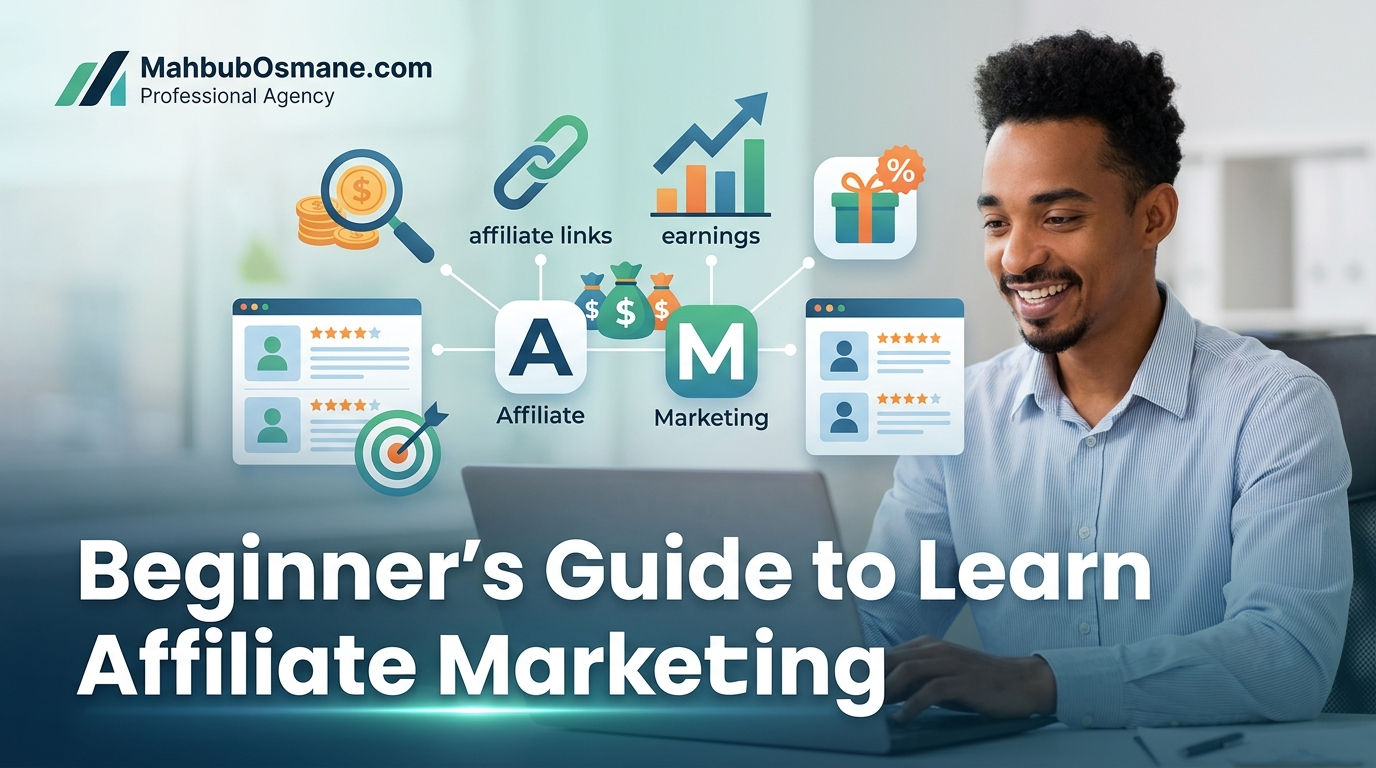
The Ultimate Beginner’s Guide to Learn Affiliate Marketing: From Zero to Your First Dollar
If you have ever searched for ways to build an online business, create a passive income stream, or transition out of the traditional 9-to-5 grind, you have undoubtedly run across the term affiliate marketing.
It sounds like the ultimate digital dream: recommend a product you love, share a link, and watch commissions roll into your bank account while you sleep.
But if you strip away the flashy lifestyle videos on social media, what does it actually take to succeed as an affiliate marketer today? Is it still viable for absolute beginners? And how do you build a real, sustainable business rather than just a hobby that makes a few pennies?
This comprehensive, step-by-step guide is designed to cut through the noise. We will break down exactly how affiliate marketing works, lay out a clear framework for launch, and explore the advanced strategies required to scale your earnings from zero to a full-time income.
Understanding the Affiliate Marketing Ecosystem
Before writing content or choosing products, you must understand the underlying mechanics of the industry. At its core, affiliate marketing is a performance-based marketing system where a business rewards an individual (the affiliate) for bringing in customers through their independent marketing efforts.
It is a true win-win-win system:
-
The Brand expands its reach and only pays for actual conversions.
-
The Consumer discovers a product that solves a problem, often backed by a trusted recommendation.
-
The Affiliate earns a percentage of the sale without the overhead, risk, or customer service responsibilities of creating a physical or digital product.
The Four Pillars of the Affiliate Ecosystem
To navigate this landscape smoothly, you need to know who the key players are and how they interact.
+-------------------------------------------------------------+
|                         1. THE BRAND                        |
|             (Merchant / Creator / Product Owner)            |
+------------------------------+------------------------------+
                               |
                               | Creates Affiliate Program
                               v
+-------------------------------------------------------------+
|                     2. THE AFFILIATE NETWORK                |
|           (Middleman / Tracking Platform / Escrow)          |
+------------------------------+------------------------------+
                               |
                               | Manages Links & Tracking
                               v
+-------------------------------------------------------------+
|                      3. THE AFFILIATE                       |
|           (Publisher / Influencer / Content Creator)        |
+------------------------------+------------------------------+
                               |
                               | Drives Traffic & Clicks
                               v
+-------------------------------------------------------------+
|                        4. THE CONSUMER                      |
|                  (End User / Buyer / Audience)              |
+-------------------------------------------------------------+
-
The Merchant (The Brand / Product Creator): This is the party that owns the product. It can be a massive corporate entity like Amazon, a trendy direct-to-consumer fashion brand, or an individual creator selling an online course. They provide the marketing assets, inventory, and fulfillment.
-
The Affiliate (You): Also known as the publisher or content creator. Your role is to attract a specific audience, build trust, and strategically introduce the merchant’s products using a unique tracking link.
-
The Affiliate Network: These are platforms that act as intermediaries between merchants and affiliates. They host thousands of affiliate programs, manage tracking infrastructure, generate links, and distribute payments. Examples include ClickBank, ShareASale, CJ Affiliate, and Impact.
-
The Consumer: The person who reads your content, clicks your link, and purchases the product. Crucially, the consumer rarely pays more when buying through an affiliate link; the affiliate’s commission comes directly out of the merchant’s profit margin.
How Tracking Works (Demystifying the “Cookie”)
When a user clicks your affiliate link, their browser drops a tiny text file known as a cookie. This cookie contains a unique identifier that ties that specific user’s session back to your affiliate account.
The most critical element of an affiliate cookie is its lifespan (or duration). If a program has a “30-day cookie window,” it means that if a user clicks your link today but doesn’t buy the product until 28 days from now, you still get credited with the sale. If they buy on day 31, you miss out. Cookie windows vary wildly across programs—Amazon offers a notoriously short 24-hour cookie, while some software-as-a-service (SaaS) brands offer a generous 60-day, 90-day, or even lifetime tracking window.
Step-by-Step Blueprint to Start from Scratch
Building a profitable affiliate marketing operation requires a structured, logical approach. Jumping straight into posting links on social media without a foundation is a recipe for quick burnout. Use this intentional, step-by-step framework to launch correctly.
Step 1: Choose Your Niche (The Riches are in the Niches)
The single biggest mistake beginners make is trying to promote everything to everyone. They build a website and review tech gadgets on Monday, weight loss supplements on Wednesday, and dog toys on Friday.
When you do this, you build an audience of nobody. Search engines won’t see you as an authority, and human readers will leave because your site lacks a clear focus.
Instead, you need to find a niche—a specific segment of a larger market.
Bad Niche: Fitness
Good Niche: Home workouts for busy corporate professionals
Great Niche: Kettlebell training for dads over 40
The Niche Selection Sweet Spot
To evaluate if a niche is viable, look for the intersection of three core elements:
-
Interest / Knowledge: You don’t need a PhD in the subject, but you should be interested enough to write 50 to 100 articles about it without losing your mind.
-
Audience Demand (Search Volume): Are people actively searching for solutions within this niche? You can use free tools like Google Trends, AnswerThePublic, or Ahrefs Free Keyword Generator to verify that people are asking questions about the topic.
-
Commercial Intent (Monetization): Are people already spending money in this space? If there are books, courses, software, physical products, and competitors running Google Ads in this niche, it’s a healthy sign that money is flowing.
Step 2: Choose Your Platform
Where will your affiliate content live? While you can run affiliate marketing across various channels, they generally fall into two main categories:
Option A: Your Own Website / Blog (Highly Recommended)
Owning your platform gives you complete control over your business. You aren’t at the mercy of sudden social media algorithm updates that can cut your organic reach overnight.
-
Pros: Complete ownership, excellent long-term asset value, high search engine optimization (SEO) potential, and a professional look that attracts premium affiliate programs.
-
Cons: Small upfront cost for hosting/domain, and a slight technical learning curve.
Option B: Social Media / Video Platforms (YouTube, TikTok, Instagram)
Creating content on third-party channels lets you tap into massive built-in audiences quickly.
-
Pros: Completely free to start, highly engaging, great for building visual trust or showcasing physical products through video.
-
Cons: You do not own the platform. If the algorithm changes or your account is flagged, your business can vanish overnight.
The Ideal Approach: Use a self-hosted blog as your central command hub, and pick one primary social media or video channel (like YouTube) to funnel traffic back to your site.
Step 3: Find and Join Affiliate Programs
Once your niche is locked in and your platform is set up, you need to source high-quality products to promote. Affiliate programs generally fall into three tiers based on their payout structures:
| Program Type | Commission Rates | Volume Potential | Examples |
| High-Paying, Low-Volume | 30% to 50% (Often recurring) | Low to Medium | B2B Software, CRM tools, Premium Web Hosting |
| Low-Paying, High-Volume | 1% to 10% | High | Amazon Associates, Target, Walmart |
| High-Paying, High-Volume | Massive upfront commissions ($100+) | Medium to High | Credit cards, Insurance, Financial services |
Where to Look for Programs
-
Affiliate Networks: Join marketplaces like Impact.com, ShareASale, CJ Affiliate, and Awin. These networks give you immediate access to thousands of recognized household brands.
-
Direct Programs: Look up your favorite software or independent digital products. Scroll to the footer of their official website and look for links that say “Affiliate Program,” “Partners,” or “Earn Money With Us.”
-
Amazon Associates: The ultimate training ground for beginners. While the commission percentages are low, Amazon converts incredibly well because people already trust the platform and keep their credit cards on file. Plus, you get a commission on the entire cart the user purchases, not just the specific product you linked.
Deep Dive into the Two Main Affiliate Models
To specialize effectively, it helps to look at the two distinct operational paths you can take: The Content Site Model and The Funnel-and-Paid-Traffic Model.
Model 1: The Authority Content Site (SEO & Organic Traffic)
This is the traditional, sustainable approach to affiliate marketing. You build an information hub that serves a specific audience by answering their questions and solving their problems via search engines like Google.
[ User Searches Google for a Problem ]
                  │
                  ▼
   [ Lands on Your Blog Post / Article ]
                  │
                  ▼
 [ Reads Valuable Guide / Review Content ]
                  │
                  ▼
 [ Clicks Affiliate Link to Suggested Tool ]
                  │
                  ▼
  [ Buys Product on Merchant Website ] ──> (You Earn Commission)
The magic of this model lies in user intent. When someone searches “Best lightweight backpacking tents under $200” on Google, they are standing at the digital checkout line with their credit card out. If your article provides a detailed comparison and a clear recommendation, your click-through and conversion rates will be exceptionally high.
Model 2: The Direct Funnel Model (Paid Traffic & List Building)
If you don’t want to wait for organic search rankings to kick in, this fast-paced model uses paid advertisements (Meta Ads, Google Ads, native networks) to drive traffic directly into a custom landing page.
[ Paid Ad (Facebook, Google, TikTok) ]
                  │
                  ▼
      [ Opt-In Landing Page ] ───> (Captures Email Address)
                  │
                  ▼
   [ Bridge Page / Video Review ]
                  │
                  ▼
 [ Redirect to Merchant Affiliate Link ]
Instead of sending paid traffic directly to your affiliate link—which most ad networks ban or penalize—you send them to a Bridge Page. This intermediate page warms up the cold visitor, explains the benefits of the product, and collects their email address first. This ensures you build an active email list asset even if the visitor doesn’t buy the product immediately.
Crafting Affiliate Content That Converts
The phrase “Content is King” is incomplete. In affiliate marketing, helpful, high-intent content is king. If your content reads like a thin, uninspired copy-paste job of an Amazon product description, users will click away instantly.
To convert readers into buyers, you must establish trust. Here are the three primary archetypes of high-converting affiliate content:
In-Depth Single Product Reviews
A deep-dive analysis of one specific product. Your goal is to give a comprehensive look at the pros, cons, pricing, and real-world performance.
-
The Secret to Winning: Be radically honest. If a product has flaws, highlight them. If you only shower a product with praise, readers will see through it as a sales pitch. Pointing out who a product is not good for actually increases your credibility and boosts sales from the audience it is right for.
The Round-Up “Best [X] for [Y]”
These comparison articles pit multiple options against each other to help readers make a definitive choice. For example: “The 5 Best Accounting Software for Solo Freelancers in 2026.”
-
Structure for Success: Always put a clear “Top Pick” or summary table at the very top of the article. Many users are in a rush and want an immediate answer. Do not force them to scroll through 4,000 words to find out which option is best.
Step-by-Step Tutorials and How-To Guides
Show people how to achieve a specific goal or solve a frustrating problem. Inside the guide, seamlessly integrate the tools or products required to complete the steps.
-
Example: A tutorial on “How to Build a WordPress Website in 20 Minutes” will naturally include affiliate links for web hosting, domain registrars, and premium themes. The user buys the products because they are completely integrated into the solution they are trying to implement.
Driving Traffic — Turning on the Faucet
You can have the most beautiful website and the most persuasive reviews on the internet, but without traffic, your affiliate business is just an expensive digital diary. You need eyes on your content. Let’s look at the two primary strategies for driving high-quality traffic.
Organic Search Engine Optimization (SEO)
SEO is the art and science of configuring your content so that search engines rank it at the top of results for relevant search terms. It is a long-term play, but it delivers the highest return on investment over time because the traffic is free, highly targeted, and passive.
Step A: Keyword Research
Find out exactly what your target audience is typing into search boxes. Look for Long-Tail Keywords—phrases that are 3 to 5 words long. They have lower monthly search volume than broad terms, but they carry much lower competition and significantly higher buyer intent.
Broad Search (High Competition, Low Intent): “Shoes”
Long-Tail Search (Low Competition, High Intent): “Best wide-toe box running shoes for flat feet”
Step B: On-Page Optimization
Once you know your keyword, place it strategically within your article:
-
In the URL slug (e.g.,
[yoursite.com/best-running-shoes-flat-feet](https://yoursite.com/best-running-shoes-flat-feet)) -
In the main Title tag (H1) and at least one subheading (H2)
-
Within the first 100 words of your introduction
-
In the image alt text attributes
Step C: Build Search Intent Satisfaction
Google’s ultimate goal is to satisfy the user’s query as quickly as possible. Ensure your article directly, thoroughly answers the search term without unnecessary filler. Use short paragraphs, clear bullet points, and clean formatting to make your page easy to skim.
Leverage YouTube Video SEO
YouTube is the world’s second-largest search engine. Video allows you to physically show a product, unbox it, and demonstrate its features in real-time.
People love watching reviews before making a purchase. You can record a high-quality hands-on review, instruct viewers to look in the description box for the links, and use clean, shortened affiliate links to track your video conversions.
Compliance, Legalities, and Ethical Rules
Affiliate marketing operates within strict legal and corporate boundaries. Ignoring these rules will not only get you banned from top-tier affiliate programs but can also land you in hot legal water.
The FTC Disclosure Requirement
In the United States, the Federal Trade Commission (FTC) requires all affiliate marketers to clearly disclose their financial relationships with the brands they promote. Similar consumer protection laws apply globally (such as the CMA regulations in the UK).
The Rule: Your disclosure must be clear and conspicuous. It must be placed before a user encounters an affiliate link.
-
Bad Practice: Hiding a tiny “Disclaimer” link in your website’s footer.
-
Good Practice: Placing a short sentence at the top of every blog post: “Disclosure: Some of the links in this post are affiliate links, meaning that at no additional cost to you, I will earn a commission if you click through and make a purchase.”
Program Policies (Avoiding the Ban Hammer)
Every affiliate program has a strict terms of service (ToS) document. Read them carefully. The most common reasons beginners get instantly banned include:
-
Bidding on Brand Keywords: Buying Google Ads targeting the brand’s own trademarked name (e.g., buying an ad for “Bluehost coupons” to drop your affiliate link).
-
Cloaking Links in PDF eBooks: Many programs, including Amazon Associates, strictly forbid placing affiliate links inside offline media like downloaded PDFs or emails.
-
Buying Through Your Own Links: Trying to use your own tracking links to get a discount on your personal purchases.
Actionable 90-Day Roadmap for Absolute Beginners
To make sure this guide doesn’t just sit in your browser tabs as passive information, let’s turn it into a concrete, 90-day execution framework. If you dedicate just 1 to 2 hours a day to this plan, you will build a solid, functional asset.
Your Next Steps to Success
Affiliate marketing is not a lottery ticket; it is a legitimate business model that requires consistency, strategic patience, and an audience-first mindset. The creators who succeed are the ones who shift their focus away from “How do I make money fast?” and toward “How can I become the most helpful, reliable resource in my niche?”
Start small, pick a niche you enjoy exploring, build your platform, and remain consistent with your publication schedule. Over time, those early trickles of traffic will compound into a predictable stream of revenue.
Accelerate Your Growth: Partner with an Elite Digital Marketing Team
Building a profitable affiliate ecosystem, optimizing high-converting content, and mastering search engine mechanics requires profound technical expertise and continuous maintenance. While the blueprint laid out above gives you the strategic foundation to succeed, executing these moving parts at an enterprise scale demands a dedicated team of digital specialists.
Whether you are an aspiring affiliate brand scaling your web footprint or an established enterprise looking to dominate global markets, MahbubOsmane.com delivers the elite infrastructure you need.
We provide end-to-end, corporate-grade digital solutions tailored for ambitious organizations across Saudi Arabia, the UAE, Qatar, Kuwait, the USA, the UK, Canada, Germany, Lithuania, and Bangladesh.
Our Core Enterprise Capabilities:
-
Professional SEO: Advanced keyword modeling, competitor intelligence, and data-driven optimization to secure sustainable top-tier Google rankings.
-
Content Writing & Strategy: High-converting, authoritative copy designed to fulfill user intent and transform passive readers into buyers.
-
Website Development: Lightning-fast, secure, and mobile-optimized web architectures built for optimal user experience and conversion rates.
-
AdOps & Paid Traffic Management: High-ROI ad campaign management across Meta, Google, and premium programmatic ad networks.
-
Graphic Design & Professional Video Editing: Engaging corporate visual assets, interactive media, and high-retention video setups optimized for YouTube, TikTok, and social funnels.
Proven Freelance Excellence You Can Trust
In digital marketing, transparency and data-backed performance are everything. We don’t just promise results—we have delivered them consistently at the highest global tiers:
-
700+ Completed Projects with flawless, 5-star feedback on Upwork.
-
Fully verified and available for long-term contract engagement on Hubstaff Talent.
Let our elite freelance track record become the engine that drives your business’s digital transformation.
Ready to Dominate Your Market? Contact Us Today
Skip the trial-and-error phase. Reach out to our global team directly to schedule a strategy consultation.
-
🇸🇦 Saudi Arabia Offices:
+966549485900or+966553227950 -
🇧🇩 Bangladesh Head Office:
+8801716988953 -
✉️ Corporate Inquiries:
hi@mahbubosmane.com/mahbubosmane@gmail.com -
🌐 Official Platform: www.MahbubOsmane.com
Frequently Asked Questions (FAQ)
Is affiliate marketing still profitable?
Yes, absolutely. The digital landscape has shifted toward highly targeted, hyper-niche content. While generic product review sites face intense competition, creators who build genuine trust, write authoritative reviews, and leverage multi-channel traffic (like combining a blog with short-form video) are seeing higher conversion rates than ever.
How much money do beginner affiliate marketers make?
Affiliate marketing earnings operate on a performance basis, meaning there is no fixed salary.
-
Initial Months: Typically little to no income as you build your site, create foundational content, and index on search engines.
-
First Half-Year: Moderate earnings as initial organic traffic trickles in.
-
Beyond one year: Scaled income for those who remain consistent. Your revenue scales directly with the quality of your traffic and the commercial intent of your chosen niche.
Do I need a website to start affiliate marketing?
While it is technically possible to promote links entirely on social media platforms (like TikTok, Instagram, or YouTube), we highly recommend launching your own self-hosted website. Owning your platform protects your business from sudden social media algorithm changes that can wipe out your audience overnight. It also makes you look much more professional to premium, high-paying affiliate programs.
How much does it cost to start an affiliate marketing business?
If you choose the organic content route, the upfront costs are exceptionally low:
-
Domain Name: Small yearly registration fee.
-
Web Hosting: Minimal monthly infrastructure hosting cost.
-
Content/Design: Completely free if you write the content and design the site yourself using free WordPress setups. This makes it one of the most accessible business models in the world, requiring minimal capital to get off the ground safely.
What is the difference between affiliate marketing and dropshipping?
-
Affiliate Marketing: You recommend someone else’s product. When a customer buys, the merchant handles payment processing, product packaging, shipping, inventory, and customer service. You simply collect a commission.
-
Dropshipping: You sell products through your own digital storefront. You choose the retail price, process the customer’s payment, and manually or automatically order the item from a third-party supplier who ships it to the user. You are fully responsible for customer support, returns, and complaints.
Can I do affiliate marketing if I am an absolute beginner?
Yes. You do not need a background in coding, advanced graphic design, or professional marketing to start. The core skills required are an ability to research a topic thoroughly, communicate clearly through text or video, and remain consistent with your publication schedule.
How do affiliate networks track my sales?
When an internet user clicks your unique affiliate link, a small text file called a cookie is placed silently in their web browser. This cookie contains your unique publisher tracking ID. If the user makes a purchase within the program’s specified cookie lifespan, the system automatically attributes the sale to your account and assigns your commission.
What does “Cookie Duration” or “Cookie Lifespan” mean?
This refers to the amount of time an affiliate cookie remains active in a user’s browser. For example, if a program has a 30-day cookie duration, you will earn a commission if the user clicks your link today and buys anytime within the next 30 days. If they buy on day 31, the cookie expires, and you will not receive credit.
What are the best affiliate networks for beginners to join?
Beginners should target networks that offer instant or low-barrier approvals and a massive directory of recognizable brands:
-
Amazon Associates: Perfect for learning the ropes and tapping into an ultra-high conversion rate.
-
Impact.com: Excellent dashboard interface featuring household retail and software brands.
-
ShareASale: Great for finding mid-sized, specialized independent brands.
-
ClickBank: Ideal if you want to promote digital products, eBooks, and software with high commission margins.
How do affiliate marketers get paid?
Most affiliate networks issue payouts on a structured schedule (such as 30 or 15 days after the closing month). Payment methods vary by network but typically include Direct Deposit (ACH), PayPal, Wire Transfer, or Payoneer. Most programs require you to hit a minimum earnings threshold before triggering a payout.
What is a “Niche” and why is it so important?
A niche is a specific, narrow segment of a broader market. For example, instead of targeting the massive “Pets” market, a niche would be “Agility training for Border Collies.” Targeting a micro-niche allows you to build topical authority quickly, rank faster on search engines, and talk directly to an audience that has a very specific problem to solve.
How many affiliate products should a beginner promote?
Start with 1 to 3 core products. Trying to promote dozens of different items right out of the gate makes your content look messy, dilutes your authority, and confuses your readers. Choose a few stellar products that you personally trust, use, or have researched extensively, and build comprehensive content hubs around them.
Can I place affiliate links in my emails or newsletters?
It depends entirely on the program’s Terms of Service (ToS). Many networks encourage email affiliate marketing because email lists convert incredibly well. However, some programs—most notably Amazon Associates—strictly forbid putting affiliate links inside emails, downloaded PDFs, or any offline media. Always review the program rules before sending links to your subscriber list.
Do I need to buy the products myself to review them?
While having physical possession of a product makes your reviews highly authentic and gives you custom imagery or video assets, it is not strictly mandatory. You can conduct exhaustive “compiled research reviews” by deeply analyzing user manuals, customer feedback forums, video unboxings, and manufacturer spec sheets to construct a highly valuable, synthesized guide for your readers.
What is an affiliate disclosure, and is it mandatory?
Yes, it is legally mandatory. Consumer protection agencies require digital publishers to clearly state if they are receiving financial compensation for recommending a product. This disclosure must be placed prominently on your page before a user hits an affiliate link, written in simple, clear language.
Why am I getting clicks on my affiliate links but no sales?
If your dashboard shows high click volume but zero conversions, it usually indicates a breakdown in one of three areas:
-
Mismatched Intent: Your article attracts people looking for a free solution, but your link points to an expensive premium tool.
-
Outdated Pricing/Offers: The landing page details or pricing models don’t match what you promised in your content.
-
Poor Vendor Landing Page: Your content did a great job pre-selling, but the merchant’s checkout page looks unoptimized.
What is Search Engine Optimization (SEO) and how does it relate to affiliate marketing?
SEO is the systematic practice of optimizing your blog posts so that search engines rank them highly for relevant queries. In affiliate marketing, SEO is your ultimate traffic channel. When you target long-tail, buyer-intent keywords (like “best ergonomic office chairs for lower back pain”), SEO delivers free, recurring, highly targeted traffic right to your affiliate offers.
What is “High-Ticket” affiliate marketing?
High-ticket affiliate marketing involves promoting products or services that carry premium price tags—typically from several hundred to thousands of dollars. These are often enterprise software solutions, premium business mastermind courses, or luxury travel packages. While it takes longer to secure a conversion, a single sale can yield massive commission margins.
Can I do affiliate marketing without showing my face?
Yes. This is called “faceless” or “anonymous” affiliate marketing. You can build a themed authority blog, run a faceless YouTube channel utilizing stock footage and voiceovers, or operate niche Pinterest boards. Your audience doesn’t need to know who you are as long as the information you present is accurate, engaging, and genuinely solves their problems.
What should I do if my business needs help setting up websites, writing content, or managing traffic?
Building all of these assets completely by yourself can be incredibly time-consuming. If you are an enterprise or an ambitious brand looking to skip the technical learning curve, you can outsource your operations to a professional agency.
Internal Resources
-
Want to skip the technical setup and launch an authority platform that ranks from day one? Explore our premium Website Development Services at MahbubOsmane.com to build a lightning-fast, high-converting blog infrastructure.
-
Content is the fuel that powers every click and conversion. If you need search-optimized, persuasive product reviews written by industry experts, check out our Professional Content Writing Solutions.
-
Driving traffic is the ultimate challenge for beginners. Learn how our tailored Search Engine Optimization (SEO) Services can help you dominate competitive long-tail keywords and attract ready-to-buy consumers completely passively.
-
If you want to bypass the slow burn of organic search engine indexing, scale your business instantly by partnering with our expert Digital Marketing and Paid AdOps Team to launch high-ROI bridge page campaigns.
External Resources
-
To discover high-intent keywords, track search volume trends, and perform comprehensive competitor analysis, we highly recommend setting up a free account with Ahrefs Keyword Explorer.
-
When you are ready to expand past consumer retail items and tap into thousands of specialized corporate and digital affiliate programs, browse the global marketplace directory on Impact.com.
-
Compliance is non-negotiable for digital publishers. To ensure your website remains completely legal and avoids costly regulatory penalties, carefully review the official FTC Endorsement Guides and Advertising Disclosures.
-
Ready to start your affiliate journey by recommending physical products on the world’s largest e-commerce storefront? Read the entry guidelines and register directly at the Amazon Associates Central Portal.
About the Author
Mahbub Osmane is a digital marketing expert who helps businesses build effective online strategies, including selecting and managing the right social media channels for growth. With hands-on experience across platforms and markets, Mahbub shares practical, actionable insights to help businesses connect with their audience and grow their brand presence.
Contact information Email: hi@mahbubosmane.com Website: https://mahbubosmane.com/ Mobile: +966 54 948 5900 (KSA) / +880 1716 988953 (BD) Address: 2282 7284 Al Malawi Southern 1, As Sulimaniyah Dist, Makkah 24236, Saudi Arabia