
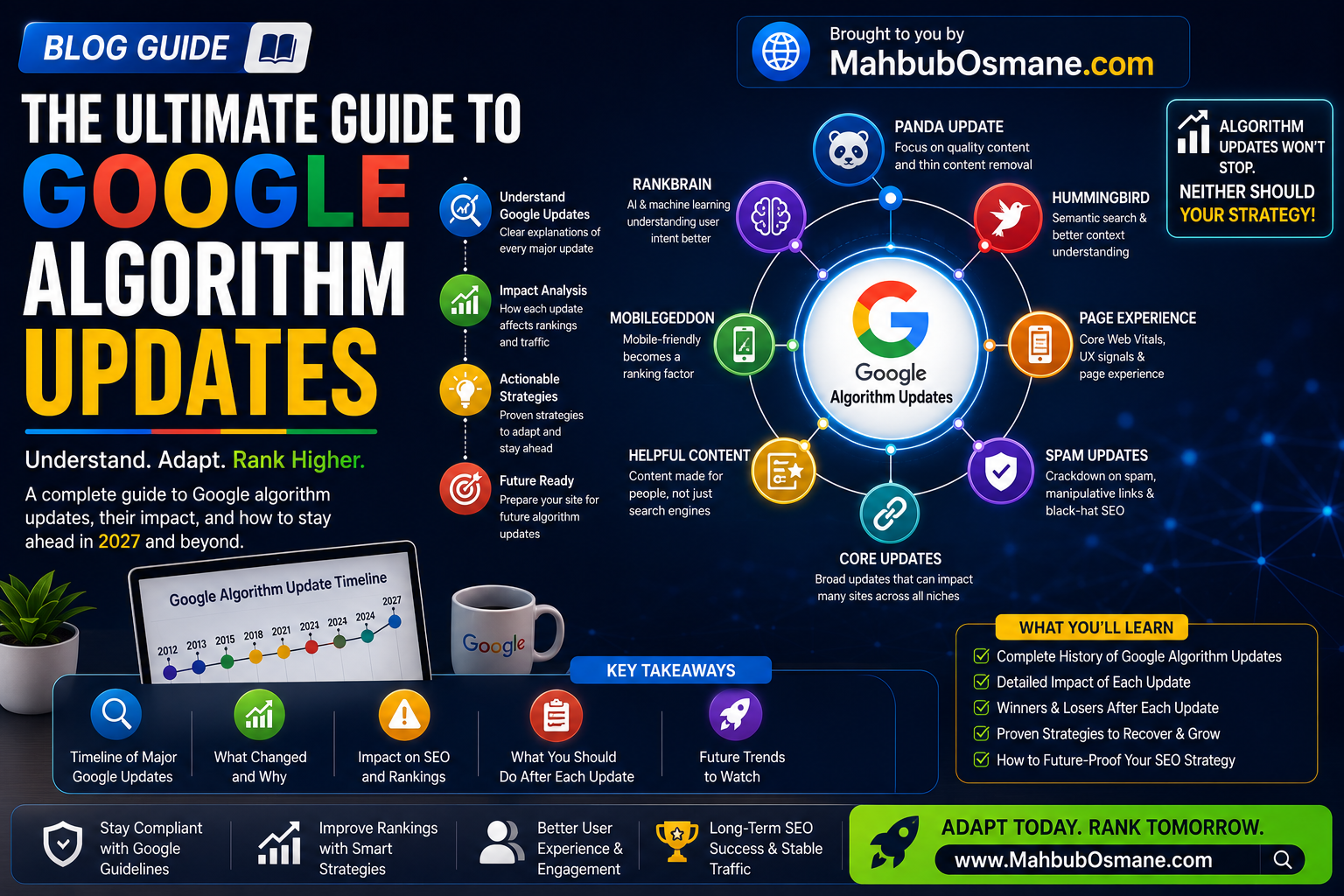
The Ultimate Guide to Google Algorithm Updates
For anyone running a website, managing an e-commerce store, or practicing SEO, Google is the ultimate gatekeeper. A single algorithm update can double your organic traffic overnight—or cause it to plummet into digital obscurity.
Google processes billions of searches every day. To keep users coming back, the search engine must ensure that the results it delivers are accurate, safe, high-quality, and highly relevant. This is where Google algorithm updates come into play.
Understanding how these updates work, why they happen, and how to adapt to them isn’t just a technical necessity; it’s the foundation of long-term business survival on the web.
This comprehensive guide will unpack the history of Google’s algorithms, explore the most impactful updates, analyze recent core updates, and provide an actionable, step-by-step framework for diagnosing and recovering from traffic drops.
What Are Google Algorithm Updates and Why Do They Matter?
An algorithm is a complex mathematical formula and system that Google uses to retrieve data from its massive search index and instantly determine which pages best answer a user’s query.
In the early days of the internet, ranking a website was simple: you filled a page with a specific keyword over and over again (keyword stuffing), bought thousands of cheap links, and watched your site shoot to the top of the Search Engine Result Pages (SERPs).
Google quickly realized that this created a terrible user experience. People were finding low-quality, spammy websites that offered no real value.
To fix this, Google began systematically updating its algorithms. Today, Google updates its systems thousands of times a year. While most of these are minor tweaks that pass unnoticed, several times a year Google rolls out massive Core Updates that completely rearrange the digital landscape.
Why Google Changes the Rules Continually
-
Improving User Experience (UX): Google wants users to find the best possible answer with the least amount of effort.
-
Combating Spam and Manipulation: As SEO tactics evolve, webmasters find new loopholes. Google updates plug these holes to maintain fairness.
-
Adapting to Changing Technology: The way people search changes. The rise of voice search, mobile browsing, and now conversational AI requires entirely new ranking mechanisms.
-
Rewarding True Expertise: Google strives to shift traffic away from “made-for-SEO” content farms and toward genuine, expert-driven publications.
The Golden Era of SEO Shifts: Classic Algorithm Updates
To understand where Google is going, we have to look at where it started. The foundation of modern SEO was built on a series of major algorithmic overhauls launched between 2011 and 2016.
Here is a breakdown of the classic updates that permanently changed the rules of web publishing.
Google Panda (2011): The War on Thin Content
Before Panda, the web was dominated by “content farms”—huge websites that published thousands of low-quality, short articles daily to rank for long-tail keywords.
-
Primary Target: Low-quality content, thin content, duplicate text, high ad-to-content ratios, and keyword stuffing.
-
The Impact: Panda introduced a quality score to web pages. Sites with thin, unhelpful articles saw massive ranking drops across their entire domain.
-
The Lesson: Focus on depth, uniqueness, and comprehensive answers. Quality always beats quantity.
Google Penguin (2012): Crushing Manipulative Link Building
In the pre-Penguin era, backlinks were purely a numbers game. You could pay an agency to blast your URL across thousands of low-grade directories, blogs, and forums, using exact-match anchor text to easily manipulate rankings.
-
Primary Target: Spammy link profiles, link farms, paid backlinks, and aggressive exact-match anchor text optimization.
-
The Impact: Millions of websites lost their traffic overnight. Initially, Penguin ran periodically, meaning a site penalized by Penguin had to wait months or even years for the next refresh to recover.
-
The Evolution: In 2016, with Penguin 4.0, Google integrated this system into its core, real-time algorithm, choosing to ignore spammy links rather than penalize the whole site directly.
Google Hummingbird (2013): Semantic Search Arrives
Hummingbird was not just an adjustment; it was a total rewrite of Google’s core engine. Instead of looking at a search query as a string of isolated keywords, Google began trying to understand the intent and context behind the words.
-
Primary Target: Lack of contextual relevance.
-
The Impact: It enabled semantic search. If a user searched for “places to eat Italian food near me,” Hummingbird understood that “places to eat” meant restaurants, and “near me” required geolocated results.
-
The Lesson: Stop writing content optimized for isolated phrases. Write naturally about broad topics, covering related concepts and answering natural questions.
Google Mobilegeddon (2015): The Mobile-First Pivot
As smartphones exploded in popularity, Google recognized that sending mobile users to desktop-only websites with tiny text and broken layouts was a terrible experience.
-
Primary Target: Non-mobile-responsive websites.
-
The Impact: Websites that were not optimized for mobile devices were heavily penalized in mobile search results. This eventually evolved into Mobile-First Indexing, meaning Google now uses the mobile version of your website as the primary baseline for how it ranks your content overall.
Google RankBrain (2015): Machine Learning Takes the Wheel
RankBrain was Google’s first major deployment of machine learning in search. It was designed to help Google interpret queries it had never seen before (which make up roughly 15% of daily searches).
-
How it Works: RankBrain converts words into mathematical vectors. If it encounters an unfamiliar word or phrase, it finds similar words it already understands and maps out the most logical search results.
-
The Real Shift: It marked the transition of Google from a static, rule-based algorithm to an adaptive, artificial intelligence-driven ecosystem.
The Modern Era: Broad Core Updates, E-E-A-T, and Helpful Content
In recent years, Google moved away from launching single-name updates like Panda or Penguin. Instead, the search giant now deploys Broad Core Updates several times a year, alongside specific sub-systems targeting helpfulness, reviews, and spam.
Modern SEO is no longer about checking technical boxes; it is governed by holistic quality frameworks.
Understanding Broad Core Updates
Unlike historic updates that focused on a single issue (like links or keywords), a Core Update adjusts the fundamental weights and balances of Google’s entire ranking ecosystem.
When a Core Update rolls out, Google is reassessing how it measures content value across the entire web. If a site drops during a core update, it doesn’t necessarily mean it has “broken rules” or committed webspam. Often, it simply means that other websites have created content that better aligns with Google’s updated understanding of quality and user intent.
The E-E-A-T Framework: The Golden Standard
You cannot understand modern Google updates without understanding E-E-A-T. While not a direct algorithmic ranking factor itself, E-E-A-T is the blueprint Google gives its human Search Quality Raters to grade the performance of the algorithm.
| Element | What Google Looks For | Actionable Application |
| Experience | First-hand, real-world experience with the topic. | Show photos of you using the product, talk about personal challenges, use “I” or “we”. |
| Expertise | Formal credentials, qualifications, or deep knowledge of the subject matter. | Include detailed author bios, link to professional portfolios, cite accredited degrees. |
| Authoritativeness | Your overall reputation in your niche or industry. | Build brand mentions, earn links from industry leaders, become a go-to source. |
| Trustworthiness | The transparency, honesty, and safety of your website. | Clear contact pages, visible editorial policies, secure checkouts (HTTPS), accurate citations. |
Crucial Warning: E-E-A-T is critically vital for YMYL (Your Money or Your Life) niches. These are topics that directly impact a reader’s health, financial stability, safety, or happiness (e.g., medical advice, investment tips, legal guides). Google holds YMYL sites to strict quality standards.
The Helpful Content System (HCS)
Launched in late 2012 and heavily integrated into core updates across 2023 and 2024, the Helpful Content System caused massive volatility in the digital publishing industry.
Its primary goal is simple: Reward content written for humans, and penalize content created solely for search engine rankings.
-
The Site-Wide Classifier: The Helpful Content System applies a site-wide signal. If Google determines that a significant percentage of your pages are thin, unhelpful, or written purely to rank in search engines, your entire site will suffer a drop in visibility—even your genuinely high-quality pages.
-
The AI Content Boom Connection: The rise of generative AI tools allowed publishers to pump out hundreds of generic articles daily. The Helpful Content System acts as a filter against this flood of low-effort, automated content, looking for unique perspectives and genuine human insight.
How to Diagnose an Algorithm Hit
When organic traffic drops, it’s easy to panic and start changing things randomly. However, blind changes usually make the situation worse. You need a structured, diagnostic approach to figure out exactly what happened.
Correlate Traffic Loss with Official Dates
Your first job is to determine if your traffic drop aligns with an official Google update or if it’s an isolated, site-specific issue (like a broken robot.txt file or server downtime).
-
Log into Google Analytics and Google Search Console (GSC).
-
Isolate your organic traffic and set the timeline to show the last 90 days.
-
Look for sudden, sharp drops in clicks and impressions.
-
Cross-reference the exact date of your drop with authoritative SEO industry news trackers (such as Search Engine Land, Search Engine Journal, or Google’s official Search Status Dashboard).
Determine the Scope of the Damage
Is your entire website down, or did a specific section take the hit?
-
Site-wide Drops: If impressions and clicks drop equally across every single URL on your domain, you are likely dealing with a broad Core Update hit, a site-wide Helpful Content classifier, or a manual action penalty.
-
Granular Drops: If only a specific category, folder, or keyword cluster lost rankings, you are likely dealing with a shifts in search intent, a product review update, or localized competitor outperformance.
Check for Manual Actions
Algorithm updates are automated, but Google also employs a human webspam team that hands out Manual Actions.
To check if you have a manual penalty:
-
Open Google Search Console.
-
Scroll down to the Security & Manual Actions tab on the left menu.
-
Click on Manual Actions.
-
If you see “No issues detected,” your drop is purely algorithmic. If you see a specific violation listed (e.g., Unnatural links, Pure spam), you must fix that exact issue and submit a reconsideration request.
Step-by-Step Blueprint for Algorithm Recovery
Recovering from a major Google algorithm update requires patience, time, and honest effort. There are no quick-fix tricks. If your site was flagged as low-quality or unhelpful, you must fundamentally improve it to win back Google’s trust.
Here is a step-by-step recovery process.
Step A: Audit for Thin and Unhelpful Content
Look at your content through the eyes of an unbiased visitor. Ask yourself: Does this article offer value that cannot be found on ten other websites?
-
Identify Low-Value Pages: Use Google Search Console to find pages that have generated zero clicks or impressions over the past six months.
-
The Three Choices Framework:
-
Prune (Delete): If an article is outdated, brief, and completely irrelevant to your brand, delete it entirely and set up a 404 status or redirect it if it has historical backlinks.
-
Noindex: If a page is necessary for your users (like a privacy policy, category archive, or registration page) but offers no unique SEO value, add a
noindextag to prevent it from watering down your site’s overall quality score. -
Improve (Consolidate): If you have three short, weak articles covering different angles of the same topic, merge them into one authoritative, deep-dive guide.
-
Step B: Maximize On-Page E-E-A-T
Inject clear, verifiable trust signals throughout your entire site architecture.
-
Revamp Author Profiles: Move away from generic “Admin” or anonymous lifeless bylines. Every article should be assigned to a real human. Write a detailed author bio explaining why this person is qualified to write on this topic. Link out to their LinkedIn profile or personal portfolio.
-
Cite High-Quality Sources: If you quote a statistic or state a medical/financial fact, link directly to primary, authoritative sources (like scientific journals, government websites, or major research institutions).
-
Add Editorial and Review Standards: If applicable, state clearly at the top of the article: “Fact checked by [Expert Name]” or “Originally written by X, updated on [Date] for accuracy.”
Step C: Optimize for Search Intent and User Experience
Sometimes, you drop because Google re-evaluates what searchers actually want to see when they type in a keyword.
-
Analyze the New Winners: Search for your target keywords. Look at the top three ranking sites. What format are they using? Are they long-form guides, tools, video landing pages, or listicles? If you are offering a 4,000-word essay but users want a quick calculator tool, you will lose rankings.
-
Fix Core Web Vitals: A slow, frustrating site ruins the user experience. Ensure your site loads quickly, passes Google’s Core Web Vitals assessments (Largest Contentful Paint, Interaction to Next Paint, Cumulative Layout Shift), and contains no intrusive pop-ups that block the reading layout.
Step 4: Clean Up Your Link Profile
If you suspect your drop is link-related (or correlates with a Spam Update):
-
Audit your backlink profile using tools like Ahrefs, Semrush, or Moz.
-
Look for spikes in low-quality, toxic, automated links from scraper sites.
-
While Google is generally efficient at ignoring negative SEO and spammy backlinks automatically, if you have historical footprints of participating in paid link networks, clean them up or use the Google Disavow tool cautiously as a last resort.
Future-Proofing Your SEO Strategy
The best way to survive a Google algorithm update is to build a brand that is resilient enough not to care about minor changes. Here is how you can future-proof your digital presence.
Build a True Brand, Not Just an SEO Site
Google wants to rank entities that exist in the real world.
-
Focus on driving direct traffic, building an active email newsletter, and growing social media channels.
-
When thousands of users type your brand name directly into Google every month, it sends an incredibly powerful signal of trust and authority to the search algorithm.
Diversify Your Traffic Channels
Relying 100% on Google organic search for your business revenue is high-risk. Build a diversified marketing stack:
                  ┌────────────────────────┐
                  │ Total Business Traffic │
                  └───────────┬────────────┘
                              │
         ┌────────────────────┼────────────────────┐
         ▼                    ▼                    ▼
┌─────────────────┐  ┌─────────────────┐  ┌─────────────────┐
│ Google Search   │  │ Email Marketing │  │ Social Media    │
│ & Discover      │  │ & Newsletters   │  │ (LinkedIn, YT)  │
└─────────────────┘  └─────────────────┘  └─────────────────┘
If one channel experiences a temporary setback due to an algorithm shift, your business will continue to thrive using the remaining pillars.
Focus on First-Party Data and Original Research
In an internet increasingly filled with rehashed AI summaries, original data is highly valuable. Conduct surveys, share unique case studies, publish internal insights, and create charts. Other sites will naturally link back to your original research, building a strong, natural link profile that protects your site during spam and core updates.
Conclusion: The Path Forward
Google algorithm updates can be incredibly frustrating, but their core objective remains unchanged: connecting users with high-quality, trustworthy content.
If you focus on building a fast, secure website, publishing deep, expert-driven content that solves real user queries, and establishing a genuine brand, you will naturally align with what Google’s algorithms are trying to achieve.
Instead of trying to game the algorithm, design your website for the human beings reading it. When you focus entirely on providing value to the end user, your site becomes naturally resilient to changes, allowing your traffic to grow consistently over the long term.
Good luck with your SEO journey! If you want to dive deeper into practical technical audits, check out our other guides on website optimization and modern digital marketing strategies.
Recover, Protect, and Scale Your Rankings with an Elite Digital Partner
Navigating the turbulent waters of Google’s algorithm updates is not a journey you have to take alone. While an unexpected update can disrupt your traffic overnight, it also presents a massive market opportunity to leapfrog your competitors—if you have the right team of experts in your corner.
At MahbubOsmane.com, we help ambitious businesses across Saudi Arabia, the UAE, Qatar, Kuwait, the USA, the UK, Canada, Germany, Lithuania, and Bangladesh build bulletproof, future-proof digital assets. Whether you need to recover lost organic traffic, scale your content velocity safely, or build an entirely new high-performance web platform, we deliver.
Why Global Brands Trust MahbubOsmane.com
We don’t just talk about results—we have a proven global track record:
-
Elite Upwork Status: Over 700+ completed jobs with flawless 5-star feedback.
-
Trusted Professional Network: Top-rated, vetted talent available via Hubstaff Talent.
-
Full-Service Execution: Our multidisciplinary team manages everything under one roof:
-
Professional SEO & AdOps (Recovery, auditing, monetization, and yield-optimization)
-
Expert Content Writing (Built for E-E-A-T and real human helpfulness)
-
High-End Web Development (Fast, secure, and mobile-first optimized)
-
Creative Assets: Custom Graphic Design and Professional Video Editing
-
Let’s Build Your Traffic Recovery & Growth Blueprint
Stop worrying about the next core update. Let our elite team audit your site, identify vulnerabilities, and build a high-converting, omnichannel strategy that drives revenue.
Contact Our Consultants Directly
-
Email Us: hi@mahbubosmane.com or mahbubosmane@gmail.com
-
Visit Our Website: www.MahbubOsmane.com
Call or Message Us Directly (WhatsApp Available on All Lines):
-
Saudi Arabia Office: +966549485900 / +966553227950
-
Bangladesh Office: +8801716988953
FAQ
What is a Google algorithm core update?
A core update is a broad change to Google’s foundational ranking systems, designed to improve the overall relevance and quality of search results globally. Unlike targeted updates that address specific issues like link spam, core updates re-evaluate how content value is measured across the entire web.
How often does Google update its ranking systems?
Google makes minor adjustments and updates to its search systems thousands of times a year. However, major “Broad Core Updates” that cause noticeable shifts in traffic typically occur only three to four times a year.
What is the difference between an algorithmic hit and a manual action?
An algorithmic hit is an automated drop in traffic because your site no longer aligns with Google’s quality metrics. A manual action is a penalty issued by a human reviewer at Google because your site explicitly violated webmaster guidelines, and it will be visible in the “Manual Actions” tab of Google Search Console.
Does losing traffic after an update mean my website is being penalized?
Not necessarily. Core updates do not target specific websites for punishment. A drop in traffic often simply means that other websites have updated their content, built better authority, or that user intent for your target keywords has shifted, making other pages a better match.
What does E-E-A-T stand for, and is it a direct ranking factor?
E-E-A-T stands for Experience, Expertise, Authoritativeness, and Trustworthiness. It is not a direct, individual ranking factor or a score calculated by a machine. Instead, it is a human evaluation framework that Google uses to train its algorithms to identify high-quality content.
Why are YMYL websites held to higher quality standards?
YMYL stands for “Your Money or Your Life.” These are topics related to health, finance, safety, civic duties, or legal matters. Google applies strict algorithm filters to these pages because inaccurate or low-quality information could directly harm a searcher’s physical, emotional, or financial well-being.
How long does it take to recover from a Google Core Update?
Recovery times vary depending on the depth of changes needed. Generally, if you improve your content and user experience, you will need to wait for the next major Core Update to roll out—which can take three to six months—for Google’s system to fully re-evaluate your entire site.
What is Google’s Helpful Content System?
Integrated deeply into Google’s core ranking engine, the Helpful Content System uses a site-wide signal to identify pages that seem to have been created primarily to rank well in search engines rather than to help or inform real human visitors.
Can a single unhelpful page hurt my entire website’s rankings?
Yes. The Helpful Content System applies a site-wide classifier. If a significant portion of your website consists of thin, unhelpful, or rehashed content, it can drag down the rankings of your genuinely high-quality pages as well.
What should I do with old, low-traffic content during an audit?
You have three options: Prune, Noindex, or Improve. If the content is useless to your target audience, delete it (Prune). If it is necessary for your users but holds no search value, add a noindex tag. If it has potential, update and rewrite it to add deep, original value.
Does Google penalize websites for using AI-generated content?
Google explicitly states that it does not penalize AI content simply because it was generated by a machine. Google focuses on the quality and helpfulness of the content. However, if AI is used to mass-produce low-effort, repetitive content purely to game search rankings, it will be flagged by the Helpful Content System.
How does user intent affect my keyword rankings after an update?
Google constantly refines its understanding of what searchers want. If an update determines that people searching for a specific keyword want a quick calculation tool rather than a 3,000-word blog post, informational pages will drop in rank, even if they are well-written.
What are Core Web Vitals, and do they impact algorithm updates?
Core Web Vitals measure real-world user experience, focusing on loading performance, interactivity, and visual stability. While they are a ranking factor, they rarely cause sudden, massive drops on their own during a Core Update; instead, they act as a tie-breaker between otherwise equal pieces of content.
How can I protect my e-commerce website from product review updates?
Ensure your product reviews provide genuine, first-hand evidence of testing, such as original photos, videos, quantitative measurements, or comparisons with competing products. Google filters out low-effort affiliate roundups that merely repeat the manufacturer’s product descriptions.
What is Mobile-First Indexing?
Mobile-First Indexing means Google primarily uses the mobile version of a website’s content for indexing and ranking. If your desktop site looks perfect but your mobile site is slow, buggy, or missing text, your overall search rankings will suffer across all devices.
Should I disavow bad backlinks immediately after a traffic drop?
Only if you have historically engaged in black-hat link building, paid link schemes, or private blog networks (PBNs). For normal negative SEO or automated scraper links, Google’s Penguin system is smart enough to simply ignore them, meaning a disavow file is rarely necessary for modern recovery.
How do I use Google Search Console to diagnose an algorithm hit?
Navigate to the Performance report, set a date filter covering the period before and after the announced update, and analyze if the drop is universal across all pages (indicating a site-wide core update issue) or isolated to a specific cluster of keywords or landing pages.
How can I future-proof my website against future Google updates?
Focus on building a real brand, not just an SEO website. Diversify your traffic sources through email newsletters and social media, publish original research or data that others will naturally reference, and always prioritize the reading experience of your human audience over technical search optimization.
External Resources
-
Official Algorithm Outage Tracker: Monitor live updates and system deployments directly on the Google Search Status Dashboard.
-
The Blueprint for Content Quality: Read the exact instructions human evaluators use to judge website quality by downloading the Google Search Quality Rater Guidelines Overview.
-
Organic Performance Monitoring: Set up tracking, diagnose crawling drops, and confirm core indexing metrics through Google Search Console.
Internal Resources
-
Professional Search Strategy: Take a look at our fully managed optimization plans at MahbubOsmane.com SEO Services.
-
Comprehensive Interactive Training: Learn how to optimize your own pages with our structured digital modules on the MahbubOsmane.com Courses Hub.
-
Omnichannel Scale Planning: Explore our strategic blueprints for high-impact growth on the MahbubOsmane.com Homepage Blog.
About the Author
Mahbub Osmane is a digital marketing expert who helps businesses build effective online strategies, including selecting and managing the right social media channels for growth. With hands-on experience across platforms and markets, Mahbub shares practical, actionable insights to help businesses connect with their audience and grow their brand presence.
Contact information Email: hi@mahbubosmane.com Website: https://mahbubosmane.com/ Mobile: +966 54 948 5900 (KSA) / +880 1716 988953 (BD) Address: 2282 7284 Al Malawi Southern 1, As Sulimaniyah Dist, Makkah 24236, Saudi Arabia